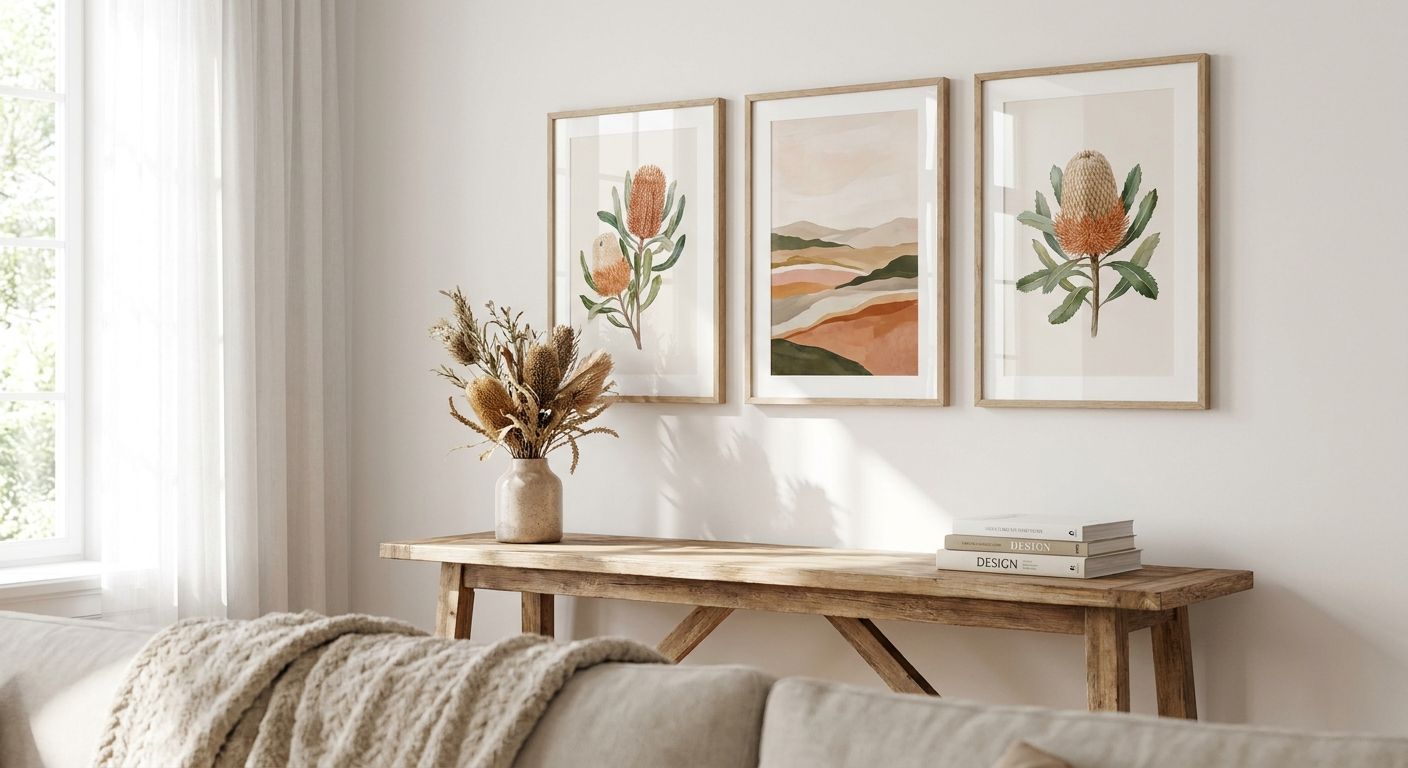
Australian art prints for a native-inspired home use gum trees, banksia, kangaroo paw and ochre-toned outback scenes to ground an interior in a distinctly Australian sense of place, and the right print, size and finish depend on the room, the wall and the light it gets in 2026.
- Australian art prints built on native flora and landscape motifs work best when the palette matches your home's existing warm tones, not the other way round.
- Into the Gum Trees and Native Bouquet are original Australian pieces suited to a native-inspired living room or entry statement wall.
- Canvas prints handle direct sun worse than framed prints behind glass, so check your room's light before committing to a large canvas.
- Peel-and-stick wallpaper suits renters who want a native pattern across a full wall without drilling.
Why australian art prints matter for a native-inspired home
A native-inspired home is trying to read as local, not imported. Gioia Wall Art stocks style guides built around specific Australian home types, the raised Queenslander and the timber weatherboard cottage among them, because owners of those homes are usually the ones searching for wall art that matches the architecture rather than a generic Scandinavian or Hamptons look.
That's the segment difference: a native-inspired buyer isn't shopping "botanical prints" broadly, they want recognisable Australian species, an ochre-and-eucalyptus palette, and pieces that hold up against harsh Australian light. Generic European florals or tropical Balinese motifs solve a different brief entirely.
The verdict: pick true native species and a landscape-appropriate finish before you shop by colour or size. Getting the motif right first saves a reprint or a return later.
Building a native-inspired wall art scheme, step by step
Pick a true native palette before anything else
Start with the plants and colours that actually grow in your region, not a decorator's idea of "Australiana."
- Match species to region: banksia and coastal wattle for a beach house, desert grevillea and ochre tones for an inland or outback-facing home
- Sample terracotta, eucalyptus green and warm sand swatches against your actual wall, not on a screen
- Skip tropical monstera and palm-leaf prints — they read as Southeast Asian, not Australian
- Pull one dominant tone from an existing rug, cushion or timber floor so the print anchors rather than competes
Choose flora, fauna or landscape as your lead motif
Every native-inspired room needs one dominant category, then everything else supports it.
- Flora: close-up banksia, waratah or kangaroo paw studies for a botanical focal point
- Fauna: kookaburra, black cockatoo or kangaroo silhouettes for a bolder statement
- Landscape: outback horizons, gum tree canopies or coastal headlands for a calmer, wide-view piece
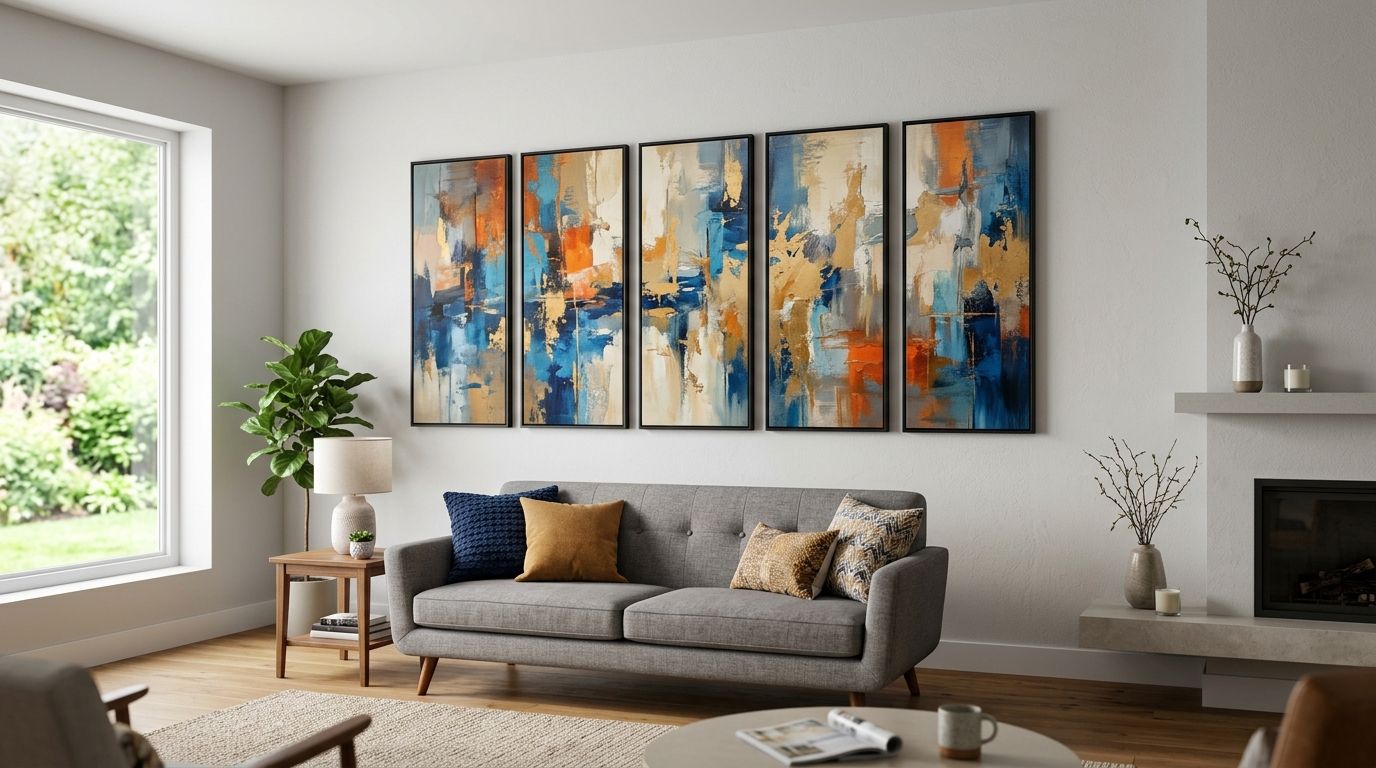
- Abstract native interpretations: a geometric take on the Australian bush, the way Into the Gum Trees reads the structure and colour of native landscape without being literal
Match the piece to the room's light and humidity
The fastest way to ruin a native art print is hanging it somewhere the finish can't handle.
- Canvas prints suit low-glare hallways and bedrooms with filtered light
- Avoid an uncoated canvas on a wall that gets direct western afternoon sun
- Bathrooms and laundries need a framed print with sealed glass, not raw canvas
- Kitchens need a washable framed surface near cooking splash zones
- North-facing living rooms handle darker, richer palettes better under bright indirect light
Scale the print to the wall, not the room
A small print on a big Queenslander hallway wall disappears; an oversized print in a tight entry overwhelms it.
- Measure the actual wall space, not the floor area of the room
- Above-sofa art should span roughly two-thirds of the sofa's width
- Entryway console pieces sit narrower and taller than living room statement pieces
- Stairwells suit a vertical panorama-shaped native landscape over a square one
- Three to five smaller native prints in a gallery layout can replace one oversized canvas
Layer texture instead of buying one flat print
A single print rarely carries a native-inspired room on its own once you're past the entry.
- Reserve an original painting for the one wall guests see first
- Keep supporting walls to canvas or framed prints to control the overall look
- Use unframed prints where you plan to rearrange or swap pieces later
- Add a textured element — timber frame, linen mat, or a warm wallpaper panel — behind a single anchor piece rather than stacking multiple loud prints
Decide between a print and an original for your statement wall
This is a budget and commitment decision as much as a design one.
- An original painting is one-off, usually signed, and can't be reordered in a different size
- A canvas print gives you the same visual weight at a lower entry point and can be reproduced
- A framed print sits between the two — glass protection with more flexibility than an original
- An unframed print lets you match an existing frame style already used elsewhere in the home
Native Bouquet, an original acrylic-on-canvas piece from Gioia Wall Art, runs 81cm (W) x 81cm (H) x 3.5cm (D), varnished, sides painted, signed on the back — a physical detail no print reproduction carries.


Comparing your native-inspired art print options
| Option | Best for | Key limitation |
|---|---|---|
| Canvas print | Large statement walls in low-glare rooms | Fades faster in direct sun without UV coating |
| Framed print | Bathrooms, kitchens, high-humidity rooms | Glass can glare under bright downlights |
| Unframed print | Renters and custom framing projects | Needs a separate frame purchase and fitting |
| Original painting | One irreplaceable feature wall | Higher cost, one-off, can't be reordered in another size |
| Peel-and-stick wallpaper | Renters wanting a full native pattern wall | Removal needs care on textured or painted plaster |
A framed australian art prints pick behind glass wins on longevity in a bathroom or kitchen; an original wins on impact in an entry or living room, but only once.
Common mistakes with native-inspired art prints
- Reaching for generic botanical prints instead of true native species — European peonies or tropical monstera read as decor, not place, in a native-inspired room
- Buying one oversized print for a small entry wall instead of a tighter vertical piece scaled to the actual space
- Hanging a raw canvas on a wall with unchecked afternoon sun — the UV exposure shows within a year of a north or west-facing window
- Matching the print to the sofa fabric instead of the room's undertone, which dates fast the next time furniture changes
- Skipping the original-vs-print decision entirely and defaulting to whatever is in stock, rather than deciding budget and commitment first
FAQ
What are the best australian art prints for a native-inspired home in 2026?
Prints built around true native species — banksia, kangaroo paw, gum trees — in an ochre, terracotta or eucalyptus palette work best in 2026, matched to the room's actual light and wall size rather than a trend colour.
Is a canvas print or framed print better for native Australian wall art?
Framed prints behind glass hold up better in bathrooms, kitchens and sunny rooms. Canvas prints suit low-glare hallways and bedrooms and cost less, but fade faster without a UV coating.
Do native Australian art prints work in a Queenslander or weatherboard cottage?
Yes — native motifs read as authentic against timber-and-tin architecture in ways imported florals or tropical prints don't. Scale the piece to the high ceilings and hallway proportions typical of these homes.
How do I stop a canvas print fading in a sunny room?
Keep uncoated canvas out of direct afternoon sun, or choose a framed print with UV-protective glass for north or west-facing walls. Rotating art periodically also slows visible fading.
Should I buy an original painting or a print for a feature wall?
Buy an original for the one wall guests see first if you want a signed, one-off piece; buy a canvas or framed print for supporting walls where you may want to swap the look later.
What size native art print do I need above a sofa?
Aim for roughly two-thirds of the sofa's width. A three-seater sofa needs a wider single piece or a multi-print gallery grouping rather than one small canvas.
Can renters use native-inspired wall art without drilling holes?
Unframed prints in lightweight hangers and peel-and-stick native wallpaper panels both avoid permanent wall damage and suit share houses or short-term leases.
What colours pair with native Australian motifs?
Terracotta, warm ochre, eucalyptus green and sandy neutrals pair naturally with native flora and fauna prints, echoing the actual colours of the Australian bush and outback.
One last thing
An original piece like Native Bouquet is signed on the back and varnished at 81cm x 81cm x 3.5cm — a detail worth checking before you buy, because it's the one thing a print reproduction can never carry, no matter how good the canvas quality is in 2026.