A large statement wall needs multi panel canvas art that reads as one continuous image across two or more canvases, not a scatter of unrelated prints competing for attention. This audience is decorating open-plan living rooms, double-height stairwells, and walls behind long sofas where a single small canvas simply disappears, so the sizing and spacing rules are different from a normal gallery wall.
- Multi panel canvas art works best on walls wider than 2.4m - a triptych or 5-panel split reads as one image, not three separate prints.
- Gioia Wall Art's large canvas prints come in standard panel splits so the image lines up without custom framing.
- Leave roughly 5cm between panels: tighter crowds the image, wider breaks the visual line across the wall.
- Panoramic single canvases skip the seam question entirely but weigh more per piece and need two people to hang safely.
Why multi panel canvas art matters for a large statement wall
A wall over 3 metres wide makes a standard 60x90cm canvas look like an afterthought. Multi panel canvas art solves the scale problem by splitting one composition across two, three, or five stretched canvases, so the piece grows to match the wall instead of shrinking the room down to the print.
It also solves a handling problem most people ignore until delivery day. A single canvas wide enough to cover a 3.5m wall is awkward to freight and awkward to carry through a doorway. Split that same image across three or five panels and you walk it in one canvas at a time.
In 2026, open-plan living and dining zones in new-build Australian homes keep pushing feature walls wider, which is exactly where multi panel canvas art earns its place over a single framed print.
Measure your wall before you shop
Get the numbers right before you look at a single design. This is the step most buyers skip, and it causes the most returns.
- Measure the full wall width and subtract 10-15% so the art doesn't run edge to edge
- Measure ceiling height and mark the top panel edge roughly 15-20cm below the ceiling line on high walls
- Above a sofa or console, span roughly two-thirds the width of the furniture below
- Photograph the wall in daylight and again at night so you can check contrast later
- Note switches, vents and trims that will interrupt panel placement
Choose your panel split for the wall you have
The number of panels changes how the composition reads, not just how many boxes arrive at your door.
- Diptych (2 panels) for narrower feature walls, above a console, or either side of a doorway
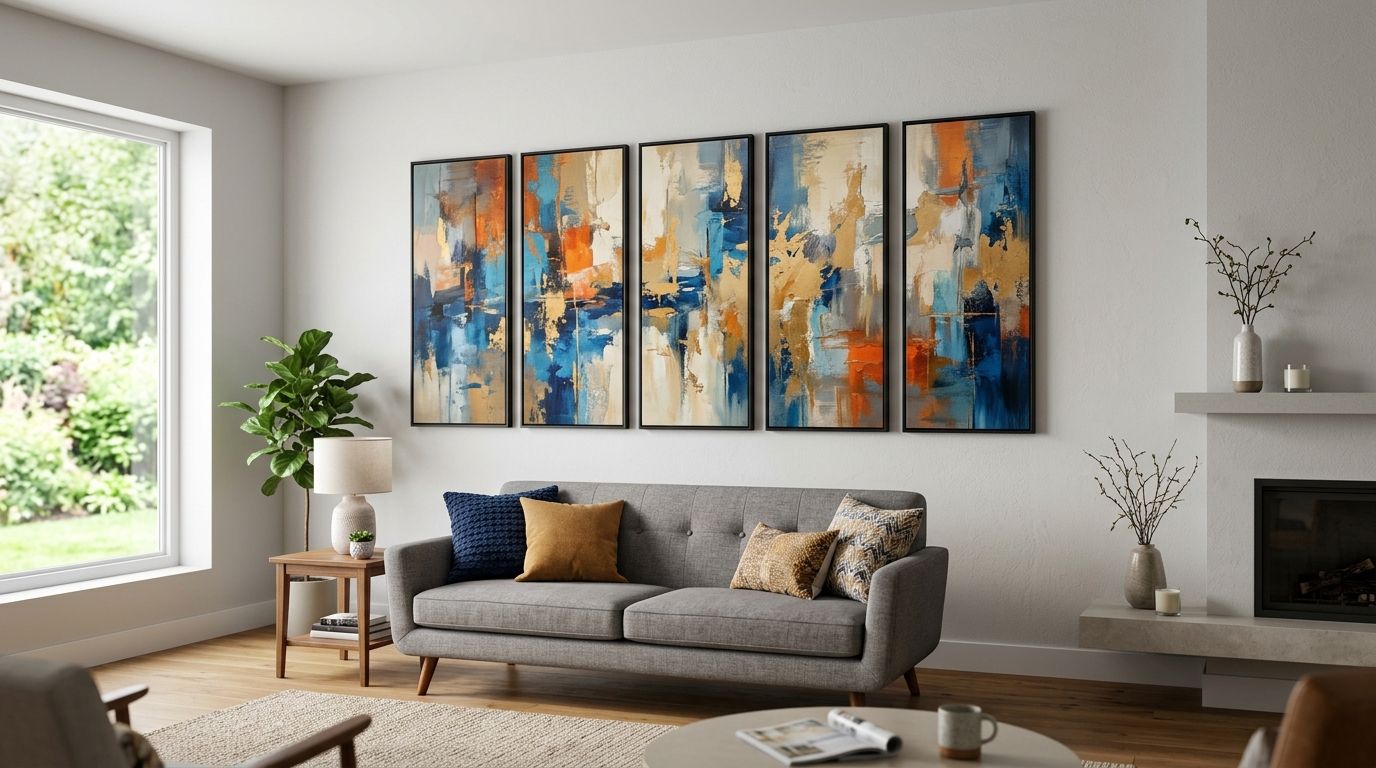
- Triptych (3 panels) for above-sofa styling and entryways - the most forgiving split for symmetry
- 5-panel sets for double-height voids, staircases and walls wider than 3.5m where a triptych looks stretched
- Odd-numbered splits centre better on a wall than even splits, which can read as two separate halves
Gioia Wall Art's large canvas prints for big walls come in these standard splits, so the composition is designed to cross the seams cleanly rather than cropped after the fact.
Match the canvas style to your room's palette
A multi panel set is the biggest visual statement in most rooms, so the style has to earn that space rather than fight the furniture.
- Pull one dominant colour from the artwork and repeat it elsewhere - a cushion, a rug edge, a lamp base
- Warm timber floors and linen furniture read better with muted, earthy palettes than high-saturation abstracts
- Cool-toned rooms with concrete or matte black fixtures suit monochrome or high-contrast compositions
- If the room already carries a bold pattern, keep the canvas composition simpler so the wall doesn't compete with itself
Plan the gap and alignment before delivery
Spacing separates a set that looks intentional from three prints hung by accident.
- Keep roughly 5cm between panels - consistency matters more than the exact distance
- Use a laser level, not a tape measure alone, to keep top edges dead level
- Mark positions on painter's tape first and step back before drilling anything
- For a triptych, centre the middle panel on the wall or the furniture, then work outward
Hang heavy multi panel sets safely
Large canvases are heavier and more awkward than a standard print, and hardware mistakes are the most common cause of damage on install day.
- Use D-rings and picture wire rated for the panel's weight, not a single centred hook
- Locate studs where possible; use rated wall anchors on plasterboard sections
- Hang the largest panel first as your reference point, then work outward
- Get a second person for any panel over roughly 1m in either dimension
The guide to hanging heavy canvas prints safely covers stud-finding and anchor selection in more depth than fits here.
Light the wall properly
A multi panel set loses impact under flat, single-source lighting, especially at night when a big wall is the main thing anyone looks at.
- Angle a picture light or track spot at roughly 30 degrees to avoid glare across the canvas texture
- Avoid overhead-only lighting - it flattens texture and drops shadows into the panel gaps
- Warm white around 2700-3000K reads more natural on canvas than cool white, which washes out earthy palettes
Comparison: multi panel options for a large statement wall
| Option | Best for | Key limitation |
|---|---|---|
| Diptych (2 panels) | Narrow feature walls, either side of a doorway | Too little visual weight on walls over 3m |
| Triptych (3 panels) | Above-sofa styling, entryways | Alignment must be precise or symmetry breaks |
| Panoramic single canvas | Wide walls where you want zero visible seam | Heavier per piece, hard to hang solo |
| 5-panel gallery set | High ceilings, staircases, double-height walls | Most complex install, spacing errors show fastest |
Compare a panoramic wall art option directly against a multi panel split if you'd rather avoid gaps entirely. The trade-off is one heavier canvas instead of several lighter ones.
Common mistakes buyers make on a large statement wall
- Buying one size too small. A set that suits a 2.4m wall looks lost on a 3.6m wall. Measure the wall, not just the furniture.
- Uneven panel gaps. A 3cm gap on one side and 7cm on the other makes an expensive set look cheap from across the room.
- Ignoring the ceiling line. Panels hung too close to the ceiling on a high wall float away from the room instead of anchoring it.
- Choosing the image before the palette. Falling for a composition online without checking it against existing room colours is the leading cause of returns.
- Skipping a stud finder. A multi panel set weighs more in total than one print of the same overall size, and plasterboard alone won't hold every panel long term.
FAQ
What is multi panel canvas art?
Multi panel canvas art is one composition split across two or more stretched canvases, hung with a small gap between each so the image reads as a single piece. It suits walls too wide for a standard single canvas to fill without looking undersized.
How many panels should I use for a large statement wall?
A triptych of 3 panels suits most walls up to about 3.5m wide, while 5-panel sets suit wider walls, staircases and double-height voids. Diptychs work better on narrower feature walls under 2.4m.
Is a triptych or a panoramic canvas better above the sofa?
A triptych is lighter to hang piece by piece and more forgiving on spacing, while a panoramic single canvas removes the seam entirely but needs two people to hang. Both work above a sofa - it comes down to whether you want visible gaps.
How much gap should I leave between canvas panels?
Roughly 5cm is the standard gap for multi panel canvas art. Consistency across every gap matters more than the exact distance you pick.
How big should multi panel canvas art be in a high-ceiling room?
In high-ceiling rooms a 5-panel set scaled across most of the wall width reads better than a small triptych stranded in empty space. Measure the wall and subtract 10-15% for margin.
Can I mix multi panel canvas with framed prints on one wall?
Yes, but keep the multi panel set as the single dominant piece and place framed prints elsewhere in the room. On the same wall the two compete for the same sightline.
How do I hang multi panel canvas sets without an installer?
Mark panel positions with painter's tape, use a laser level to keep top edges even, and hang the largest panel first as your reference. Rated D-rings and wall anchors matter more than the number of nails.
What is the difference between a diptych and a triptych?
A diptych splits one image across 2 canvases and a triptych splits it across 3. Triptychs suit wider walls and centre more naturally above furniture.
One last thing
The detail most people get wrong in 2026 isn't the artwork, it's gap consistency - a 2cm variance across a 3-panel set is visible from the other side of the room even when the image is perfect. Measure every gap before the final nail goes in, not just the first one.