Panoramic wall art for wide feature walls is artwork sized and formatted to fill an oversized, uninterrupted wall — usually anything from 2.4m upward — without the stretched, pixelated or oddly-cropped look you get from scaling up a standard-width print. A wide feature wall behaves differently from a regular wall: sightlines are longer, furniture below it is often lower-profile, and a single small print reads as lost rather than intentional. The fix is matching format to width first, then picking the image — not the other way round.
- Panoramic wall art for wide feature walls works best as 2-3 matched canvas panels once a wall passes about 2.4m wide.
- A single oversized panel past roughly 200cm wide is harder to ship, hang and keep flat than a multi-panel set.
- Peel-and-stick wallpaper murals cover walls wider than any canvas option, with zero visible seam.
- Gioia Wall Art's canvas prints only look sharp at panoramic sizes when the source file resolution matches the print size, not the other way round.
Why panoramic wall art matters for wide feature walls
Open-plan living and dining zones, long entryway runs, and above-sofa walls in newer Australian homes are frequently wider than the 90-150cm range most standard prints are designed for. Hang a single small canvas dead-centre on a 3.5m wall and the eye reads bare space on both sides before it reads art.
The alternative that actually works for canvas prints for open-plan living spaces is sizing the artwork to the wall, not the wall to a print you already like. A panoramic piece — whether one long canvas, a matched multi-panel set, or a wallpaper mural — turns the width into the feature instead of a problem to hide.
This matters more on wide walls than anywhere else in the house because there's nowhere to hide a mismatch. A crooked panel gap or a stretched, blurry image is far more visible across 3m than across 1m.
Update your measurements before you shop
Get the wall's real dimensions before you look at a single product page.
- Measure total wall width edge to edge, not just the section behind furniture
- Record ceiling height and the height of any cornices or downlights that might interrupt a tall piece
- Measure from the floor to the top of your sofa or console so you know where the art's bottom edge should sit
- Note the distance you'll typically view the wall from — a hallway is viewed close-up, an open-plan lounge from 3-4m away
- Photograph the wall in daylight and in evening light to check for glare on glossy canvas
Decide between one panel, a multi-panel set, or wallpaper
This is the single biggest decision for a wide feature wall, and it should come before you fall in love with an image.
- A single oversized canvas panel suits walls up to roughly 200-240cm with one clear sightline
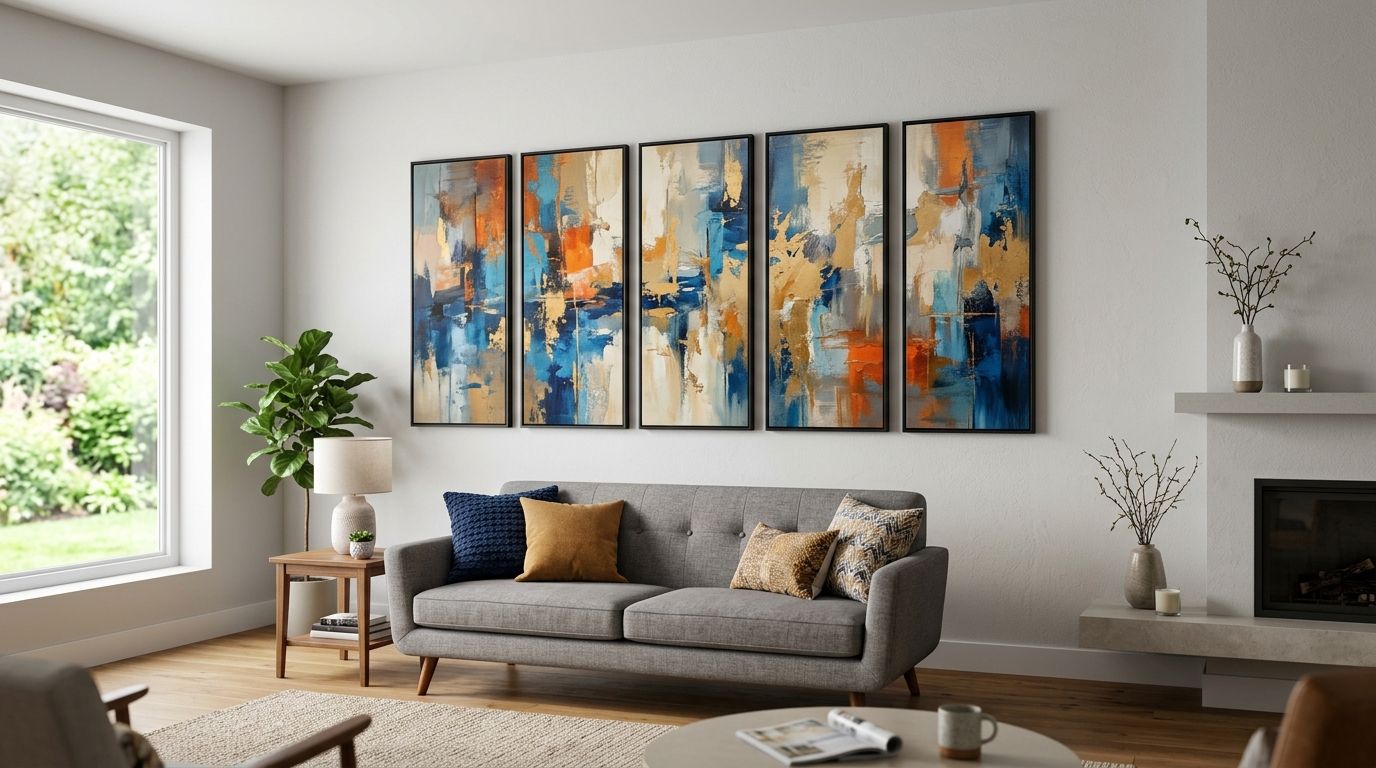
- A multi-panel canvas set (2-4 panels) suits walls from 240cm to 4m or more, and is easier to ship and hang than one giant sheet
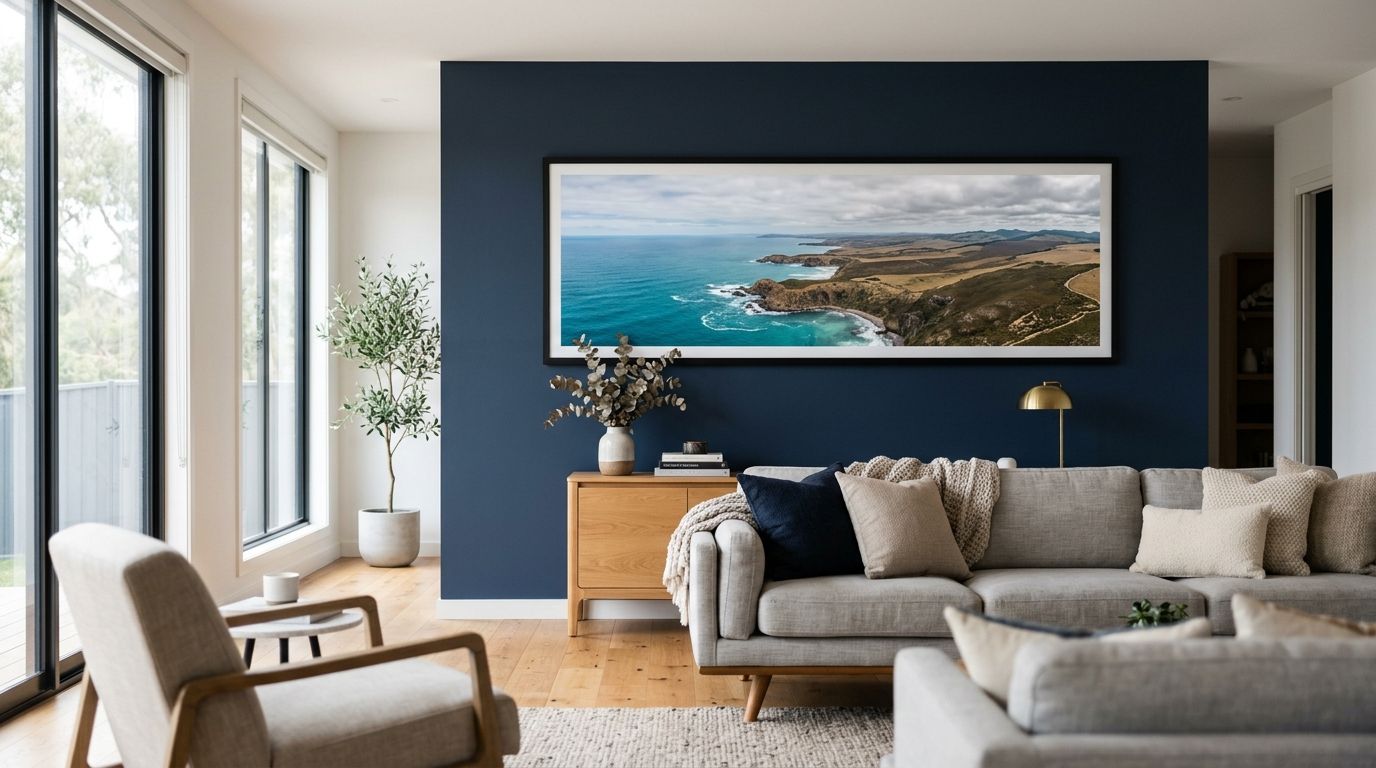
- A framed panoramic print adds a visible edge, which works well in hallways and entryways where you want definition
- Peel-and-stick wallpaper murals suit walls wider than any canvas format allows, plus rentals and walls with awkward angles
- Gioia Wall Art stocks both canvas panels and removable wallpaper, so the format decision doesn't force a compromise on the image
Match the artwork's aspect ratio to your wall, not the other way round
A wall that's 3.5 times wider than it is tall needs an image shot or composed at close to that ratio — cropping a square image to fit forces awkward composition choices.
- Horizon-line landscapes and coastal scenes naturally suit 2:1 to 3:1 panoramic ratios
- Abstract and textural art tolerates a wider stretch better than detailed figurative work, which can look thin when pulled too wide
- Multi-panel sets let you break a wide ratio into 2-3 panels instead of forcing one continuous image, which is more forgiving on tricky walls
- Check the product page for the panel split before ordering — some panoramic pieces are pre-designed for a 2 or 3-panel hang
Check the file resolution before committing to an oversized print
This is the step most people skip, and it's the one that causes the most returns on large-format art.
- Large prints viewed from 2m or more away can run lower resolution than close-viewed pieces without visible pixelation
- Prints meant to be seen up close — hallway walls, staircase landings — need a sharper source file than a lounge feature wall viewed from across the room
- Ask before ordering custom-size printing on any image, since stretching a standard file past its intended size is the fastest way to get a soft, blurry panel
- Gioia Wall Art's panoramic and multi-panel canvas options are printed to size rather than stretched from a smaller master file
Choose framed or unframed for a wide format
Framing changes how a wide wall reads, and it's not purely aesthetic — it changes the hang, too.
- Framed multi-panel sets create a visible break between panels, which can look intentional and gallery-like
- Unframed canvas gives the seamless, wraparound look most people picture when they think "panoramic"
- Wallpaper needs no frame at all and is the only format with zero visible break across the entire width
- Heavier frames need proper wall fixings, especially across a wide run of 3+ panels
Plan the hanging system before the piece arrives
A panoramic piece that's badly hung looks worse than a smaller print hung well.
- Use a stud finder across the full width before marking panel positions, not just at the centre
- Leave equal gaps between panels — 5-8cm is the standard convention for multi-panel canvas sets, and uneven gaps are the fastest way to make a set look accidental
- Get a second person on hand for any single panel over 120cm wide
- Read up on hanging heavy canvas prints safely before you commit to fixings, especially on plasterboard
Style the wall around the panoramic piece
The art does the heavy lifting on a wide wall, so the styling around it should stay quiet.
- Keep furniture below the piece low-profile so the art reads as one continuous sweep
- Avoid hanging competing smaller art beside or below a panoramic feature — it should stand alone
- Add a sconce or picture light at each end of a very wide piece so the far edges don't fall into shadow
- Choosing furniture shorter than the print's width, as covered in above-the-sofa styling, keeps the mounting looking deliberate rather than squeezed in
Comparing your options for a wide feature wall
| Option | Best for | Key limitation |
|---|---|---|
| Single oversized canvas panel | Walls up to 200-240cm, one clear sightline | Harder to ship and hang; any flaw is highly visible across the full sheet |
| Multi-panel canvas set (2-4 panels) | Open-plan living and dining walls 240cm-4m+ | Panel gaps must be measured evenly or the image reads as misaligned |
| Framed panoramic print | Hallways, entryways, walls needing defined edges | Frame weight adds hanging complexity on plasterboard |
| Peel-and-stick wallpaper mural | Walls wider than any canvas option, rentals, angled walls | Pattern repeats can become visible on unusually tall walls |
Before committing to a full wallpaper mural on a wide wall, ordering a swatch sample to check the pattern and colour against your actual light is the cheapest insurance available in 2026.


Common mistakes people make with panoramic wall art
- Buying one print sized for a standard wall and centring it on a wide one — this leaves bare space on both sides instead of a full feature
- Skipping the panel-gap math on multi-panel canvas — uneven spacing is the fastest way to make a matched set look like three separate purchases
- Choosing a highly detailed image for a wall viewed from across the room — fine detail disappears at distance and the piece reads as a flat colour block
- Not checking source file resolution before ordering an oversized single panel — this is the single biggest cause of soft, blurry prints on large-format canvas
- Ignoring ceiling height — a wide-but-short print on a tall wall reads as a letterbox strip rather than a feature
FAQ
What's the best material for panoramic wall art on a wide feature wall?
Canvas suits walls up to about 4m across as a multi-panel set, while peel-and-stick wallpaper suits anything wider or with awkward angles. Gioia Wall Art stocks both formats, so the choice comes down to wall width and whether you want a framed edge or a seamless mural.
Is a multi-panel canvas set better than one giant print for wide walls?
For most walls over 240cm, yes — multi-panel sets are easier to ship, hang and replace individually than one continuous sheet. A single oversized panel only makes sense under about 200-240cm where handling stays manageable.
How wide can a single canvas panel go before it looks stretched?
Past roughly 200-240cm a single panel becomes harder to print sharp and harder to hang flat, which is why most panoramic wall art for wide feature walls splits into 2-3 panels beyond that point. The exact limit depends on the source image's resolution.
Does panoramic wall art work above a bed as well as above a sofa?
Yes, provided the bed frame and headboard are lower-profile than the artwork's width, so the piece reads as a full sweep rather than squeezed above the furniture. The same measuring and panel-gap rules apply to either wall.
Can I use wallpaper instead of canvas for a really wide wall?
Wallpaper murals cover any width with zero visible seam, which makes them the better choice once a wall is too wide for a practical canvas panel count. Ordering a sample first confirms the pattern and colour read correctly at full scale.
How much empty wall should stay around a panoramic piece?
Leave enough margin that the art doesn't touch adjoining walls or door frames, generally at least 15-20cm on each side. Too little margin makes the piece look cramped rather than intentional.
Do panoramic prints need professional installation?
A single framed panel under 120cm can usually be hung solo with a stud finder and the right fixings. Multi-panel sets over three panels, or anything over 3m wide, are easier and safer with a second person helping align the gaps.
What resolution do I need for an oversized print?
Prints viewed from 2m or more away tolerate lower resolution than close-viewed pieces like hallway art, so a file that looks sharp on screen isn't automatically ready for panoramic scale. Confirm the print size against the source file before ordering custom sizing.
One last thing
The wall itself decides the format before the image does — measure width and viewing distance first, pick canvas panels or wallpaper second, and only then start browsing images. Skip that order in 2026 and you'll end up choosing a piece you love that simply won't work at the size your wall needs.