Heavy canvas prints and original paintings don't fail because the art is wrong for the wall — they fail because a $3 picture hook was asked to carry a job it was never rated for.
- Hanging heavy canvas prints safely in 2026 means finding a stud or a rated anchor, not a nail and a picture hook.
- Canvas over 100cm wide or 5kg needs two mounting points — a single hook loosens within months.
- French cleats outperform D-rings on large original paintings like statement pieces over 15kg.
- Adhesive strips are fine under 2kg only — anything heavier needs a proper wall anchor. Buy the anchor, skip the strip.
- Plasterboard walls need toggle bolts rated to at least double the artwork's actual weight.
Why this matters
A large canvas or an original painting isn't a poster. Stretched canvas over 100cm wide often weighs 3-6kg once you add the timber frame, and a framed original on linen can push past 15kg. Drop that weight on plasterboard with a nail rated for 2kg and you're not asking if it will fall — you're asking when.
The fix isn't complicated, but it does depend on getting the wall type, the hanging hardware, and the weight distribution right before you pick up the drill. Get the sizing wrong from the start and every step after it compounds — check how to choose the right size wall art for your wall before you even confirm the piece fits the space you've picked.
What you'll need
- Stud finder (electronic, not the magnet type — plasterboard studs are timber or steel, magnets only catch screws)
- Pencil and a spirit level or laser level
- Drill with a masonry bit (brick/concrete) or a wood bit (timber stud)
- Wall anchors rated for at least double the artwork's weight — toggle bolts for plasterboard, plugs and screws for brick or besser block
- D-ring hardware or a French cleat kit, sized to the canvas frame depth
- Picture wire rated to the load, or braided steel cable for anything over 10kg
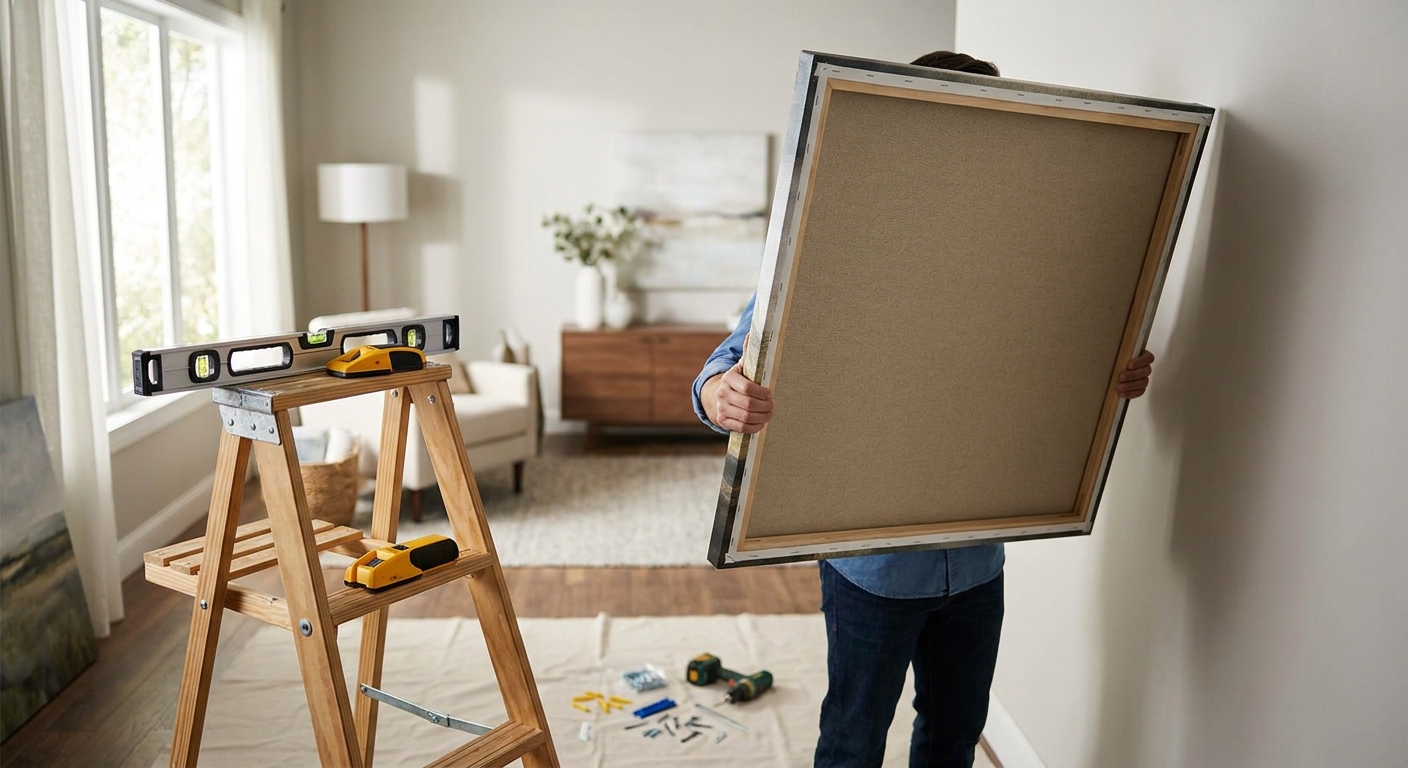
- Tape measure and a helper — a second pair of hands matters more here than on a small print
The steps
1. Weigh and measure the piece before you touch the wall
You can't choose the right hardware without knowing the actual load. A stretched canvas around 100cm x 100cm typically sits at 3-5kg; a framed original painting on a wood panel, like the pieces in Gioia's collection that run 120-180cm wide, can weigh 10-18kg once the frame and stretcher bars are counted.
Measure the piece and, if you don't have a scale, estimate on the heavy side. Common mistake: guessing light because canvas "feels" hollow — the timber stretcher frame inside adds more weight than people expect.
2. Find a stud, or plan for a rated anchor
A timber or steel stud takes weight far better than plasterboard alone. Run the stud finder across the target zone and mark every hit with a pencil dot.
No stud in the right spot? That's normal — studs sit 40-60cm apart and your ideal hanging point rarely lines up. In that case, a toggle bolt rated to 20kg+ in plasterboard is the safe substitute, never a standard plastic wall plug.
3. Mark your hanging points with a level, not by eye
For anything over 100cm wide, one hook isn't enough — you need two mounting points spaced evenly, or a French cleat that spans the width of the frame. Measure from the top of the frame down to the hanging hardware, transfer that measurement to the wall, then check it with a spirit level before drilling.
Common mistake: measuring once and drilling immediately. Measure the D-ring spacing twice — a 5mm error at this stage shows up as a visibly crooked painting once it's on the wall.
4. Choose French cleats for anything over 15kg
D-rings and wire work fine up to around 10-12kg. Past that, a French cleat — two interlocking timber or metal strips, one on the wall, one on the frame — distributes weight along the full width of the piece instead of concentrating it at two small points.
This matters most for large statement canvases and original paintings meant as a room's focal point. If you're sizing up a big feature-wall piece, the sizing considerations are different again — worth a look at the best statement wall art for a feature wall before you commit to a French cleat install over a permanent wall.
5. Drill and anchor into the marked points
Drill straight, not at an angle — angled holes weaken the anchor's grip in plasterboard. For toggle bolts, drill the hole to the exact size stated on the packet; too large and the toggle won't seat, too small and it won't pass through.
For brick, besser block or concrete, use a masonry bit and a plug rated for the wall anchor size, and don't rush the pilot hole — a shallow hole is the single most common reason a brick-wall anchor fails within the first year.
6. Hang, then load-test before you walk away
Once the piece is up, apply gentle downward and forward pressure to check the anchor holds under real load, not just its own weight. A canvas that shifts or the wall that flexes under hand pressure means the anchor isn't rated correctly — pull it and start again rather than hoping it settles.
7. Level and lock it in
Check level one final time with the piece hanging, not before. Large canvases can sit fractionally off if the wire has stretched slightly during install — a small adjustment now saves you from a permanently tilted feature piece.


Troubleshooting
The wall is solid brick or besser block and the drill keeps skating. Start with a centre punch or a nail tap to create a starter dent before drilling — masonry bits wander on smooth brick faces without one.
The canvas tilts within a few weeks of hanging. Almost always a single hanging point on a wide piece. Add a second D-ring or switch to a French cleat rather than re-hanging on the same single hook.
Wire shows above the top of the frame. The hanging wire is set too tight or too high on the D-rings. Loosen it by a few centimetres so the frame sits flush and the wire tucks behind the top edge.
The toggle bolt spins and won't tighten in plasterboard. The pilot hole is oversized for the toggle. Remove it, patch the hole, and redrill slightly smaller, or shift the anchor point 3-4cm over.
You're renting and can't drill into the wall at all. This changes the entire approach — weight-rated adhesive hooks only work up to around 2-3kg, well under most large canvases. The full workaround, including which fixings landlords actually allow, is in how to hang wall art without damaging rental walls.
The piece is going above a bed or a headboard and keeps looking off-centre. Hanging height and spacing rules change when there's furniture underneath — that's a separate sizing problem, not a hardware one.
Tools and resources
- Stud finder and a rated toggle bolt kit (plasterboard) or masonry plugs (brick)
- French cleat hardware for anything over 15kg
- A spirit or laser level — don't eyeball a piece this size
- If you're hanging more than one large canvas together, spacing rules differ from a single feature piece — see how to arrange a gallery wall layout before you start marking multiple points
What to do next
Once the piece is secure, the next failure point isn't the wall — it's proportion. A heavy canvas hung too small for the wall looks like an afterthought no matter how solid the install is. Confirm the scale is right for the room before you finalise hanging height, and if the piece is going above a bed, that placement has its own spacing rules worth checking separately.
FAQ
How much weight can a standard picture hook hold?
A standard single picture hook holds around 2-5kg depending on the nail gauge, well under most canvas prints over 100cm wide. Anything heavier needs a stud fixing or a rated wall anchor, not a picture hook.
Do I need a stud finder to hang a heavy canvas print?
Yes, in most cases. A stud gives far more holding strength than plasterboard alone, and for anything over 5kg it's the safer first option before relying on a toggle bolt.
Are French cleats better than D-rings for large paintings?
French cleats hold better for pieces over 15kg because they spread weight across the full width of the frame instead of two small points. D-rings and wire are fine for lighter canvases under 10-12kg.
Can I use adhesive strips to hang a heavy canvas print?
Only for pieces under 2kg. Adhesive strips aren't rated for the weight of a standard stretched canvas or original painting and will peel under sustained load.
How do I hang a heavy canvas print on plasterboard without a stud?
Use a toggle bolt rated to at least double the artwork's weight. A 15kg painting needs an anchor rated for 20kg or more, drilled to the exact pilot size stated on the packet.
Is it safe to hang a heavy canvas print above a bed?
Yes, provided it's anchored into a stud or a properly rated fixing — the same weight rules apply regardless of what's underneath. Hanging height above a bed follows separate proportion rules, not weight rules.
What's the weight limit for hanging wire versus a French cleat?
Standard picture wire is rated up to around 10-12kg; past that, braided steel cable or a French cleat handles the load more evenly and reduces strain on the frame's D-rings.
How do renters hang heavy canvas prints without damaging walls?
Weight-rated adhesive hooks max out around 2-3kg, so most heavy canvases need a landlord-approved fixing or a lighter alternative print. Rental-safe methods differ from permanent-wall methods and are worth checking before signing a lease agreement about wall damage.
One last thing
The weight number on a canvas listing is almost always the bare stretched print — add the timber stretcher bars and any float frame and the real installed weight runs 20-30% higher than what's printed on the product page. Anchor for that higher number, not the listed one, and you won't be back at the hardware store in six months.