A gallery wall lives or dies on how well the frames talk to each other, not on how good any single piece looks alone. This guide breaks down what actually matters when picking framed prints for gallery walls and which pieces from Gioia Wall Art's current catalogue earn a spot on yours.
- Caught Up and Fifty Shades are the strongest framed anchors for a 2026 gallery wall — both ship Currently Framed at 31 x 71cm. Buy.
- Mixing more than two frame finishes on one wall is the fastest way to make framed prints for gallery walls look chaotic. Skip.
- 30 x 30cm square canvases like Melody Mad and Lasting Comfort fill gaps between larger anchor pieces. Consider, but budget for framing.
- Keep spacing between frames tight and consistent rather than eyeballing gaps piece by piece.
Why this matters
Most people buying framed prints for gallery walls make the decision one piece at a time, then wonder why the finished wall looks like a mismatched pile-up instead of a curated collection. The fix isn't more art — it's a plan for frame finish, size ratio and colour before anything gets hung. Gioia Wall Art works through this exact problem with customers every week, and the same four or five decisions come up every time.
Who this is for
This guide is for anyone assembling a multi-piece wall display — above a sofa, along a hallway, up a staircase — rather than hanging one statement print. If you've already got one or two framed pieces and are trying to figure out what to add without the wall looking cluttered, this is written for you specifically.
What to look for in framed prints for gallery walls
Frame finish consistency
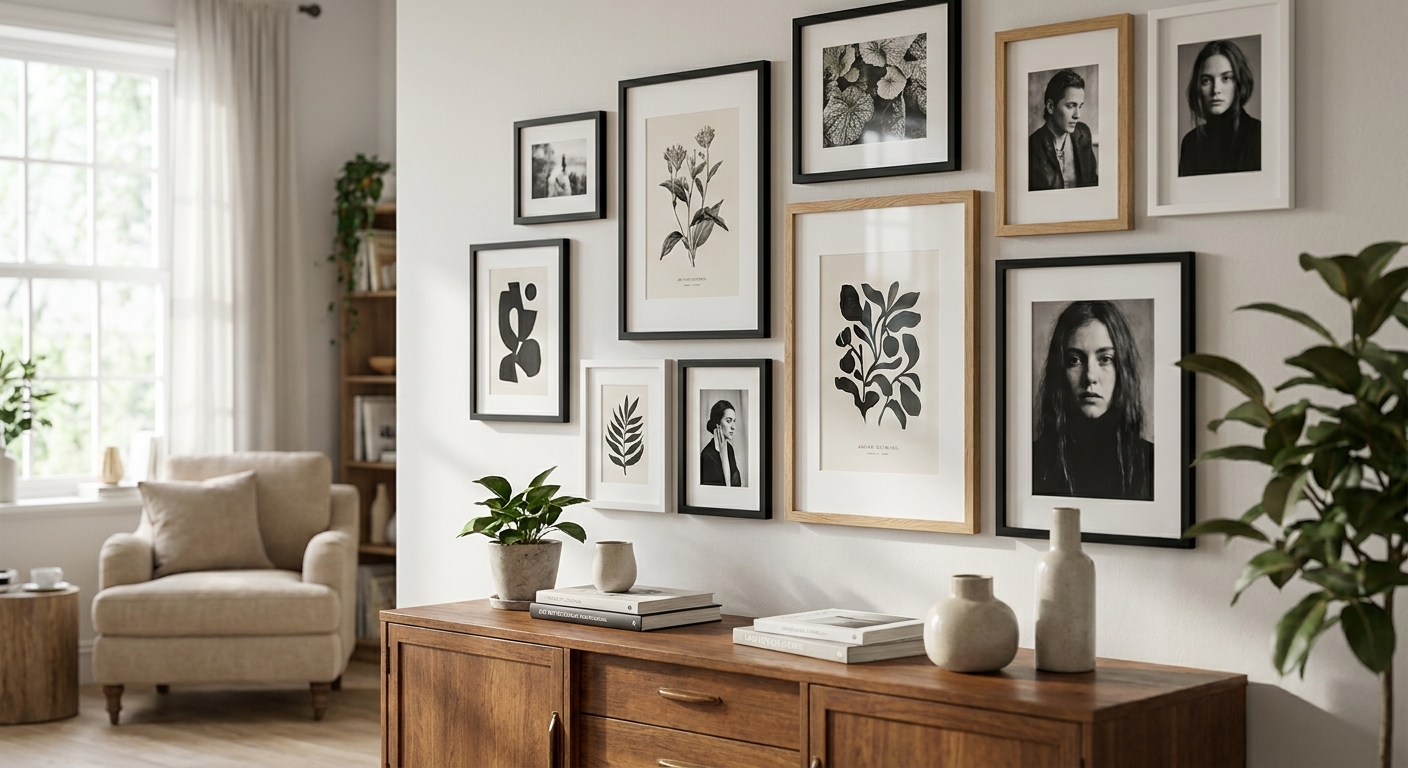
Pick one frame finish — matte black, natural timber, or white — and stick to it across the whole wall. A gallery wall with three different frame colours reads as a garage sale, not a curated collection, no matter how good the individual prints are.
Mat board and border width
A wide, even mat border around each print creates visual breathing room and makes mismatched print sizes feel intentional. Skip mats entirely and you need every piece to be a near-identical size, which limits your options.
Size and proportion mixing
A gallery wall needs at least one larger anchor piece — something in the 60cm-plus range — surrounded by smaller supporting prints. Without a size hierarchy, the eye has nowhere to land and the whole arrangement feels flat.
Colour and subject cohesion
Prints don't need to match, but they need a shared thread — a palette, a texture, or a subject family (abstract, landscape, botanical). Random genres thrown together across a wall in 2026 read as indecisive rather than curated.
Glazing and glare control
Glass-fronted frames near a window or under a downlight throw glare that ruins the piece from most viewing angles. Check where the wall sits relative to natural light before committing to a glazed frame finish.
Hanging hardware and wall protection
Heavier framed canvases need proper D-rings or wire, not the sawtooth hangers that come standard on lightweight prints. This matters more on a gallery wall because a dropped piece takes the whole arrangement down with it.


Top picks for your gallery wall
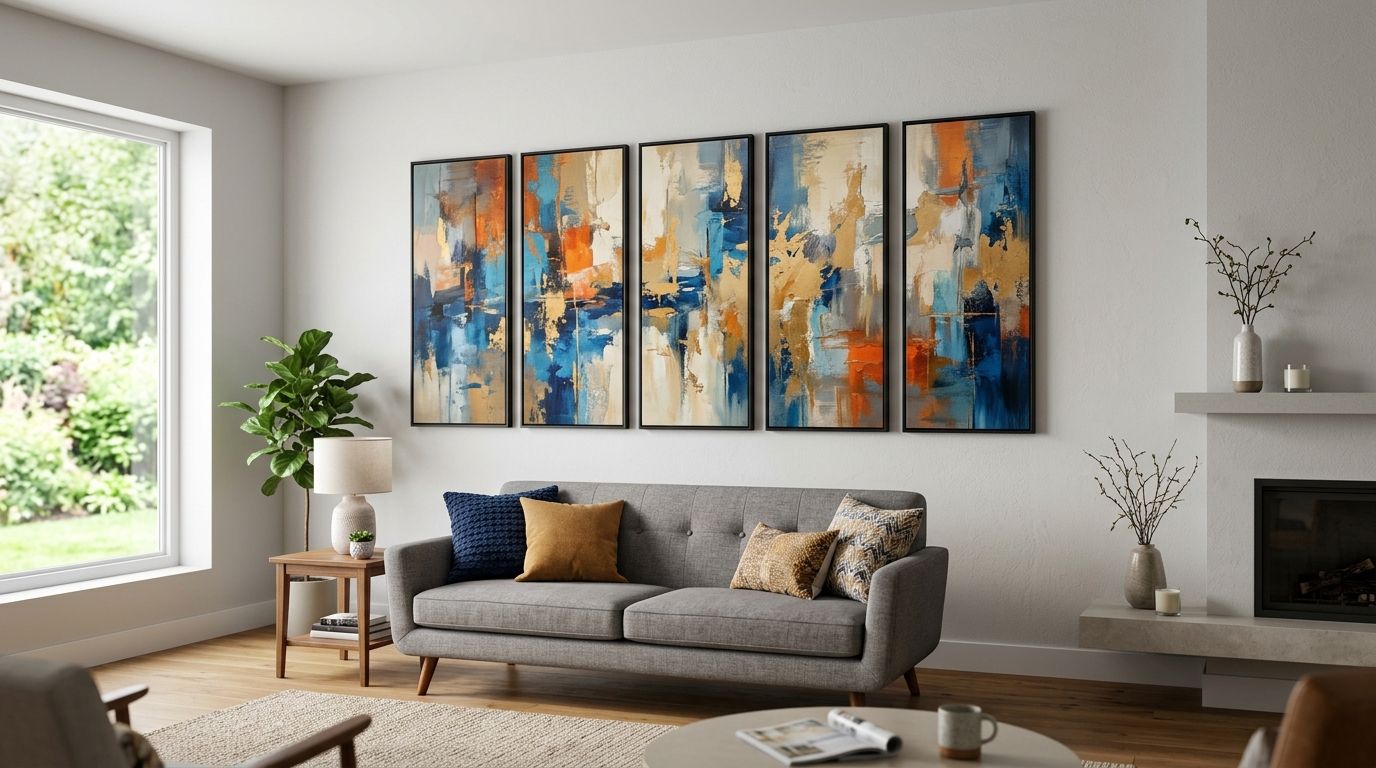
Caught Up — the anchor piece. This 31 x 71cm canvas ships currently framed, which saves you a separate framing order and guarantees the finish matches from day one. The tension between structure and chaos in the composition gives a gallery wall a strong visual centre without overwhelming smaller pieces around it. At $790, it's priced to be the wall's biggest single investment. Buy.
Fifty Shades — the moody companion. Same 31 x 71cm dimensions, same currently-framed finish, same $790 price point as Caught Up, which makes pairing the two dead simple if you want a matched vertical pair on either side of a doorway or sofa. The darker palette gives contrast against a lighter anchor piece. Buy.
Melody Mad — the filler square. A compact 30 x 30cm piece at $300, currently unframed, that works as connective tissue between two larger prints. Because it ships unframed, factor in a matching frame finish before it goes up, but the small footprint and low price make it easy to add two or three without blowing the budget. Consider.
Lasting Comfort — the neutral connector. Another 30 x 30cm canvas at $300, unframed, with a calmer palette than Melody Mad. Use it to break up a run of bolder pieces so the wall doesn't feel like it's shouting from every angle. Consider.
What to avoid
- A single oversized statement print instead of a grouping. It looks decisive in isolation but defeats the point of a gallery wall — you end up with one hero piece and empty wall around it.
- High-gloss varnish finishes on a wall that faces a window. The glare shifts as the sun moves through the day in 2026 and you'll notice it every afternoon.
- Frames bought from three different suppliers. Even close matches in black timber vary in width and depth enough to look off once four or five are side by side.
Verdict comparison
| Piece | Size | Frame status | Price | Best role | Verdict |
|---|---|---|---|---|---|
| Caught Up | 31 x 71cm | Currently framed | $790 | Anchor | Buy |
| Fifty Shades | 31 x 71cm | Currently framed | $790 | Companion anchor | Buy |
| Melody Mad | 30 x 30cm | Currently unframed | $300 | Filler | Consider |
| Lasting Comfort | 30 x 30cm | Currently unframed | $300 | Neutral connector | Consider |
FAQ
What's the best frame finish for a gallery wall in 2026?
Matte black and natural timber are the two safest choices for framed prints for gallery walls in 2026 because they read as neutral against most wall colours. Pick one finish and use it across every piece in the grouping.
How many framed prints do I need for a gallery wall?
Most gallery walls work well with five to nine pieces, mixing one or two larger anchor prints with several smaller supporting pieces. Fewer than five tends to look sparse; more than nine gets hard to arrange without crowding.
Is it better to buy prints already framed or frame them separately?
Buying currently framed prints, like Caught Up or Fifty Shades at 31 x 71cm, removes the guesswork of matching frame finishes later. Unframed pieces give more flexibility on finish but require an extra framing step before hanging.
How much space should I leave between framed prints on a gallery wall?
A gap of roughly 5 to 8cm between frames is standard for a tight, cohesive gallery wall look. Wider gaps work for a more spaced-out, gallery-style hang but need larger anchor pieces to hold the wall together.
Can I mix different sizes of framed prints on the same wall?
Yes, and you should — a mix of sizes with at least one larger anchor piece creates the hierarchy that makes a gallery wall feel intentional. All-same-size prints tend to look like a grid rather than a curated wall.
What's the most common mistake with framed prints for gallery walls?
Mixing more than two frame finishes on one wall is the most common mistake, since it makes an otherwise well-chosen set of prints look mismatched. Committing to one finish before buying solves this before it starts.
Do square canvases work well in a gallery wall layout?
Square 30 x 30cm canvases work well as filler pieces between larger rectangular anchors, since their compact footprint fits gaps that a bigger print can't. Melody Mad and Lasting Comfort are both this size and priced at $300 each.
Should gallery wall frames match the room's other furniture?
The frame finish should relate to the room's dominant metal or wood tone, but it doesn't need to match exactly. A matte black frame reads well against most Hamptons, Japandi and Scandinavian interiors without needing to match hardware precisely.
One last thing
The pieces that ship currently framed, like Caught Up and Fifty Shades, remove one entire decision point from the process — you're not trying to match a frame order to a print weeks after buying it. Start a gallery wall with those two anchors before adding the smaller unframed squares around them, and the framing consistency problem solves itself before it becomes a problem.