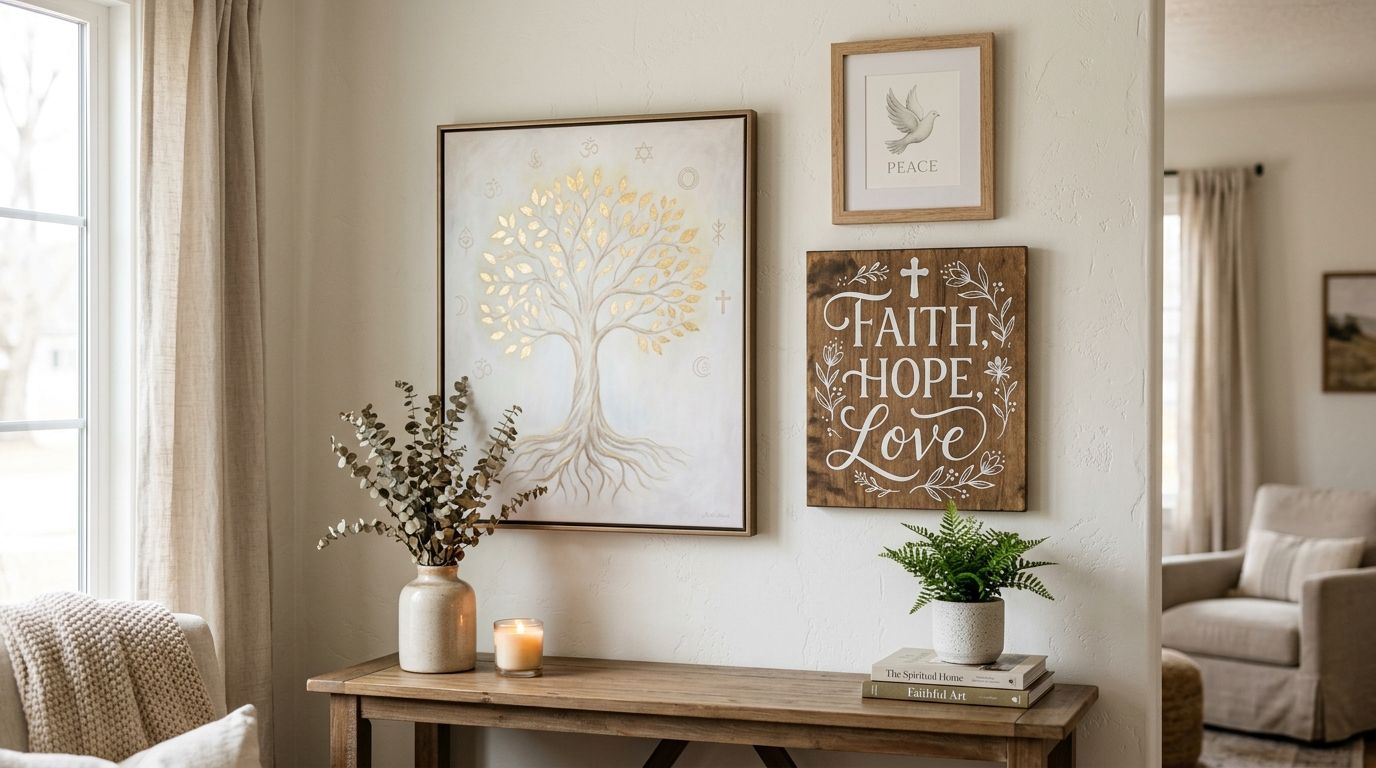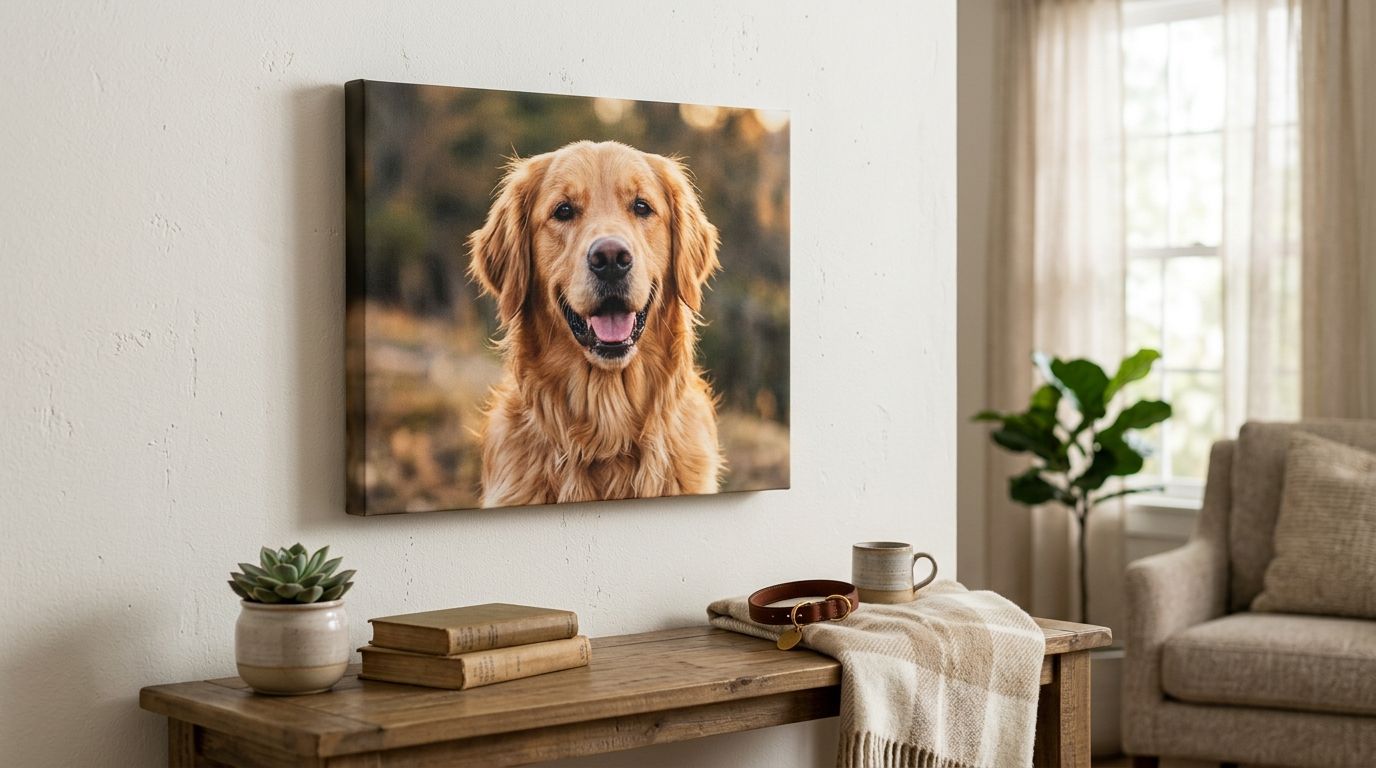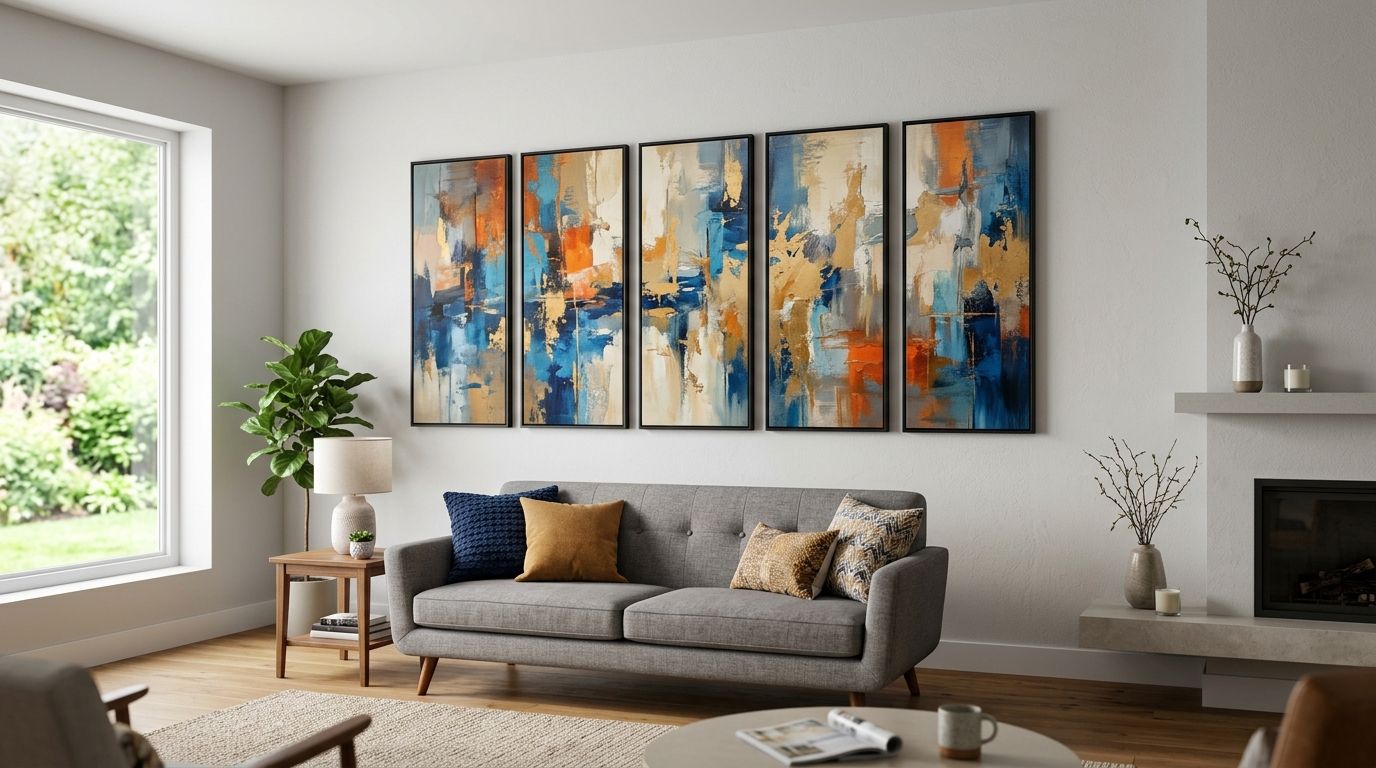
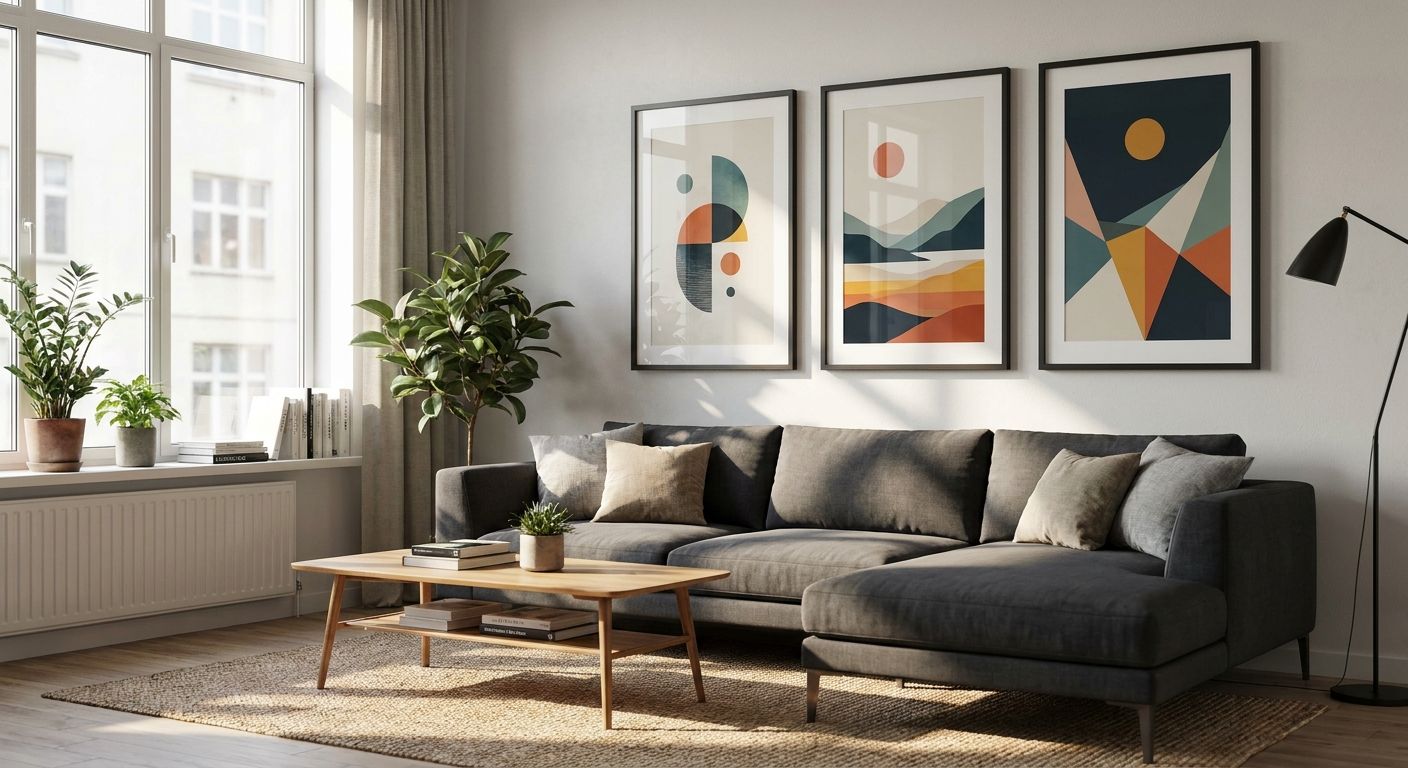
Modern apartment living room walls call for digital art prints that are digitally created or reproduced onto canvas, paper or metal, then scaled to suit smaller runs and open-plan sightlines instead of one oversized statement piece. Apartments come with constraints houses don't: rental clauses on drilling, lower ceilings, and living rooms that flow straight into the kitchen or hallway with no clear break for a single hero wall. That means the print, the size and the hanging method all get chosen against the room's layout first, and the artwork second.
- Digital art prints work best in modern apartment living rooms when sized to two-thirds of the sofa or media unit width.
- Canvas prints suit open-plan apartments because they need no glass and don't glare under downlights.
- Framed unframed prints from Gioia Wall Art give renters a no-drill option for lease-friendly hanging in 2026.
- A 3-5 print gallery layout reads better in small apartment living rooms than one large single print.
- Original paintings cost more per square metre than digital reproductions and rarely fit a renter's budget or timeline.
Why digital art prints matter for modern apartment living rooms
Apartment living rooms in 2026 are smaller on average than freestanding house living rooms, and most sit inside a lease that restricts wall damage. That single fact decides more of the buying process than style preference does: a print has to look intentional in a room with less wall run, and it has to come down cleanly if you move.
Digital art prints solve the size problem because reproduction lets a design scale to almost any dimension without the cost of an original canvas being painted to order. They solve the rental problem because canvas and lightweight framed formats hang on strip hooks or picture rail systems, not masonry anchors. A print chosen for a house's 3.4-metre wall will overwhelm an apartment's 2.4-metre one — sizing to the room, not the trend, is the first decision.
Build the room around the print, step by step
Measure your wall before you shop
Do this before browsing anything, because a print bought on impulse rarely fits the wall it lands on.
- Measure the full wall width and subtract furniture width either side
- Use painter's tape to mock up the print's outer dimensions on the wall
- Check ceiling height — anything under 2.4m needs a horizontal, not vertical, orientation
- Stand at the room's main entry point and check the mock-up reads from there
- Note power points, light switches and vents that a large print would need to clear
Match the print style to your apartment's light
Apartments often get one strong light source rather than windows on two sides, so tone and finish matter more than they do in a house.
- North or east-facing rooms handle warmer, higher-contrast prints without washing out
- South-facing rooms with cooler light suit prints with warmer undertones to balance the room
- Matte canvas resists glare better than glass-framed prints under downlights
- Check the wall opposite windows for reflection before committing to a glossy finish
- Cross-reference styles against a wall art for small apartments guide if the room runs under 20 square metres
Choose a print medium that survives a lease inspection
This is where the manual approach (removable strips, picture rails, no-drill clips) meets the faster path of buying formats already built for it.
- Stretched canvas prints hang on a single hook and leave one small mark
- Framed prints with D-ring hardware distribute weight across two points, not one
- Unframed prints on paper work with slim clip frames a renter can remove in minutes
- Digital canvas prints from Gioia Wall Art ship ready to hang, which skips the framing step entirely for apartments on a tight settle-in timeline
- Check the property manager's clause on picture hooks before drilling anything, even a small nail
Build a layout instead of a single hero print
Open-plan apartments rarely have one obvious feature wall, so a gallery of 3-5 prints often reads better than a lone oversized piece.
- Anchor the layout with the largest print at eye level, roughly 145-155cm to its centre
- Keep gaps between prints between 5cm and 10cm for a cohesive block, not a scattered one
- Mix one photographic or digital print with one abstract or pattern piece for contrast
- Reference a canvas prints for open-plan living spaces layout guide before finalising the arrangement
- Stop at 5 pieces in a living room under 25 square metres — more starts to compete with furniture
Pick a palette that echoes your furniture, not the trend
A print bought because it trended online rarely sits well against a sofa or rug chosen a year earlier.
- Pull one colour from the rug or cushions and match it in the print's palette
- Avoid matching the sofa colour exactly — echo it, don't repeat it
- Neutral apartments (grey, white, timber tones) take bolder digital prints better than busy ones
- Test the print against the wall colour in daylight and again under evening lighting
Style above the sofa without overpowering the room
A print or gallery above the sofa should run about two-thirds the width of the sofa itself — narrower reads as an afterthought, wider crowds the wall.
- Hang the bottom edge 15-20cm above the sofa back, not the cushions
- Keep single large prints for sofas over 2.2m wide; go with a gallery below that
- Check the above-the-sofa styling approach if the wall also holds a shelf or console
- Avoid centring on the sofa alone if the wall is asymmetric — centre on the wall instead
Protect prints from apartment light and moisture
Apartments with floor-to-ceiling glass or a kitchen opening into the living room expose prints to UV and steam that houses with smaller windows don't.
- Keep prints out of direct afternoon sun where possible, especially unframed paper
- Choose canvas over paper near a kitchen pass-through exposed to steam
- Dust with a dry microfibre cloth only — no water or cleaning spray on digital prints
- Rotate prints between rooms every year or two if one wall gets consistent direct light
“A print or gallery above the sofa should run about two-thirds the width of the sofa itself.”
Comparing your options for a modern apartment living room
| Option | Best For | Medium | Key Limitation |
|---|---|---|---|
| Digital canvas print | Renters wanting a no-drill, ready-to-hang piece | Stretched canvas | Can't be reframed later without buying new |
| Framed digital print | Living rooms wanting a finished, gallery look | Paper or canvas behind glass or acrylic | Heavier, needs two-point hanging hardware |
| Unframed digital print | Renters who want to swap art often | Paper only | Needs a separate frame to hang cleanly |
| Original painting | Buyers wanting a one-of-one piece as an investment | Paint on canvas or board | Higher cost per piece, longer lead time |
Verdict: digital canvas prints win for most modern apartment living rooms in 2026 because they need no glass, no separate frame, and no drilling beyond a single picture hook.
Common mistakes apartment renters make with digital art prints
- Buying house-scale prints for apartment walls — a print sized for a 3m+ wall dwarfs the furniture in a smaller room
- Drilling straight into rendered or plasterboard walls without checking the lease clause on picture hooks
- Hanging one print too high because the ceiling reads lower in an apartment than the eye expects
- Ignoring reflected glare from an open-plan kitchen's downlights on glass-framed prints
- Overcrowding a gallery wall in a living room under 20 square metres, leaving no visual rest point
FAQ
What size digital art print suits a modern apartment living room?
Size the print to roughly two-thirds the width of the sofa or media unit it sits above. A living room under 25 square metres usually suits one 90cm-120cm canvas or a 3-5 piece gallery instead of anything larger.
Are digital art prints better than original paintings for apartments?
Digital art prints cost less per square metre and hang lighter, which suits a rental timeline better than an original painting. Original paintings suit buyers wanting a one-of-one piece and are willing to wait longer and pay more for it.
Can I hang canvas prints without drilling into a rental wall?
Yes, stretched canvas prints hang on a single picture hook or adhesive strip rated for the print's weight, leaving one small mark at most. Check your lease's clause on picture hooks before hanging anything permanent.
How many digital art prints should go on one apartment wall?
Cap a gallery wall at 5 pieces in a living room under 25 square metres, since more starts to compete visually with furniture. One large hero print works better on walls over 3 metres wide.
Do digital art prints fade in direct apartment sunlight?
Unframed paper prints are more exposed to UV fading than canvas or glass-framed prints. Keep prints out of direct afternoon sun where possible, especially in apartments with floor-to-ceiling glass.
What's the difference between framed and unframed digital art prints?
Framed prints arrive finished behind glass or acrylic and hang with two-point hardware, while unframed prints are paper only and need a separate frame. Unframed suits renters who swap art out often; framed suits a set-and-forget living room.
Where should I hang art above the sofa in an apartment?
Hang the bottom edge of the print 15-20cm above the sofa back, not the cushions, and centre it on the wall rather than the sofa if the wall is asymmetric. This keeps the piece from reading as an afterthought.
One last thing
The apartment detail most people skip is checking the wall from the room's entry point, not from the sofa. A print that looks balanced sitting on the couch can look off-centre or too small the moment you walk in the front door — mock it up with painter's tape and check both angles before you hang anything for good in 2026.