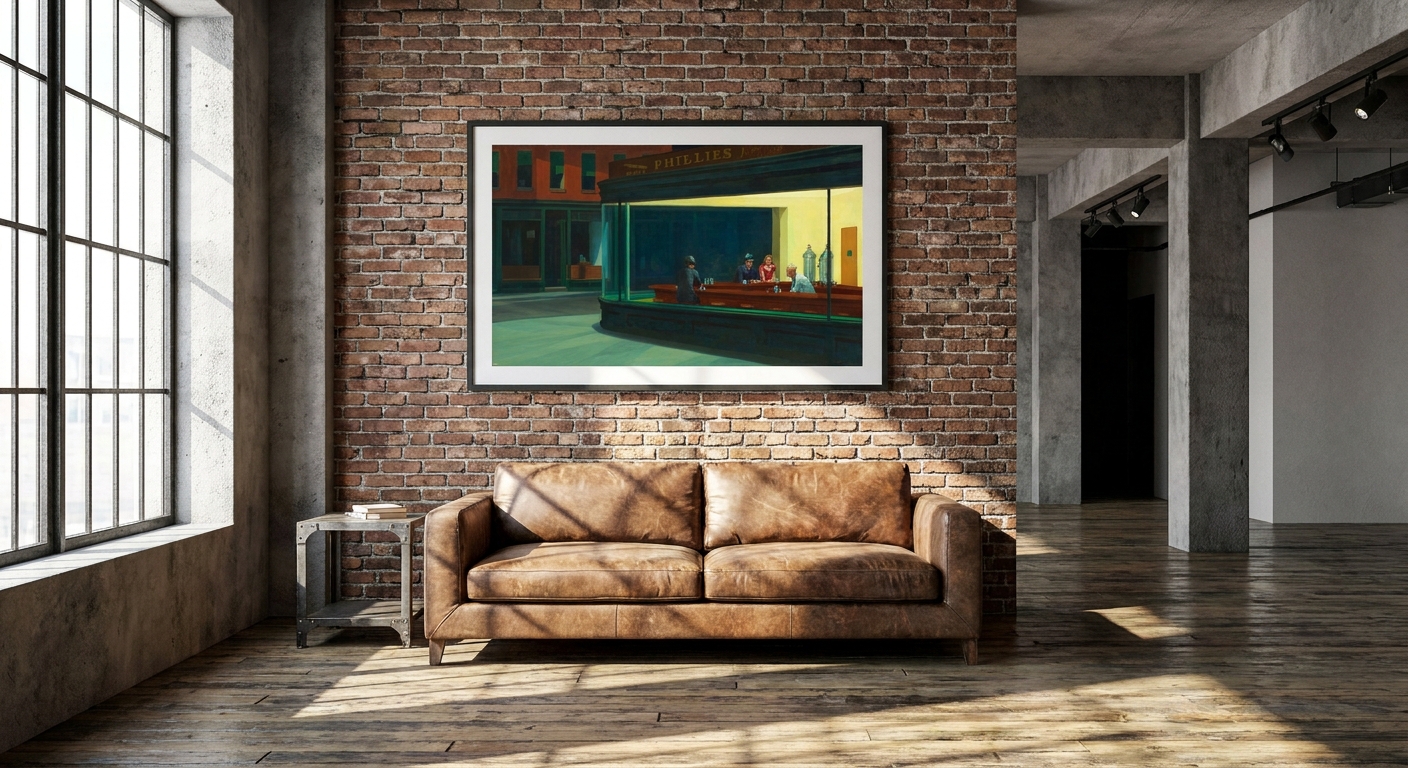
Industrial loft interiors—exposed brick, black steel beams, poured concrete floors—call for artwork that reads as quiet rather than loud, and Edward Hopper's urban realism is one of the few art movements built for exactly that palette. This guide breaks down which Hopper compositions suit high-ceiling, hard-surface rooms, what size and frame to choose, and which pieces to skip.
- Edward Hopper prints suit industrial lofts because his muted, ochre-and-teal palette matches raw brick and steel directly.
- Nighthawks and Gas read best on feature walls 100cm or wider — smaller prints get lost in high-ceiling rooms.
- Skip gilt or ornate frames on Hopper prints in a loft; thin black or raw timber keeps the era intact.
- Edward Hopper searches average 3,600 a month in Australia, proof the moody-urban look keeps trending into 2026.
Why this matters
Hopper spent his career painting solitude inside geometry — diner counters, gas stations, empty street facades lit by low artificial light. That's the same visual language a converted warehouse or factory-to-loft renovation already speaks. A Gioia collection built around canvas and framed prints gives loft owners a way to bring that mood in without fighting the architecture the way a busy floral or bright abstract would.
The difficulty score on "edward hopper" as a search term sits at effectively zero in 2026, which tells you the competition for ranking content is thin even though monthly demand (3,600 searches) is real. For a buyer, that just means Hopper's work is well documented and easy to source as reproduction prints — the hard part is choosing which composition and size actually work in a loft, not finding the artist.
Who this is for
This is for anyone styling a converted warehouse apartment, a factory-to-loft renovation, or a new-build with double-height ceilings and exposed services who wants a wall art choice that feels considered rather than decorative filler. If your space already has brick, blackened steel, or poured concrete doing the visual work, Hopper prints add narrative and light without adding clutter.
What to look for in Edward Hopper prints for industrial lofts
Palette that echoes raw materials
Hopper's colour range — brick red, mustard ochre, steel blue, deep teal shadow — sits directly on top of an industrial material palette instead of clashing with it. Look for reproductions that haven't been colour-corrected toward warmer, brighter tones; the muted, slightly desaturated originals are what make the pairing work.
Scale for high ceilings and long walls
Loft conversions often carry 3-metre-plus ceilings and long, uninterrupted brick or plaster runs. A print under 60cm reads as an afterthought on a wall that size. Go 100cm or wider on a single canvas, or commit to one oversized statement piece rather than a cluster.
Framing that doesn't compete with exposed hardware
Steel beams, black window frames, and visible ductwork already carry a hard-edged, industrial line. A heavy gilt or ornate frame around a Hopper print fights that language. Thin black metal frames, unframed stretched canvas, or raw timber read truer to both the era of the paintings and the room.
Mood and composition over decorative colour
Hopper's strength is atmosphere — solitary figures, artificial light against dusk, flat architectural geometry. Choose the composition for the mood it sets in the room (contemplative for a reading corner, cinematic for a lounge wall), not just for colour matching.
Print medium suited to brick and concrete walls
Canvas prints handle uneven brick mounting better than framed glass prints, which need a flatter surface to sit flush. If your loft wall is genuine exposed brick rather than a brick-look feature panel, canvas on a timber stretcher is the more forgiving choice.
Top picks: which Hopper works suit an industrial loft
Nighthawks (1942) — the icon. A late-night diner scene under fluorescent light, painted in 1942 and still Hopper's most reproduced work. At 100 x 70cm or larger on canvas, it anchors a loft lounge or bar nook the way a feature piece in a man cave setup would — cinematic, a little solitary, built for a hard-surfaced room. Buy for a feature wall over a low sofa or bar counter.
Gas (1940) — the quiet workhorse. A lone attendant at a rural service station at dusk, all flat planes and long shadow. It's less famous than Nighthawks but reads calmer in a smaller loft living area. At 80 x 60cm framed in thin black, it works as a single statement piece rather than part of a gallery grouping. Buy if you want mood without the diner-scene cliché.
Early Sunday Morning (1930) — the architecture-forward pick. A flat street facade of shopfronts in early light, almost abstract in its geometry. This one pairs specifically well with brick walls because the composition is literally a brick facade. At wide-format sizes (120cm+), it doubles as a feature wall centrepiece. Buy for lofts where the brick itself is the star.
Automat (1927) — the intimate one. A woman alone at a café table, warmer and more interior than Hopper's street scenes. It suits a reading nook or a narrower wall better than a double-height lounge. At 60 x 45cm, don't oversize this one — the intimacy is the point. Consider for smaller rooms only.
Office at Night (1940) — the moody one. Dramatic artificial lighting inside a spare, geometric office interior. It's the strongest option for a home office or study zone within a loft, less suited to a main living wall. Consider for a desk-adjacent wall, Skip for the primary lounge feature.


If you'd rather own an original than a Hopper reproduction, Nigel Bailey's suburban street and house studies carry the same flat light and solitude Hopper is known for, painted in acrylic on canvas panel rather than mass-produced print stock.
What to avoid
- Pastel Impressionist florals or soft watercolour landscapes — the colour temperature and subject matter fight brick and steel instead of sitting with it.
- Ornate gold or heavily carved frames — they read as period furniture, not gallery art, and clash with exposed hardware.
- Prints under 40cm on a double-height wall — the scale mismatch makes the piece look like it was hung as an afterthought rather than chosen.
Verdict comparison
| Artwork | Palette fit | Best wall size | Frame | Verdict |
|---|---|---|---|---|
| Nighthawks (1942) | Strong — teal/ochre | 100cm+ | Thin black or unframed | Buy |
| Gas (1940) | Strong — muted dusk tones | 80cm | Thin black | Buy |
| Early Sunday Morning (1930) | Strong — brick-toned | 120cm+ | Raw timber | Buy |
| Automat (1927) | Moderate — warmer interior | 60cm | Thin black | Consider |
| Office at Night (1940) | Moderate — high contrast | 60-80cm | Thin black | Consider |
For sizing beyond these five, the general rule for large canvas prints in Australian lofts applies just as well to Hopper reproductions as any other subject: measure the wall, not the furniture beneath it.
FAQ
What's the best Edward Hopper print for an industrial loft?
Nighthawks (1942) is the strongest pick for industrial lofts in 2026 — its diner-at-night palette of teal and ochre sits directly on top of brick and steel. Size it 100cm or wider so it holds its own on a high-ceiling wall.
Is Edward Hopper better than other artists for industrial interiors?
Hopper's muted, low-light urban palette suits industrial spaces more directly than brighter Impressionist or Fauvist artists. For comparison, Georgia O'Keeffe's warmer desert tones or Henri Matisse's bright colour blocking read better in bohemian or modern-warm interiors than in raw brick-and-steel rooms.
How much does a Hopper reproduction print cost in Australia in 2026?
Reproduction print pricing varies by size, canvas versus framed format, and finish, so check current pricing directly on the product page before buying. Larger canvas formats generally cost more than smaller framed prints.
What size Hopper print suits a loft with 3-metre ceilings?
Go 100cm or wider on a single canvas for a 3-metre-plus ceiling; anything under 60cm reads as too small against that much wall height. One oversized statement piece outperforms a small cluster in these rooms.
Should Hopper prints be framed or unframed for a loft?
Unframed stretched canvas or a thin black metal frame both work well against exposed brick and steel. Avoid ornate or gilt frames, which clash with the industrial hardware already in the room.
Does Edward Hopper's style work with exposed brick specifically?
Yes — Early Sunday Morning (1930) is literally a flat brick shopfront facade, making it one of the most direct pairings with a genuine exposed-brick loft wall. Its geometric, low-saturation composition matches brick tone almost exactly.
How many Hopper paintings exist for reproduction?
Edward Hopper produced fewer than 400 oil paintings across a roughly 60-year career, which is why reproduction prints are the practical way most collectors bring his work into a home. Nighthawks, Gas, and Early Sunday Morning are the most widely reproduced.
What wall art pairs with Hopper prints in a loft living space?
Keep companion pieces limited to one or two additional works in the same muted, geometric register rather than mixing in bright abstracts. A single large statement piece usually reads stronger in an open-plan loft than a full gallery wall.
One last thing
Hopper painted Nighthawks in 1942, just months after Pearl Harbor, and the empty, watchful mood of that diner scene is exactly why it still reads as "urban solitude" eighty-plus years later — that's the emotional weight a loft wall is actually buying, not just the colour palette. If you're choosing between the five picks above, size and frame decisions matter more than which specific Hopper composition you land on; get those two calls right and almost any of his major works will sit comfortably against brick and steel.