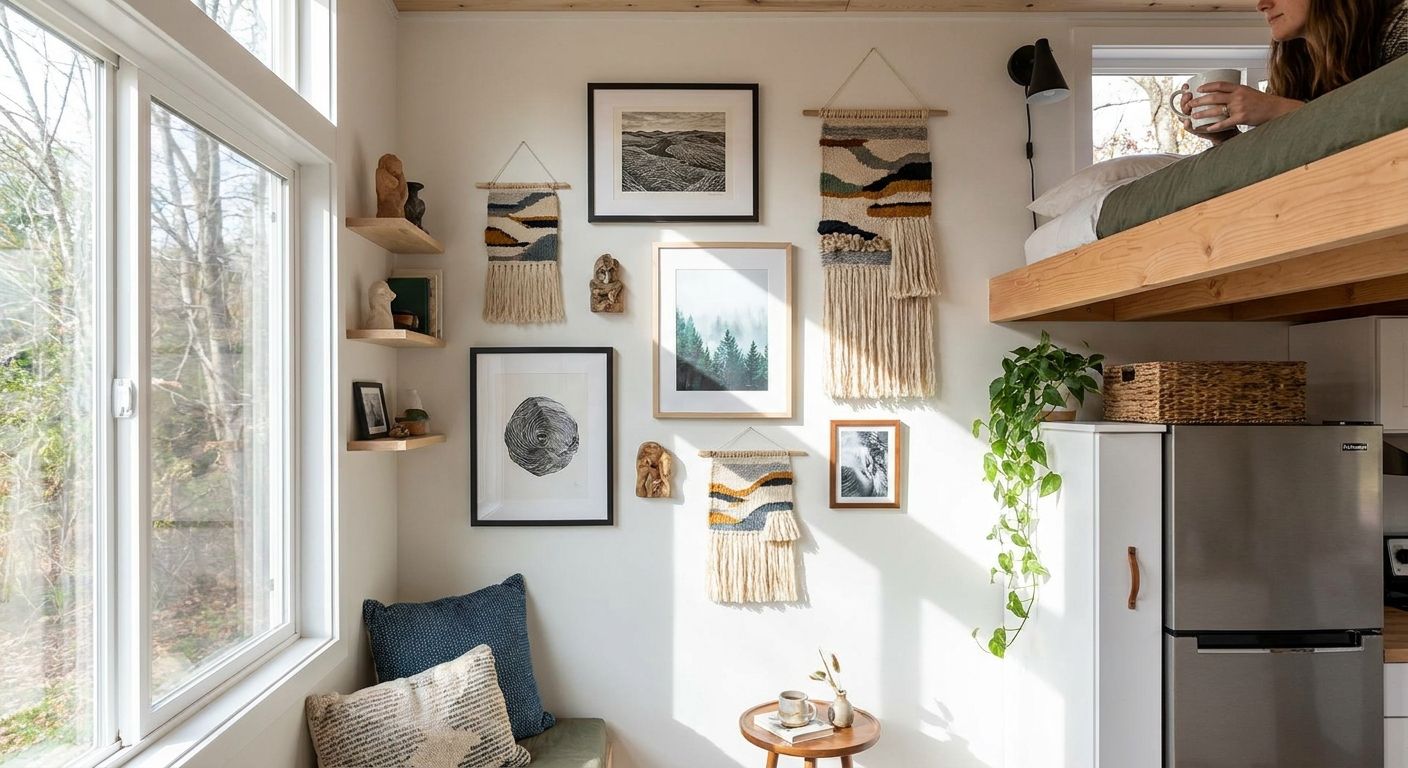
Wall art for tiny homes works when every piece earns its place on the wall, chosen for scale, colour and the illusion of extra square metres rather than just what looks good in a showroom shot. Tiny home dwellers deal with shorter wall runs, lower sightlines, and often a rental agreement that rules out drilling — so the rules that apply to a four-bedroom house don't transfer directly.
- Wall art for tiny home spaces works best as one confident piece, not a cluttered gallery wall.
- Vertical formats and lighter frames make low-ceiling rooms read taller in 2026 builds.
- Peel-and-stick options and unframed prints solve the rental problem without damaging tiny home walls.
- Gioia's canvas prints at $179.99 suit tiny homes needing one statement piece, not five small ones.
Why wall art matters for tiny home living
A tiny home has less wall to work with, so every piece of wall art carries more visual weight than it would in a standard house. Get the scale wrong and a room that's already compact starts to feel cluttered instead of considered.
Tiny home owners searching for wall art usually want two things at once: a design answer and a practical one. They're weighing colour and composition against low ceilings, tight furniture clearances, and — for anyone in a rental tiny home, caravan or granny flat — whether they can put a nail in the wall at all. That combination of style and constraint is what separates tiny home styling from a standard living room refresh, and it's why generic wall art advice doesn't always fit.
How to choose wall art for a tiny home
Measure your actual wall run before you shop
Most tiny home walls are shorter than they photograph, and buying art sized for a project-home wall is the fastest route to a return.
- Measure the full wall width, then subtract space for switches, vents and skirting boards
- Mark the intended art boundary with painter's tape and live with it for a day
- Note ceiling height — anything under 2.4m needs art that doesn't crowd the top edge
- Check the wall isn't broken up by a window, door or built-in that eats usable space
- Photograph the taped-out area from the doorway to see how it reads at a glance
Choose one statement piece over a gallery wall
Gallery walls need several metres of uninterrupted wall to breathe, and most tiny homes don't have that kind of run. One well-scaled piece almost always beats five small frames in a compact room.
- Pick a single canvas or framed print sized to roughly two-thirds of the wall width
- Skip multi-frame gallery sets unless the wall is genuinely 2m or wider
- Centre the piece over the key furniture item — sofa back, bed head or dining table
- If you want more than one work, stack two vertically instead of spreading wide
- Leave at least 10cm of breathing room either side of the frame
If you're deciding between a small apartment layout and a genuine tiny home footprint, the sizing logic in wall art for small apartments carries over directly — the wall math doesn't change much between the two.
Pick colours that extend the room, not just decorate it
Colour choice does more work in a tiny home than in a larger one, because there's less negative space to soften a bold print.
- Favour tonal palettes that echo the wall colour rather than fighting it
- Save high-contrast, busy prints for a single accent wall, never every wall
- Test warm neutrals and muted botanicals — they read calm in low light
- Avoid dark, heavy frames on already-dim walls; they shrink the room visually
- Use one print with a lighter background to bounce daylight around the space
Use vertical formats to draw the eye upward
A tall, narrow print does more to lift a low ceiling than a wide horizontal one ever will.
- Choose portrait-orientation canvas or framed prints over landscape formats where ceilings are under 2.4m
- Hang the top edge closer to the ceiling than eye level to stretch the wall visually
- Pair a vertical print with a narrow console or shelf, not a wide sideboard
- Avoid oversized square prints on narrow walls — they read as a block, not a feature
Choose rental-safe hanging methods
A large share of tiny home living happens in rentals, granny flats or short-stay setups where drilling isn't an option.
- Use adhesive strips rated for the weight of the frame, not just the canvas size
- Choose unframed or lightweight canvas prints to keep total weight low
- Lean a large piece against the wall on a shelf or picture ledge instead of hanging it
- Peel-and-stick wallpaper panels work as a feature without a single hole in the wall
- Keep original packaging if you're likely to move the piece again within the year
For a full rundown built specifically around this constraint, posters for renters who can't drill into walls covers the hanging hardware options in more depth than a general styling guide will.
Size art to the furniture beneath it, not the wall
The wall is rarely the real constraint in a tiny home — the furniture sitting under the art is.
- Keep the print width at 60-75% of the furniture piece it sits above
- Measure from the top of the sofa or bed head, not the skirting board
- Leave 15-20cm of clearance between the top of the furniture and the bottom of the frame
- If the furniture is narrow, a vertical print will always outperform a wide one
Getting the ratio right is worth the extra five minutes with a tape measure — the full method is broken down in how to choose the right size wall art for your wall.
Wall art options for tiny homes compared
| Option | Best for | Space impact | Key limitation |
|---|---|---|---|
| Canvas print | A single statement piece over a sofa or bed | Low — no frame bulk, hangs flush | Can't be swapped as easily once hung |
| Framed print | Renters who want a finished look without buying a frame separately | Medium — frame adds a few cm of depth | Heavier, needs a stronger wall anchor |
| Unframed print | Anyone who wants to reframe later or rotate seasonally | Low — flexible, light to hang and move | Needs separate framing to look finished |
| Peel-and-stick wallpaper | A feature wall in a caravan, granny flat or short-stay rental | Zero drilling, fully reversible | Best for one accent wall, not a whole room |
| Poster | Budget-first styling or a temporary share-house wall | Very low — pins or tape only | Least durable, shows wear over 2026-era humidity swings |
Verdict: canvas prints win for a permanent tiny home wall, peel-and-stick wins for anyone renting and moving within the year.


Common mistakes tiny home owners make with wall art
- Buying oversized statement art for a narrow wall. A piece scaled for a project home swallows a tiny home wall instead of anchoring it.
- Hanging a gallery wall in a room with no spare wall to give it. Multi-frame layouts need metres of clearance most tiny homes simply don't have.
- Drilling into a rental tiny home or caravan wall without checking the lease. Adhesive-mount and lean-and-lean options exist for a reason.
- Ignoring the sightline from the kitchen or loft. In an open-plan tiny home, art gets viewed from odd angles — check it from every seat, not just standing in front of it.
- Choosing heavy dark frames in a room with limited natural light. They read as a hole in the wall rather than a feature.
FAQ
What's the best wall art size for a tiny home?
Size the piece to roughly two-thirds the width of the furniture beneath it, not the full wall. In a tiny home this usually means a single medium canvas rather than an oversized statement print.
Is canvas or framed wall art better for a small space?
Canvas prints sit flush against the wall and add no visual bulk, making them the better default for a tiny home. Framed prints look more finished but add depth and weight, which matters on a narrow wall.
How do I hang wall art in a tiny home rental without damaging the walls?
Use adhesive strips rated for the frame's weight, or lean lightweight canvas prints on a picture ledge instead of drilling. Peel-and-stick wallpaper panels are also fully reversible for feature walls.
Can peel-and-stick wallpaper work in a tiny home?
Yes, peel-and-stick wallpaper works well on a single accent wall in a tiny home, granny flat or caravan because it needs no drilling and comes off cleanly. It's best kept to one wall rather than the whole room.
How much wall art is too much in a small room?
If you can't stand at the doorway and take in the whole wall in one glance, there's too much art. One statement piece per wall is the safer rule for a tiny home.
Should I use one large piece or a gallery wall in a tiny home?
One large piece almost always works better in a tiny home because gallery walls need several metres of uninterrupted space to read properly. Stick to a single canvas or a stacked pair of two vertical prints instead.
What colours make a small room feel bigger with wall art?
Tonal palettes that echo the wall colour, plus prints with lighter backgrounds, help a small room feel larger by bouncing available light. Save high-contrast, busy prints for a single accent wall.
Does wall art placement affect how tall a tiny home ceiling looks?
Yes — hanging a vertical print with its top edge close to the ceiling line stretches the wall visually and makes a low ceiling feel taller. Wide horizontal prints do the opposite.
One last thing
The single biggest lever in tiny home styling isn't the art itself — it's the top edge placement. Push the frame's top edge to within 15-20cm of the ceiling line instead of centring it at standard eye height, and a 2.3m ceiling reads noticeably taller from the doorway. It costs nothing and takes ten extra minutes with a spirit level.