Walk-in wardrobes are the smallest room you'll ever style seriously, and most wall art gets the scale wrong before it even leaves the box. This guide breaks down what actually works in a dressing space and names the specific pieces worth buying in 2026.
- Small-format original art under 60cm wins in walk-in wardrobes — oversized canvas eats hanging space. Buy.
- Matte or unframed pieces beat glass-framed prints under LED strip lighting — glare kills the effect.
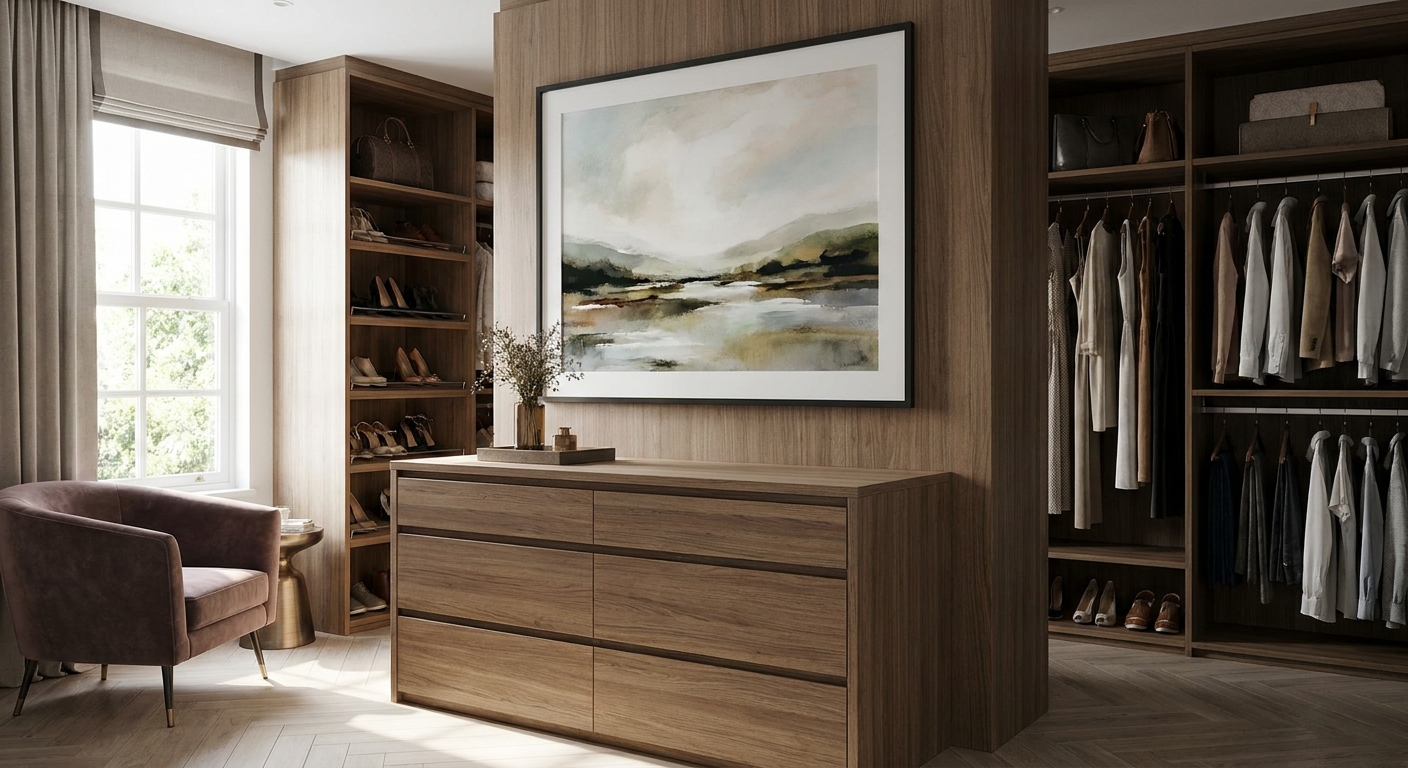
- Four Plums (43.2cm x 35.6cm) and Luminous Wild (40cm x 30cm) fit above a dresser or vanity nook without crowding it.
- Soft abstracts in neutral or warm tones read better against fabric and timber than high-contrast photography.
Why this matters
A walk-in wardrobe is a transition room. You're in it for two minutes at a time, usually under artificial light, usually looking at a mirror as much as a wall. That changes every rule that applies to a living room or hallway.
Most people buying wall art for a walk-in wardrobe make the same mistake: they treat it like a mini bedroom and hang whatever leftover canvas didn't fit elsewhere. The result is either an oversized piece that blocks a shelf, or a glossy framed print that throws glare straight back at the dressing mirror. Gioia Wall Art sees this pattern constantly in the small-format and original-art categories, where dimensions under 60cm dominate demand from dressing-room and ensuite-adjacent spaces.
Who this is for
This guide is for anyone finishing a walk-in wardrobe, dressing room, or robe-and-vanity nook and looking to add one or two pieces of wall art without cluttering a functional space. That includes renovators fitting out a new build in 2026, downsizers converting a box room into a dressing area, and anyone tired of staring at bare gyprock while getting dressed.
If you're decorating a full bedroom rather than the wardrobe itself, the sizing and glare rules below still apply, but you'll want more scale — that's a different brief entirely.
What to look for in wall art for walk-in wardrobes
Scale that respects the footprint
Most walk-in wardrobes run 4 to 8 square metres, with wall space broken up by shelving, hanging rails, and a mirror. A single piece between 30cm and 60cm wide is the sweet spot — anything larger competes with joinery rather than complementing it.
Glare control under artificial light
Walk-in wardrobes almost never get natural light, so they run on LED strips or downlights all day. Glossy glass framing bounces that light straight back at eye level. Matte finishes, canvas, and unframed prints absorb light instead of reflecting it.
Framing that won't catch on doors or rails
A framed print with a protruding edge is a hazard in a room where you're moving quickly with hangers in hand. Flush canvas or slim-profile frames sit closer to the wall and avoid snagging.
Colour that sits behind the clothes, not against them
Wardrobes are full of colour and texture already — fabric, leather, timber joinery. Busy or high-contrast prints fight all of that. Soft abstracts and muted landscapes let the space breathe.
Placement that survives daily traffic
Above a dresser, in a door reveal, or on the one dead wall opposite the mirror are the three spots that actually work. Anywhere within arm's reach of a rail gets knocked eventually.
Moisture tolerance near ensuites
If the walk-in wardrobe backs onto a bathroom, humidity creeps in. Acrylic-on-canvas originals handle this better than unsealed paper prints, which can ripple over a year or two.
Top picks for 2026
The safe pick — Four Plums. A colour pencil original at 43.2cm x 35.6cm, small enough to sit above a dresser without crowding the shelf below. The muted fruit palette reads calm under LED lighting rather than clashing with it. Buy.
The textural wildcard — Luminous Wild. A 40cm x 30cm acrylic abstract with warm gold accents and heavy texture — it catches downlights instead of reflecting them flat, which is exactly what a glossy print can't do. Buy.
The quiet layer — Go Gently. A 60cm x 60cm soft abstract in purple, pastel pink, and Payne's grey. It's on the larger end for a wardrobe wall, so it suits the single dead-wall spot opposite a mirror rather than a tight dresser nook. Consider.
The framed option — Flowers Falling From the Sky. Canvas at 30cm x 40cm, framed size 33cm x 43cm in Native Mahogany, with acrylic and gold foil detail. The frame is slim enough to avoid snagging, but skip it if your wardrobe already runs warm gold hardware — it'll compete rather than complement. Consider.


“If a canvas print is bigger than your dresser, it's fighting your storage, not decorating it.”
What to avoid
- Oversized statement canvas. A 100cm+ piece looks right in a showroom photo and wrong the moment it blocks a shelf or a rail in your actual wardrobe.
- Heavy glass framing near a dressing mirror. Two reflective surfaces facing each other under LED light is a glare trap, not a feature wall.
- High-contrast photography in a small footprint. Bold black-and-white or saturated prints demand more wall space than a wardrobe usually has to give.
If your space is rented rather than owned, the framing question gets more restrictive again — check the peel-and-stick wallpaper for renters options before drilling anything into a robe wall you don't own.
Verdict comparison table
| Pick | Size | Finish | Best spot | Verdict |
|---|---|---|---|---|
| Four Plums | 43.2cm x 35.6cm | Unframed, matte | Above dresser | Buy |
| Luminous Wild | 40cm x 30cm | Textured acrylic | Dead wall, LED-lit | Buy |
| Go Gently | 60cm x 60cm | Unframed canvas | Opposite mirror | Consider |
| Flowers Falling From the Sky | 30cm x 40cm framed | Slim mahogany frame | Door reveal | Consider |
FAQ
What's the best wall art for a walk-in wardrobe?
Small-format originals or canvas prints between 30cm and 60cm wide work best in a walk-in wardrobe. Larger pieces crowd shelving and hanging rails, which is the main complaint with wardrobe wall art in 2026.
What size art should I use in a walk-in wardrobe?
Stay under 60cm on the longest side for most walk-in wardrobes, which typically run 4 to 8 square metres. A single dead wall opposite a mirror can take up to 60cm x 60cm without crowding the space.
Should wall art in a wardrobe be framed or unframed?
Unframed canvas or matte-finish pieces are better in a walk-in wardrobe because glass framing reflects LED strip lighting straight back at eye level. A slim, low-profile frame is fine if you prefer framed work.
Can I hang canvas prints in a walk-in wardrobe?
Yes, acrylic-on-canvas originals handle the humidity of a wardrobe backing onto an ensuite better than unsealed paper prints, which can ripple within a year or two.
Is glass-framed art safe in a wardrobe?
Glass framing is workable but risky near a rail or door swing, since a protruding frame edge can snag hangers. Flush canvas avoids the problem entirely.
What colours work best for wardrobe wall art?
Soft, muted palettes read better than high-contrast prints because a wardrobe already has colour and texture from fabric, leather, and joinery. Abstracts in warm neutrals or pastels sit behind the clothes rather than fighting them.
How much does small original art cost in Australia in 2026?
Small original works in the 40cm to 60cm range typically sit between $400 and $1,500 in 2026, depending on medium and artist. Colour pencil and acrylic-on-canvas-panel pieces sit at the lower end of that band.
Where should I hang art in a walk-in wardrobe?
Above a dresser, in a door reveal, or on the single dead wall opposite a mirror are the three spots that survive daily traffic. Avoid any wall within arm's reach of a hanging rail.
One last thing
The piece that gets the most compliments in a walk-in wardrobe usually isn't the biggest one — it's the one with texture, because texture is what catches under a downlight when there's no window in the room. Luminous Wild's acrylic build does exactly that at 40cm x 30cm, which is why it outperforms flat photographic prints in this specific room type.