Direct sun is the fastest way to turn a $2,000 canvas into a faded, warped mess — and in Australia's climate, most living rooms get more UV exposure than owners realise. This guide walks through the exact fixes that stop fading, yellowing and warping before they start, in 2026 and beyond.
- Reposition canvas prints at least 1-1.5 metres from unfiltered glass to cut direct UV exposure significantly.
- UV-filtering window film or block-out blinds on north and west-facing windows is the single most effective fix for 2026 homes.
- Rotate valuable pieces every 6-12 months so fading, if it happens, stays even across the collection.
- Original paintings and premium canvas prints need UV-protective varnish or glazing, not just curtains.
- Outdoor or alfresco walls need weather-rated prints — standard canvas fails fast in direct sun and humidity.
Why this matters
Australia's UV index regularly hits 11+ across capital cities in summer, according to Cancer Council Australia's UV ratings — and that intensity comes through glass, not just open air. Canvas prints are cotton or polyester fibre coated in pigment ink or paint, and pigment breaks down under prolonged UV exposure the same way fabric and upholstery do.
The damage is rarely obvious in month one. It shows up 12-18 months later as a wall of paint that's noticeably brighter where a frame used to sit, or a canvas edge visibly duller than its centre. For rooms that catch afternoon sun, the fix has to happen before the print goes up — not after the fade line appears. Rooms styled for outdoor and alfresco spaces carry the highest risk of all, since UV and humidity hit at the same time.
What you'll need
- A UV index reference or weather app to track peak sun hours (typically 10am-3pm in Australian summer)
- UV-filtering window film, or block-out/day-night blinds for north and west-facing windows
- Sheer curtains for midday light control without total blackout
- UV-protective glazing (glass or acrylic) for framed prints, or UV-resistant varnish for original paintings
- A tape measure to check distance from glass
- A basic compass app, if you don't already know which walls face north or west
The steps
1. Map your room's sun path over one full day
Before moving anything, spend one day in 2026 watching how light actually crosses the room — not how you assume it does. Note the time direct sun hits each wall and how far the beam reaches across the floor at its worst point, usually midday to mid-afternoon.
This step gets skipped constantly, and it's why people rehang art in the wrong spot twice. Expected outcome: a rough sun map showing which walls are safe year-round and which only catch light seasonally.
Common mistake: checking the room once in the morning and assuming it's sun-safe, when the real exposure hits at 2pm.
2. Reposition prints at least 1-1.5 metres from unfiltered glass
Direct beam contact is worse than ambient brightness. A canvas sitting inside the direct sun path fades far faster than one further back in the same room, even without curtains.
Move pieces to the side wall or an internal wall where possible, especially anything original or high-value. Expected outcome: noticeably slower colour shift over the following 12 months. Common mistake: assuming a few centimetres of extra distance makes a real difference — it usually doesn't; you need at least a metre of separation from the glass line.
3. Fit UV-filtering film on north and west-facing windows
This is the single highest-leverage fix on this list. UV-filtering film sits on the glass itself, cutting the UV load reaching the room without dramatically changing how much visible light comes through.
Get it professionally installed if the window is large or curved — DIY film on big panes bubbles and peels within a season. Expected outcome: a room that stays bright but the print inside it fades at a fraction of the previous rate. Common mistake: installing film only on the window the sofa faces, and missing the west-facing window that hits the same wall at 4pm.
4. Choose UV-protective glazing or varnish for valuable pieces
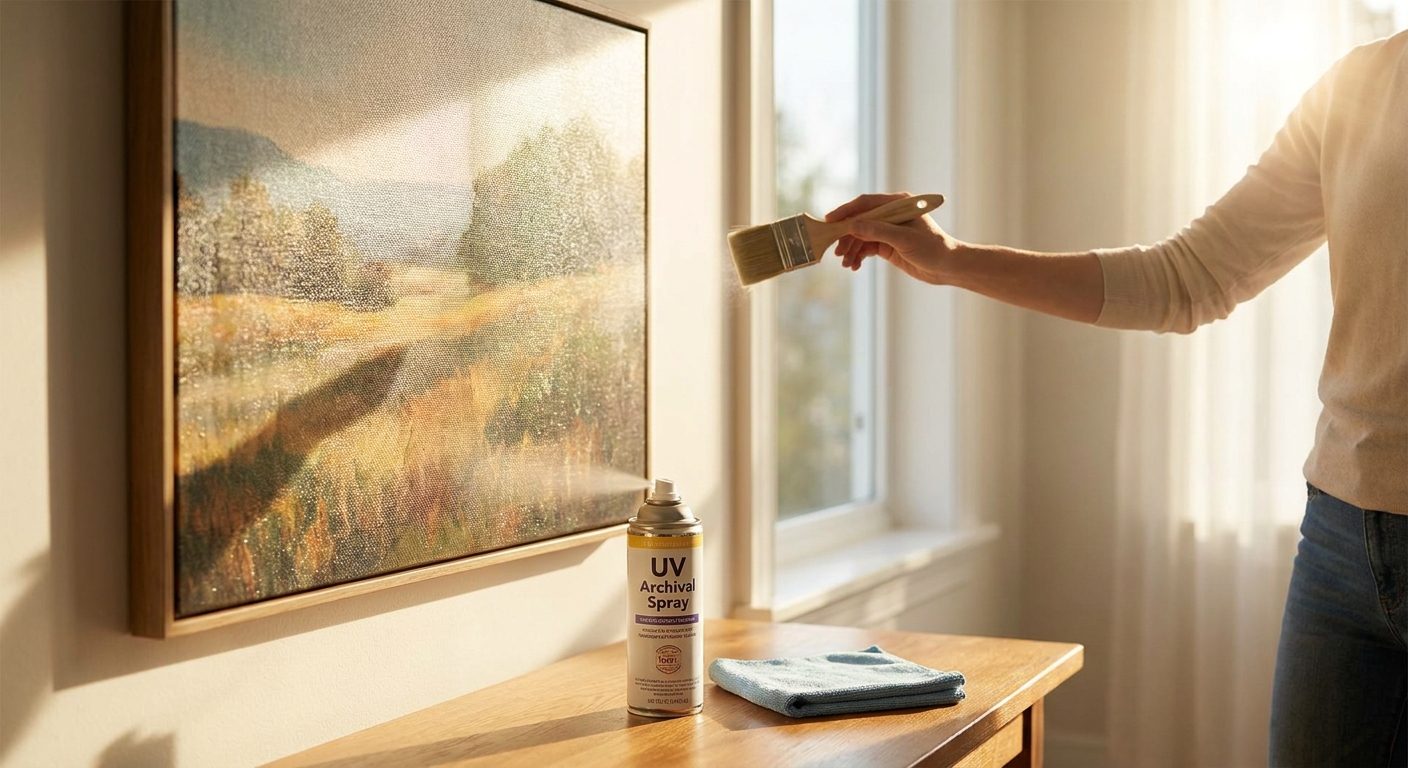
Framed prints and original paintings need a second layer of defence beyond window treatment. UV-protective glass or acrylic glazing sits directly over the print; a UV-resistant varnish does the same job on an unframed original.
This matters most for pieces like large original paintings, where a full reprint isn't possible if the piece fades. Expected outcome: measurable slowdown in colour shift even in rooms that still get some ambient UV. Common mistake: varnishing over dust or fingerprints, which seals imperfections into the surface permanently.
5. Rotate and rehang pieces every 6-12 months
Even with every precaution above, some UV gets through. Rotating pieces between a sun-facing wall and a shaded wall spreads the exposure evenly, so no single piece bears the full load.
This is standard conservation practice for galleries handling light-sensitive originals. Expected outcome: a collection that ages evenly instead of showing one obviously faded standout. Common mistake: rotating decor pieces but forgetting the one large statement canvas that's been in the same spot since it went up.
6. Add sheer curtains or adjustable blinds for midday control
Window film handles UV, but visible light and heat still build up in a room during peak hours. Sheer curtains or adjustable blinds give you a second control layer you can use daily without losing natural light entirely.
Expected outcome: a room that stays comfortable and bright without direct beam contact on the walls. Common mistake: choosing full blackout blinds and defeating the point of hanging art in a bright room in the first place — sheer fabric is the better trade-off here.
7. Keep standard canvas off exterior and alfresco walls
Standard canvas prints aren't built for outdoor humidity and direct sun combined. If you're styling a covered patio or alfresco area for 2026, that wall needs a weather-rated print, not a repositioned indoor canvas.
Expected outcome: artwork that survives a full Australian summer outdoors instead of warping within weeks. Common mistake: assuming a covered patio counts as "indoors" for UV purposes — covered doesn't mean shaded from reflected glare.
Original paintings need the most protection
Original, one-off pieces carry the highest replacement cost if sun damage sets in, which makes UV planning non-negotiable before they go on a bright wall.


Troubleshooting
- The print already shows uneven fading. There's no reversing pigment breakdown on the surface. Rotate the piece to a shaded wall to stop further damage, and treat visible fading as a signal to reprint that piece rather than repair it.
- The canvas has started to warp or bow. Heat, not just UV, causes stretcher bars to expand and contract. Move the piece away from direct heat sources like radiators or west-facing glass, and check the wall isn't a shared surface with an exterior brick wall that heats up in summer.
- The frame or mount board has yellowed. Standard mount board isn't acid-free and discolours under UV faster than the print itself. Swap to acid-free matting next time you reframe, and keep the piece off direct-sun walls in the meantime.
- UV film has started peeling or bubbling at the edges. This is almost always a DIY install issue on a large or curved pane. Get it reinstalled professionally rather than patching the peeling section.
- Blinds or curtains make the room feel dark all day. Full blackout treatments overcorrect. Switch to sheer curtains layered with adjustable blinds so you get midday UV control without losing natural light in the evening.
Tools and resources
When choosing new pieces for a bright room, factor sun exposure into the print itself, not just the window treatment. Larger statement pieces need to be planned around the room's actual light, which is covered in the guide to best canvas prints in Australia for large walls. Pair that with a UV-filtering film supplier and, for anything original or high-value, a professional framer who stocks UV-protective glazing.
What to do next
Once the room is sun-safe, the next risk is a heavy original or oversized canvas coming loose from the wall. Get the hanging hardware right before you commit to a final position — the full breakdown is in how to hang heavy canvas prints safely.
FAQ
How do you protect canvas prints from sun damage?
Keep canvas prints at least 1-1.5 metres from unfiltered glass, fit UV-filtering film on north and west-facing windows, and rotate pieces every 6-12 months. Original paintings need UV-protective varnish or glazing as a second layer of defence.
Does UV-filtering window film actually work for art?
Yes — it's the highest-leverage fix for a sun-facing room because it cuts UV at the glass before it ever reaches the wall. Professional installation matters on large or curved panes, since DIY film often bubbles within a season.
Can canvas prints be hung near a window in Australia?
They can, but not in the direct beam path during peak sun hours, roughly 10am to 3pm. A side wall or internal wall in the same room is almost always safer than the wall directly opposite unfiltered glass.
How long does it take for sun to fade a canvas print?
Visible fading typically shows up 12-18 months after consistent direct exposure, though rooms with UV index readings of 11+ in summer accelerate that timeline. Prints positioned in the direct beam path fade noticeably faster than shaded walls in the same room.
Is glass or acrylic better for UV protection on framed prints?
Both work when rated as UV-protective glazing — the material matters less than whether it's specifically UV-filtering rather than standard clear glass or acrylic. Standard glazing offers close to no UV protection on its own.
Do original paintings need different protection than canvas prints?
Yes — originals can't be reprinted if they fade, so UV-resistant varnish or glazing is worth the extra step. A standard canvas print can be reordered; a one-off original painting can't.
Can canvas art go on an outdoor or alfresco wall?
Standard canvas fails fast outdoors because direct sun and humidity hit at the same time. Alfresco walls need weather-rated prints specifically built for outdoor conditions, not a repositioned indoor canvas.
Should I rotate wall art to prevent fading?
Rotating pieces between sun-facing and shaded walls every 6-12 months spreads UV exposure evenly across a collection. It won't stop fading entirely, but it prevents one piece from becoming an obvious faded outlier.
One last thing
The wall that fades fastest usually isn't the one directly facing the window — it's the wall the afternoon sun swings onto later in the day, the one nobody thinks to check until the print's already two shades lighter than it started. Map the full day before you commit to a final hanging spot in 2026, not just the morning light.