Buying an original painting is a different transaction than buying a print — you're paying for a one-off object, and there's no way to check the price against a hundred identical copies. Here's how to work out whether the number on the tag reflects real value or just confident pricing.
- Provenance paperwork and a verified signature are non-negotiable before you pay for an original painting in 2026.
- Cross-check the artist's recent sale prices — a $2,000 asking price with no comparable sales history is a red flag.
- Canvas texture and visible brush strokes separate a hand-painted original from a printed reproduction sold as one.
- Framing, transport and insurance can add 15-25% on top of the painting price — budget for it upfront.
- For pieces under roughly $500, a curated original from a store like Gioia Wall Art is often better value than an unverified private sale.
Why this matters
Original paintings don't have a fixed retail price the way a mass-produced canvas print does. Two paintings the same size, by two different unknown artists, can sell for $200 or $2,000 depending entirely on provenance, technique and demand — and most buyers have no framework for telling the difference.
Get it wrong and you've either overpaid for decoration dressed up as investment art, or walked away from a genuinely good piece because you didn't know how to check it. The steps below give you a repeatable process, not guesswork.
What you'll need
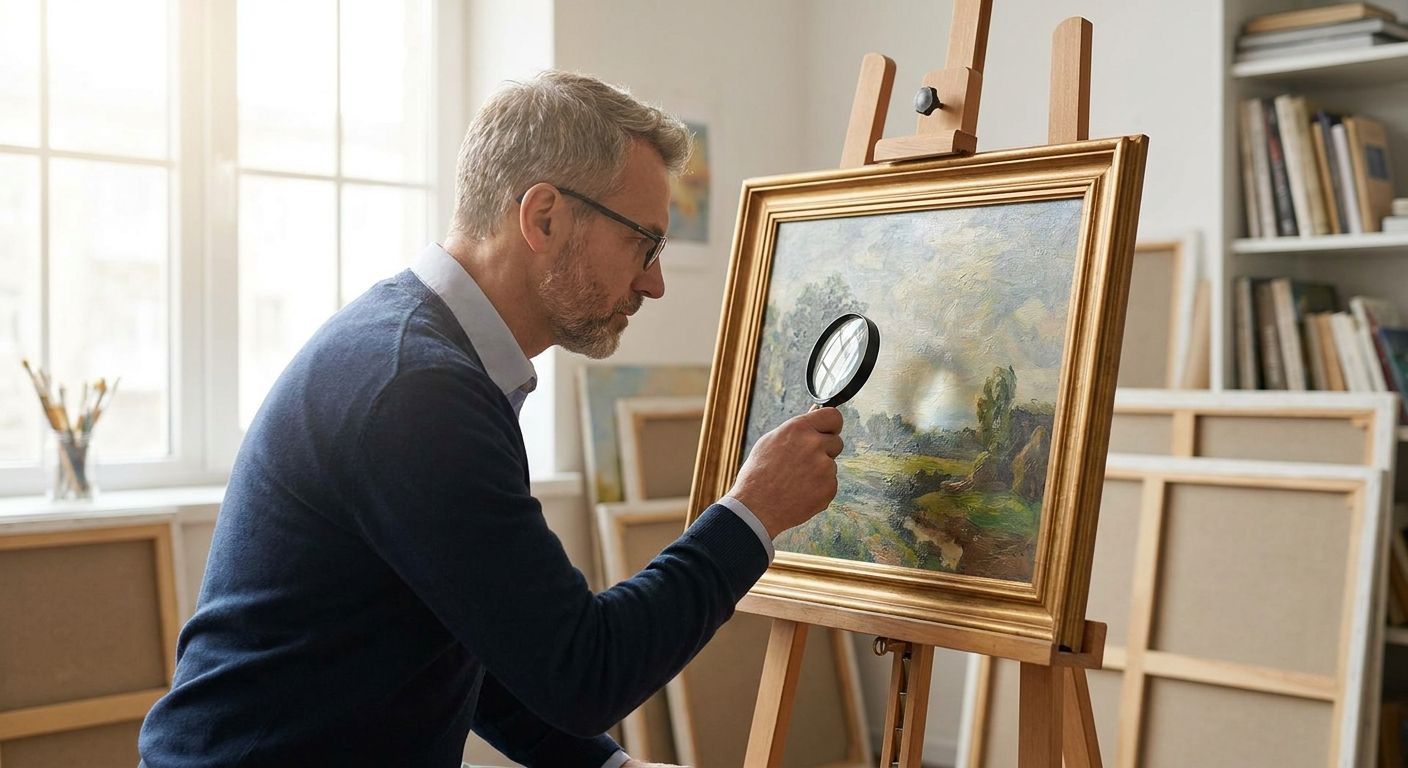
- A magnifying glass or your phone camera zoomed in, for checking brush texture and signature detail
- Access to the artist's website, Instagram or gallery representation page
- 15-20 minutes to search recent comparable sales
- The seller's documentation: certificate of authenticity, invoice, or provenance letter
- A tape measure, to confirm the painting's actual dimensions match the listing
- A budget ceiling before you start — decide the maximum you'll pay before emotion enters the room
If you're weighing an original against a gallery-curated print for the same wall, have that comparison in mind before you commit to the original's price tag.
The steps
1. Check the provenance paperwork first
This tells you whether the painting is what the seller says it is. Ask for a certificate of authenticity, a signed invoice from the original sale, or a gallery provenance letter — any documented chain of ownership.
No paperwork isn't automatically a dealbreaker for a $150 piece from an emerging artist, but it's a hard stop for anything priced above $1,000. Common mistake: accepting a verbal assurance that the artist confirmed it's real as a substitute for a written record.
2. Research the artist's market history
Search the artist's name plus "sold" or "auction" to find what comparable works have actually fetched, not just what's currently listed. Australian auction record databases like the Australian Art Sales Digest track historical hammer prices for artists who've sold through auction houses.
If an artist has no sales history at all, you're pricing on reputation and gut feel, not market data — which is fine for a decorative purchase, but means you should treat the price as negotiable rather than fixed. Expected outcome: you'll find either a price range that validates the asking price, or a gap that tells you to push back.
3. Inspect the physical surface, not just the photo
Zoom in on brush strokes, paint thickness and canvas texture. Genuine oil or acrylic originals show raised paint, visible brush direction and slight surface inconsistency — a printed reproduction sold as an original will look uniformly flat under close inspection, even with a textured varnish layer added to fake it.
Run your fingers lightly across the surface if you're viewing in person. Common mistake: judging authenticity from a listing photo alone — flat lighting hides texture completely.
4. Compare against similar works, same size and medium
A 60x90cm acrylic on canvas should be benchmarked against other 60x90cm acrylics, not against a 30x40cm piece by the same artist. Size drives price more than almost any other factor in original painting sales.
If you're also considering an appropriately sized print for the same wall, use that sizing logic here too — a painting priced per square centimetre well above comparable works needs a reason (established reputation, rare subject matter, gallery backing) or it's overpriced.
5. Get a written appraisal above your comfort threshold
For anything above roughly $2,000-$3,000, a formal appraisal from an independent valuer is worth the fee. This matters most for insurance purposes and resale intent, less so for a piece you're buying purely because you love it for your living room.
Expected outcome: a written valuation you can reference later, whether for insurance, resale, or simply peace of mind that you didn't overpay in 2026 for a piece worth half that in 2027.
6. Price in framing, transport and insurance
An unframed original often needs professional framing, which adds real cost on top of the painting itself. Factor in courier or freight costs for anything over roughly 80cm, and check whether the seller insures the piece in transit.


7. Weigh decorative value against resale value
Most people buying an original painting for their home in 2026 are buying it to live with, not to flip. If that's you, the honest question isn't whether it will appreciate — it's whether this price feels fair for something you'll look at every day for the next decade.
A painting that fails as an investment can still be a good purchase if the price matched the enjoyment, not the auction potential. Common mistake: talking yourself into an inflated price because a seller framed it as an investment piece with no data behind that claim.
Troubleshooting
The seller can't produce any documentation. Walk away above $1,000; below that, ask for a signed statement of authenticity on the spot before paying.
The price seems high compared to the artist's other listed sales. Ask directly why — gallery representation, award history or a rare subject can justify it, but one of a kind alone doesn't, since every original painting is technically one of a kind.
The surface looks too flat or uniform under close inspection. Request a video of the actual piece under different lighting angles before paying anything, especially for online-only purchases.
The signature doesn't match other verified examples from the same artist. Treat this as a serious flag and ask for provenance paperwork immediately — inconsistent signatures are one of the most common issues in overpriced or misattributed originals.
No appraiser is available in your area or timeframe. Get a written condition and comparable-sales report from a local gallery instead; it won't carry the same weight as a formal valuation but it's better than nothing before a large purchase.
There's no return policy on an expensive original. Negotiate a short inspection period in writing before finalising payment, particularly for private sales rather than gallery purchases.
Tools and resources
- Certificate of authenticity or provenance letter from the seller
- Artist's own website, gallery page or verified social profile for cross-checking signature and style
- Australian Art Sales Digest or similar auction record databases for comparable pricing
- A local independent valuer for pieces above your comfort threshold
- Curated collections like Gioia Wall Art's original paintings range if you'd rather buy from a source that's already vetted the artist and pricing
If you're leaning toward buying safely-sourced rather than chasing a private sale, browsing original paintings for sale online in Australia removes most of steps one through four from your workload — the provenance and pricing work is already done.
What to do next
Once you've settled on a piece, the next decision is where it goes and how it's hung. If you're dealing with a large or heavy original, check the guide on hanging heavy canvas prints safely before you drill anything — original paintings are irreplaceable in a way a printed canvas isn't, and a bad wall fixing is the most preventable way to damage one.
FAQ
How to value an original painting without a professional appraiser?
Check the provenance paperwork, research the artist's recent comparable sales, and inspect brush texture up close before paying. This covers most of what a formal appraisal confirms for pieces under roughly $2,000.
What's the best way to tell a real painting from a printed reproduction?
Look for raised paint texture and visible brush strokes under close inspection or zoomed-in photos. A genuine original will show surface inconsistency that a flat print, even with a textured varnish, can't replicate.
Is an original painting always worth more than a limited edition print?
Not necessarily — an unverified original with no provenance can be worth less than a well-documented limited edition print from an established artist. Value comes from documentation and demand, not medium alone.
How much does it cost to get a painting appraised in Australia?
Independent valuer fees vary by region and complexity, so get a quote before committing for pieces above roughly $2,000-$3,000. Below that threshold, a documented comparable-sales check is usually sufficient.
Should I buy an original painting online without seeing it in person?
Only if the seller provides high-resolution close-up photos or video and a certificate of authenticity. For expensive pieces, ask for a short inspection period in writing before finalising payment.
What documentation should come with an original painting purchase?
A certificate of authenticity, a signed invoice, and ideally a provenance letter showing the ownership history. Missing paperwork on anything above $1,000 is a reason to negotiate the price down or walk away.
Does frame quality affect an original painting's value?
Framing affects presentation and protection but not the painting's underlying value — a poor frame on a good original is a fixable cosmetic issue, not a pricing red flag.
How do I know if an artist's asking price will hold up over time?
Check whether the artist has a consistent sales history and gallery representation rather than a single high listing. Artists with no track record are priced on reputation, which can shift quickly in either direction.
One last thing
The single biggest overpricing pattern in the original painting market isn't fake signatures — it's artists with exactly one comparable sale, priced as if that one sale set a market. If an artist's entire pricing history is one social post and one asking price, you're not buying into a market, you're buying into a guess. Price accordingly, or buy from a source that's already done the vetting for you.