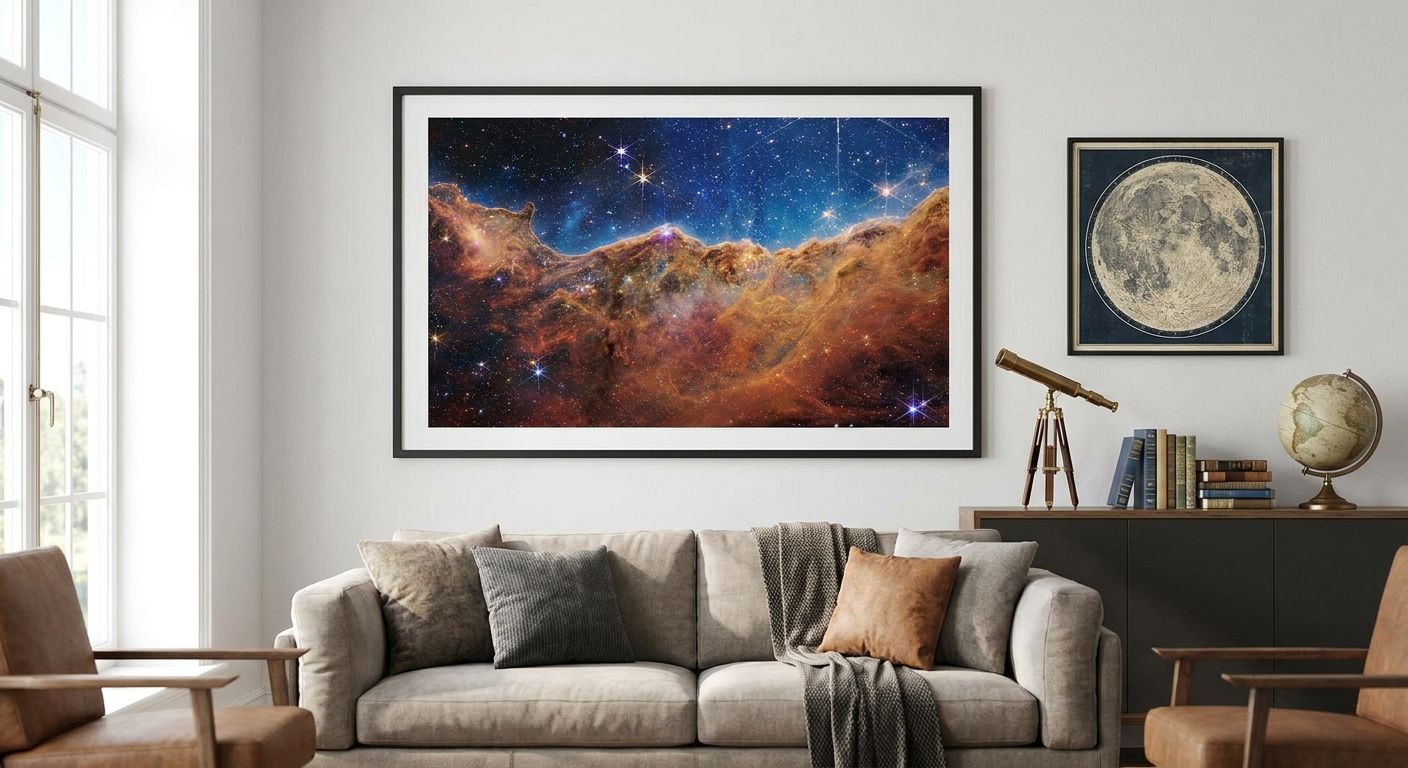
Astronomy fans don't want generic "stars" clip art. They want the Milky Way's actual dust lanes, a real constellation chart, or a moon phase sequence that looks like it belongs in an observatory, not a dorm room. This guide covers what makes space-themed wall art work in an actual Australian home rather than a novelty poster shop.
- Galaxy and nebula canvases work best oversized (120cm+) above beds or in living rooms with 2.7m+ ceilings.
- Constellation and star chart prints suit astrology-curious buyers too - the crossover audience is real in 2026.
- Moon phase sequences in black and white are the safest pick for shared or resale-sensitive rooms.
- Retro rocket and sci-fi poster art is the wildcard - great for teen bedrooms, riskier in a formal living room.
- Skip glow-in-the-dark and cartoon planet prints once a buyer is past age 12 - they read as novelty, not decor.
Why this matters
Space-themed decor has a reputation problem. Most of it looks like it came from a science museum gift shop - cartoon rockets, glow-in-the-dark stickers, cheap poster stock. That's fine for a kid's room. It's not fine for a home office, a reading nook, or a living room feature wall where an adult wants to signal genuine curiosity about the cosmos rather than a childhood phase.
The fix isn't avoiding the subject. It's choosing the right style, scale and finish so a nebula print reads as art, not merchandise.
Who this is for
This guide is for people who actually care about space - amateur astronomers, physics graduates, sci-fi readers, anyone who's spent a night looking through a telescope and wants that feeling on a wall. It also fits a second, larger crowd: buyers whose interest leans more mystical than scientific, where a constellation print does double duty in a home already styled with astrology and mystic decor. Both groups want the same thing - real detail, not a cartoon planet.
It's also for parents fitting out a teen's bedroom who want something that won't need replacing in two years, and for home-office owners who want a Zoom background that says "curious" rather than "corporate stock photo."
What to look for in wall art for space lovers
Genuine astronomical detail, not stock illustration
A nebula print should show actual gas cloud structure and color gradients - the kind captured by real telescope imagery - not a flat purple gradient with white dots scattered on top. Anyone who's looked at actual astrophotography from 2026-era space telescopes will spot the difference immediately, and so will their guests.
Scale that matches the subject
Space is enormous, and a 40cm print of a galaxy looks apologetic rather than awe-inspiring. Anything under 90cm on the long edge tends to read as a poster rather than a statement piece - size up if the wall allows it.
A tone that fits the room's light
Deep-space imagery skews dark - navy, black, charcoal backgrounds with pinpoint highlights. That works beautifully in a north-facing room with strong natural light and falls flat in an already dim space where it just disappears into the wall at night.
Framing that doesn't fight the image
A black or dark timber frame keeps a galaxy print grounded; a pale oak frame can wash out the contrast that makes the image work. Framed canvas also holds its color under years of indirect light better than an unframed poster print pinned to a wall.
Subject variety across a room, not one giant motif repeated
A constellation chart, a moon phase sequence and a single deep-space photograph read as a curated collection. Three nebula prints in a row read as a theme that's trying too hard.
Room fit - bedroom vs. office vs. living space
A home office or study can carry more literal astronomy - star charts, telescope diagrams, planetary maps. A living room usually wants the abstract end of the spectrum: color and texture that reads as art first, subject matter second.
Top picks for astronomy and space lovers
The showstopper: deep-space and galaxy canvas
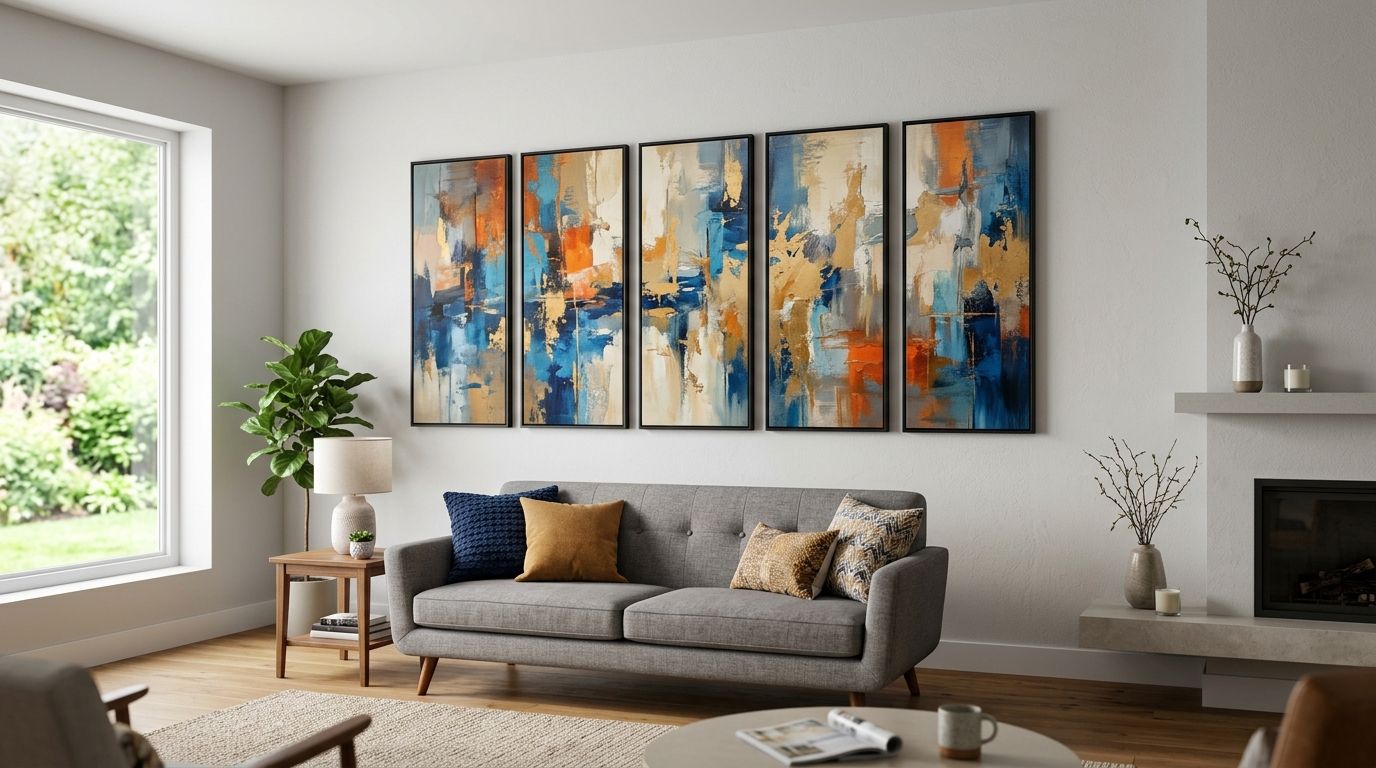
The pick for a feature wall with real height to work with. A large-format canvas in the 120cm-150cm range fills a wall the way a small print never will, and it's the piece guests actually stop in front of. It suits rooms with 2.7m-plus ceilings, which is where this kind of scale earns its keep - see large wall art for homes with high ceilings for sizing logic that applies directly here. Verdict: Buy if the wall is at least 2m wide and the room gets enough natural light to keep dark tones from disappearing.
The quiet flex: star chart and constellation line art
A line-drawn or engraving-style constellation print reads as intellectual rather than decorative, and it's the pick that works in a study, hallway or home office without competing with existing furniture. It's also the piece that bridges into astrology-curious buyers without losing scientific credibility. Verdict: Buy for anyone who wants space-themed art that reads as considered rather than novelty.
The minimalist's pick: moon phase sequence in black and white
A set of three to eight small-format prints tracking the moon through its roughly 29.5-day cycle is the safest choice in this whole category. Monochrome tones age well, resell well, and sit comfortably in a shared or neutral space where a full-color nebula might not. Verdict: Buy for anyone prioritizing longevity over drama.
The wildcard: retro rocket and sci-fi poster art
Mid-century-style rocket illustrations and vintage space-race poster reproductions bring color and personality, and they're the right call for a teenage bedroom or a games room rather than a formal living space. It's the pick most likely to need swapping out as taste matures, so treat it as a five-year piece rather than a forever piece - it's a strong fit for wall art for teenage bedrooms. Verdict: Consider for a bedroom or rumpus room, Skip for a main living area.
The collector's pick: astrophotography-style print
A single striking image - a nebula, a star cluster, a planetary close-up rendered in genuine photographic detail - works as a solo statement piece rather than part of a set. It demands the least styling effort of any pick here because it does all the visual work on its own. Verdict: Buy if you want one piece and you're done, no gallery wall required.
What to avoid
- Glow-in-the-dark novelty prints. They photograph well in a listing and look cheap under normal room lighting once the glow fades within an hour or two.
- Cartoon planet illustrations for anyone over age 12. They date a room instantly and rarely survive a redecorate.
- Oversized text-heavy "space quote" prints. A Carl Sagan line in bold sans-serif over a starfield background reads as a dorm poster, not wall art, no matter how good the quote is.
“Space art either reads as observatory or gift shop - the difference is almost always scale and color depth, not subject matter.”
Verdict comparison
| Pick | Best room fit | Tone | Verdict |
|---|---|---|---|
| Galaxy/deep-space canvas | Living room, high ceilings | Bold, dark | Buy |
| Constellation line art | Study, hallway, office | Minimal, neutral | Buy |
| Moon phase set | Bedroom, shared spaces | Monochrome | Buy |
| Retro rocket poster | Teen room, games room | Bright, playful | Consider |
| Astrophotography print | Anywhere, solo piece | Photographic | Buy |
FAQ
What's the best wall art for space lovers on a budget?
A single moon phase print or a small constellation line-art piece delivers the astronomy theme without committing to a large canvas. Start with one strong piece and build a collection over time rather than filling a wall at once.
Is a canvas print better than a framed poster for space-themed art?
Canvas holds color depth better for dark, high-contrast galaxy and nebula imagery, which is why it suits deep-space subjects more than a flat poster print. Framed prints work well for constellation charts and moon phase sets where the linework carries the detail.
How big should a galaxy canvas be for a living room feature wall?
Aim for 120cm or larger on the long edge for a genuine feature-wall effect in 2026-standard living rooms with ceilings over 2.4m. Anything smaller reads as a poster rather than a statement piece.
Does space-themed wall art work outside a kid's bedroom?
Yes, provided the style shifts from cartoon illustration to genuine astronomical detail or abstract color work. A nebula canvas or constellation chart suits a home office, study or living room just as well as a bedroom.
What's the difference between astrology and astronomy wall art?
Astronomy art depicts real celestial phenomena - galaxies, moon phases, star charts based on actual positions. Astrology art leans on zodiac symbolism and mystic imagery, though the two audiences often overlap in taste for dark, celestial color palettes.
Should moon phase prints be framed or unframed?
Framed works best for moon phase sets since the black-and-white minimalism benefits from a clean edge, especially in a black or dark timber frame. Unframed posters can work temporarily but tend to curl and fade faster with regular light exposure.
How many pieces make a good space-themed gallery wall?
Three to five pieces mixing subject types - one moon sequence, one constellation chart, one deep-space photograph - reads as curated rather than three versions of the same galaxy print. Repetition of one motif across a whole wall usually looks like a theme trying too hard.
Is retro sci-fi poster art still popular for wall decor in 2026?
Yes, particularly for teenage bedrooms and games rooms where bold color and mid-century illustration style suit a less formal space. It's a shorter-term style choice than a photographic nebula print, so treat it as decor for the next five years rather than a permanent piece.
One last thing
The piece that ages best in this category isn't the biggest galaxy canvas - it's the plainest moon phase set, because monochrome imagery never clashes with a future repaint or a new sofa. If you're only buying one space-themed piece this year, that's the safe long-term bet over the showstopper.