Monochrome interiors live and die by contrast, and the wall art you hang either sharpens that contrast or muddies it. This guide ranks the black and white wall art styles worth buying in 2026, tells you which room each one suits, and flags the pieces that photograph well online but fall flat on a real wall.
- Monochrome photography canvas wins for living rooms and entryways in 2026 - buy it first.
- Rothko-style abstract black and white art suits bedrooms and reading nooks - proven minimalist pairing.
- Mondrian-style geometric prints work best in home offices with strong architectural lines - consider, don't force it.
- Oversized black and white statement canvases can overwhelm rooms under 3m wide - skip unless the wall is genuinely large.
Why this matters
Black and white wall art gets treated like a safe default, and that's exactly where people go wrong. A monochrome home has zero colour to hide behind, so every print, frame and gap on the wall reads louder than it would in a colourful room.
Get the tone, contrast level or scale wrong and the piece looks like an afterthought instead of the anchor of the room. Gioia Wall Art sees the same pattern across monochrome interiors in 2026: buyers default to a single black-framed print because it's the obvious choice, then wonder why the wall still looks unfinished.
The fix isn't more black and white art. It's the right style of black and white art, matched to the room's light, scale and existing texture.
How this list was ranked
Each style below is scored against four things that actually matter in a monochrome home: how well it holds contrast across different light conditions, how forgiving it is of an imperfect wall, how it scales from a single feature piece to a gallery wall, and how well it ages against changing furniture. Styles that only work in a photographer's mood-lit render get marked down. Styles that read strong under harsh midday sun and dim evening lamplight both get ranked higher.
The ranking also weighs versatility across room types, since a monochrome home usually needs three or four wall art decisions, not one. A style that only suits a hallway loses points against one that scales into a living room feature wall too.
1. Monochrome photography canvas - the safe, timeless pick
Black and white photography, whether it's architecture, portraiture or landscape, holds contrast in almost any light because the tonal range is baked into the print rather than dependent on paint saturation. It reads as intentional rather than decorative, which is exactly the tone a monochrome home is chasing.
One detail matters more than people expect: grain and shadow depth. A flat, low-contrast photograph disappears against a white or grey wall, while a print with genuine black shadow anchors the room even at 60cm wide. Pair it with black and white wall art for a minimalist home styling advice before committing to size.
Verdict: Buy. This is the lowest-risk starting point for any monochrome room in 2026.
2. Rothko-style abstract monochrome art - the wildcard that earns its keep
Soft-edged abstract blocks in charcoal, ash and off-white read as calm rather than stark, which makes this style a strong fit for bedrooms and reading corners where you don't want the wall demanding attention the moment you walk in. It works because the tonal shifts are gradual instead of sharp, so the eye settles rather than snaps to one point.
Mark Rothko-inspired minimalist prints suit exactly this brief: low-contrast, large-format, built for a room that needs texture without noise.
Verdict: Buy for bedrooms and studies. Hold off if the room already has heavy pattern in the bedding or rug.
3. Mondrian-style geometric black and white prints - for architectural rooms only
Hard-edged geometric black and white art works when the room already has strong lines - exposed beams, a grid-pattern window, minimalist joinery. In a soft, curved room it competes with nothing and just looks stark.
Piet Mondrian-inspired geometric prints suit a home office or a hallway with clean sightlines far better than a living room full of curved furniture.
Verdict: Consider. Right for architectural spaces, skip it in a room with rounded, soft furnishings.
4. Botanical line art in black and white - the understated filler
Single-line botanical drawings in black ink on white or cream paper solve a specific problem: a small wall that needs texture without adding visual weight. They work at 30cm x 40cm in a hallway or above a console table where a bold photograph would feel too heavy.
The risk is scale. Line art loses all its detail past about 80cm wide unless the line weight is increased proportionally, so it's a small-wall solution, not a feature-wall one.
Verdict: Buy for small transitional walls. Skip it as a lone feature piece above a sofa.
5. Black and white typography and quote prints - situational, not universal
Bold serif or sans-serif type on a stark background photographs well and sells fast online, but it dates faster than photography or abstract art because the phrase itself carries a mood that shifts with trends. It works in a home office, a reading nook or a kids' study space where the message matters as much as the aesthetic.
Verdict: Consider for a home office or study. Skip it for a living room where guests will read it every visit.
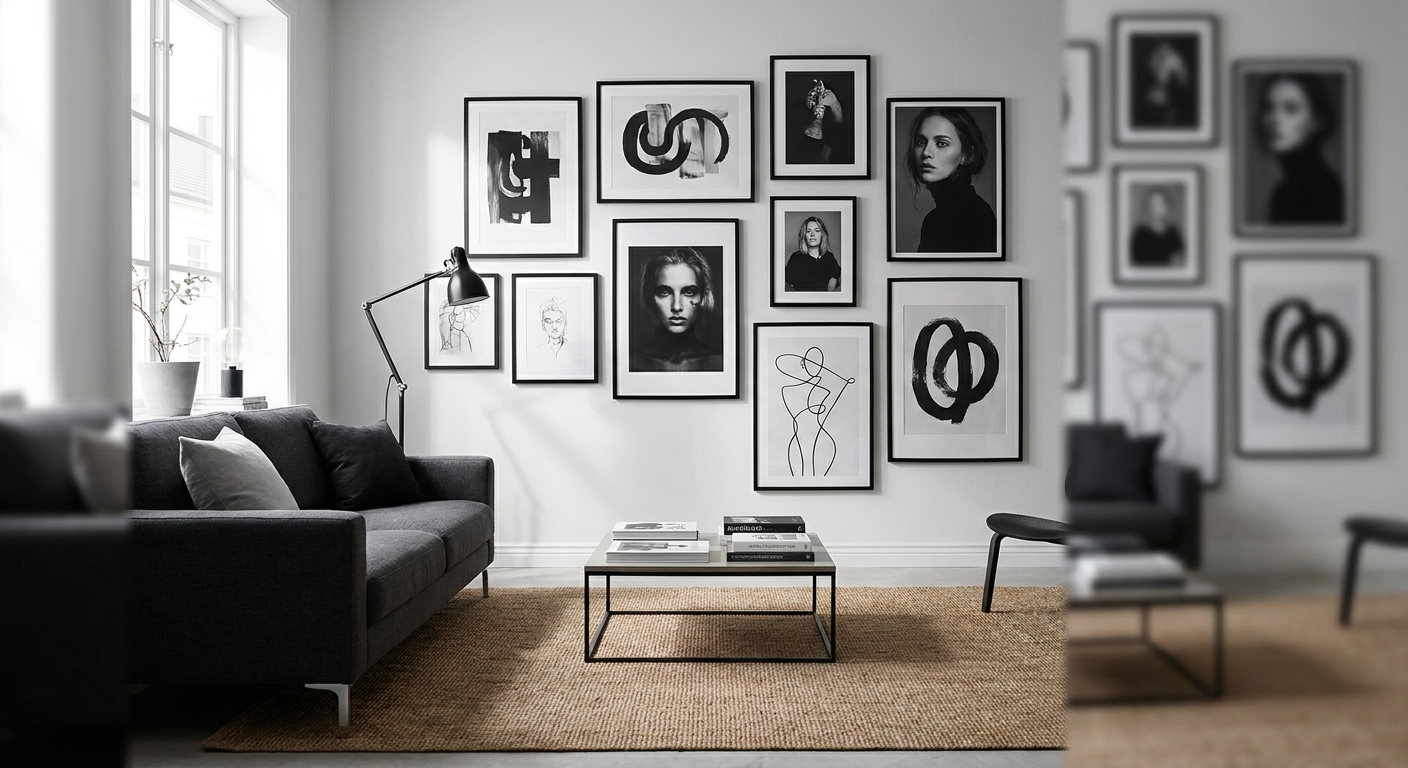
6. Framed black and white gallery wall sets - the commitment pick
A cluster of five to nine smaller black and white prints in matching frames builds density fast, and it's forgiving of an awkward wall shape because the eye reads the group, not the gaps. The trade-off is planning time: spacing, frame consistency and alignment all have to be right before the first nail goes in.
Verdict: Buy if you're prepared to plan the layout properly. Wait if you need a wall solved this weekend.
7. Oversized black and white statement canvas - high risk, high reward
A single canvas over 120cm wide in stark black and white becomes the room's focal point instantly, which is the appeal and the risk. In a room under 3 metres wide, it overwhelms the space and makes everything else look like an accessory.
Verdict: Buy for a large open-plan living wall. Skip it in a standard-size bedroom or hallway.
“If a canvas competes with your rug pattern, drop the colour and print it in black and white instead.”
Comparison at a glance
| Style | Best room | Contrast risk | 2026 verdict |
|---|---|---|---|
| Monochrome photography | Living room, entryway | Low | Buy |
| Rothko-style abstract | Bedroom, reading nook | Low | Buy |
| Mondrian-style geometric | Home office, architectural hallway | Medium | Consider |
| Botanical line art | Small hallway wall | Low | Buy small |
| Typography and quote art | Home office, study | Medium | Consider |
| Gallery wall set | Staircase, long hallway | Medium | Buy, plan first |
| Oversized statement canvas | Large open-plan living | High | Buy large rooms only |
Where to buy black and white wall art in 2026
- Match the print finish to your light. A matte finish holds contrast under direct sun; a gloss canvas can wash out under downlights, which matters more in black and white than in colour work.
- Check the actual print dimensions before ordering, not just the frame size shown in a thumbnail - a 40cm print in a room with 3-metre ceilings reads as an afterthought.
- Buy from a source that shows the print at full scale, not a cropped hero shot, so you can judge grain and shadow depth before it's on your wall.
FAQ
What's the best black and white wall art for a monochrome living room?
Monochrome photography canvas with genuine black shadow depth works best in living rooms in 2026 because it holds contrast under both daylight and lamplight. Abstract Rothko-style prints are the second-strongest pick for a softer, calmer tone.
Is black and white wall art better than colour art for a minimalist home?
For minimalist and monochrome interiors, black and white wall art usually reads stronger because it doesn't compete with the room's limited palette. A colour piece in the same room risks becoming the only saturated object, which can look accidental rather than intentional.
What size black and white print works above a sofa?
A print or canvas roughly two-thirds the width of the sofa is the standard rule for 2026 living rooms, so a 2-metre sofa suits art around 130-150cm wide. Going smaller than that leaves visible dead space above the furniture.
Does black and white wall art fade or yellow over time?
Canvas and print quality matters more than colour palette for fading; low-grade pigment on any print, black and white or colour, shifts tone under direct UV exposure. Position black and white prints away from direct sun exposure regardless of finish.
Can I mix black and white wall art with coloured pieces in one home?
Yes, and most monochrome homes in 2026 do exactly this by keeping black and white art in the main living areas and allowing colour in bedrooms or kids' rooms. The key is not mixing both in the same sightline, which fragments the room's tone.
What's the difference between black and white photography and monochrome abstract art?
Black and white photography holds sharp, defined contrast and suits rooms where you want a clear focal point. Monochrome abstract art uses softer tonal gradients and suits rooms where you want the wall to feel calm rather than commanding.
How many black and white pieces does a monochrome home need?
Most monochrome homes need three to four wall art decisions across the main living spaces, not one piece per room. Repeating the same style across connected rooms, like photography in the entry and living room, keeps the home feeling considered rather than scattered.
One last thing
The detail most buyers miss in 2026 is spacing, not style. A single black and white canvas hung dead-centre on a blank wall looks smaller than the same canvas hung 15-20cm off-centre near a doorway or light switch, because the eye reads it against an architectural line instead of empty space. Before you commit to a size, stand where you'll actually view the wall from and check the print against that sightline, not the thumbnail on screen.