Basements and rumpus rooms get treated like an afterthought when it comes to decor, and it shows: bare besser block, one sad poster from a share house, a TV wall that's otherwise empty. Wall art for rumpus rooms needs to work harder than art anywhere else in the house because the room usually has less natural light, more foot traffic, and walls that were never designed with a picture rail in mind.
- Large-format canvas beats small framed prints for wall art for rumpus rooms with low ceilings — go 100cm or wider.
- Warm, high-contrast pieces read better under downlights than pale, washed-out prints in basements.
- An original painting like Sunday 3PM works as a single statement piece where a gallery wall would look cluttered.
- Skip glass-framed art near the TV or bar — glare under artificial light ruins it within a week.
Why this matters
A rumpus room or basement is judged on vibe, not resale photography. Buyers walking through Gioia Wall Art tend to ask the same question about these spaces: what actually holds up under downlights, humidity, and a room that doubles as a kids' zone by day and a bar by night. The answer isn't the same art that works in a sunlit living room. Below-grade rooms swallow light and colour, so the wrong print just disappears into the wall.
Who this is for
This guide is for anyone finishing or refreshing a basement, rumpus room, home theatre, or games room in 2026 — the parent turning an unused lower level into a teen hangout, the renovator adding a bar corner, and the homeowner who just wants the pool table wall to stop looking like a warehouse. If your room gets little or no direct sunlight and sees more traffic than your formal living room, keep reading.
What to look for in wall art for rumpus rooms
Scale that matches the wall, not the budget
Rumpus rooms tend to have big, uninterrupted stretches of wall because there's no window to break them up. A 40cm print on a 4-metre wall looks lost. For a basement feature wall, 100cm-plus on the long edge is the minimum for the piece to register from across the room.
Colour that fights the light deficit
Most basements run on downlights or LED strips, not sun. Pale, tonal, Scandi-neutral palettes that sing upstairs go flat and grey under artificial light. Warmer palettes — ochre, rust, deep blue, forest green — hold their saturation and stop the room reading as a converted storage space.
Finish that survives humidity
Below-grade rooms run more humid than the rest of the house, especially in older Australian homes without proper below-slab sealing. Canvas on a stretcher bar tolerates minor humidity swings far better than unmounted paper prints, which can cockle or bow within a season.
Mood that matches how the room gets used
A home theatre wants moody, cinematic, low-contrast art that doesn't compete with the screen. A games room or bar corner can take bolder, more graphic pieces. Buying one style for a multi-use rumpus room usually means picking the mood of whichever activity happens most.
Glare control near screens and bar lighting
Glass-framed prints near a projector screen or a bar mirror throw reflections that are genuinely distracting during movie nights. Canvas prints and matte-finish framed prints avoid this; glossy glass over art hung opposite a screen does not.
Mounting that works on real basement walls
A lot of rumpus rooms have concrete, brick veneer, or stud walls with plasterboard over masonry — not the timber-frame walls upstairs. Lightweight canvas on a stretcher frame hangs on standard picture hooks; heavier framed originals need masonry-rated fixings sorted before the art arrives, not after.
Top picks for basements and rumpus rooms
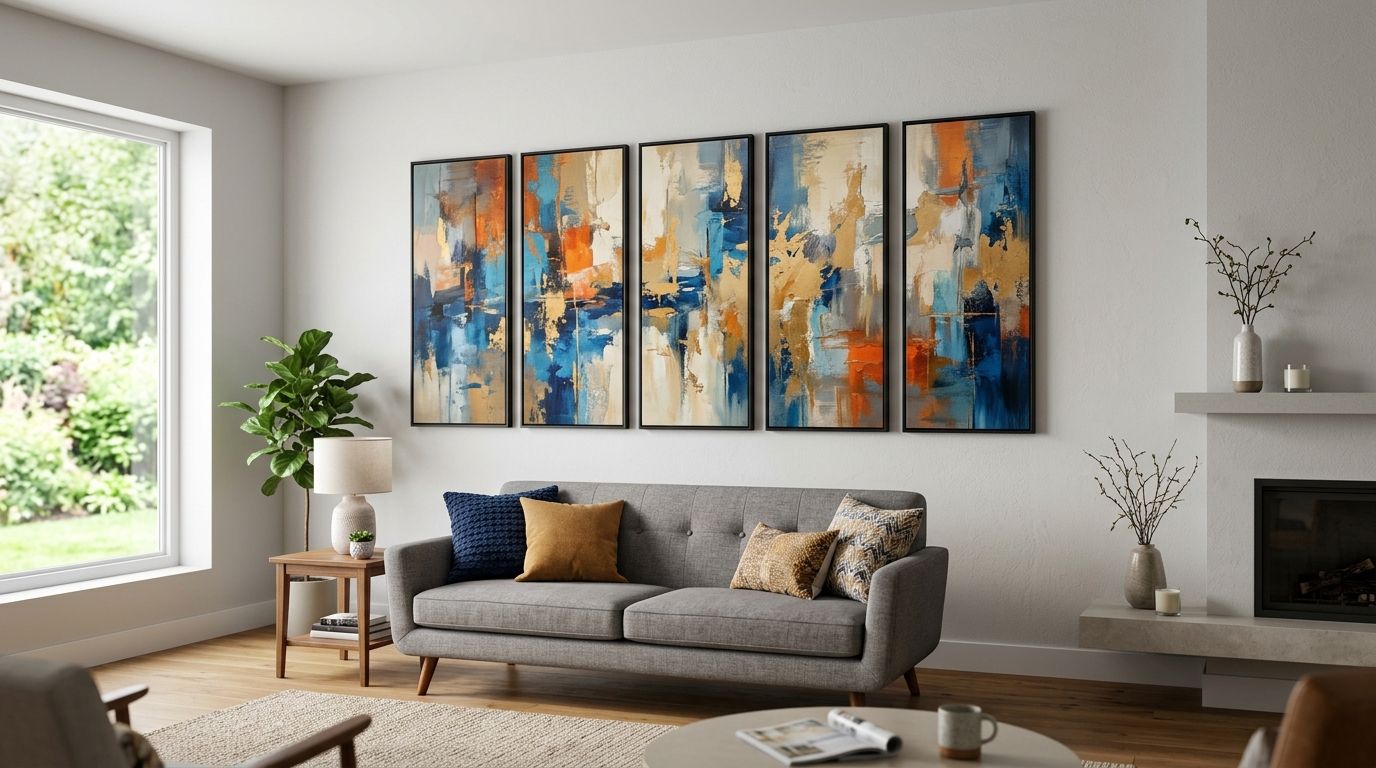
The safe pick — oversized landscape canvas. For a long, blank basement wall, a large-format landscape print anchors the whole room in one move. Large canvas prints for big walls cover this exact brief — pieces at 100cm and above that read as a single statement rather than decoration. A landscape original like Great Dividing Plateau 12, at 104cm x 104cm, is the kind of scale that works without needing a second piece beside it. Buy if your rumpus room has one dominant wall over 3 metres wide.
The wildcard — an original painting instead of a print. Most rumpus rooms get prints because they're cheaper, but an original brings texture and depth that a flat print can't match under downlights — the brushwork actually catches the light differently at night versus during the day. Original paintings for Australian interiors is where to look if the room is a genuine entertaining space rather than a storage overflow. Sunday 3PM, an atmospheric acrylic-on-canvas-panel piece at 45.8cm x 45.8cm, has exactly the moody suburban warmth that suits a bar corner or games nook. Consider it if the room gets used for hosting, not just storage.
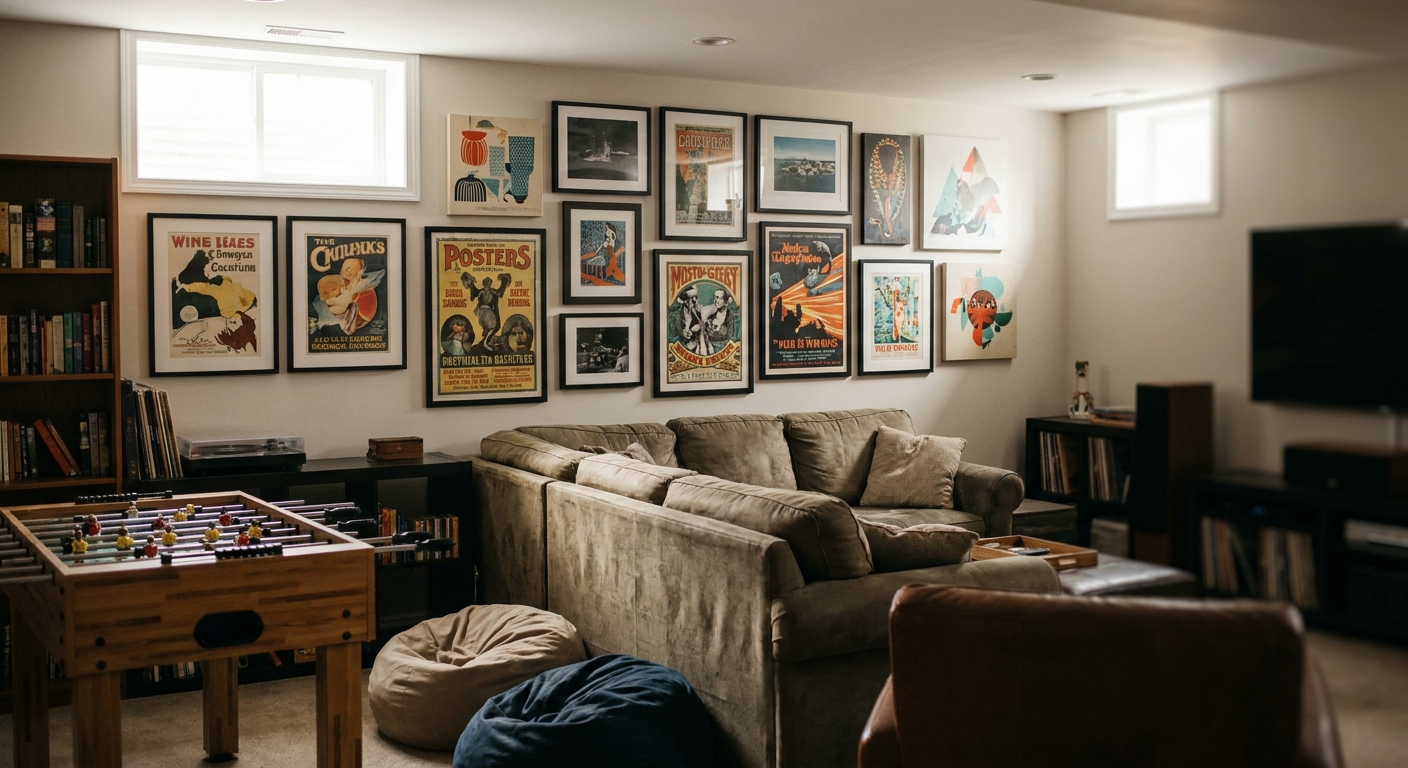
The crowd-pleaser — a gallery wall instead of one hero piece. Some rumpus rooms don't have one big wall — they have several awkward smaller ones around a pool table or bar. Framed prints built for gallery walls solve that by working as a set rather than needing one oversized anchor. Four to six mixed framed pieces at 30-50cm each fill an irregular wall better than one large canvas squeezed into a space it doesn't fit. Buy if your rumpus room has broken-up wall space rather than one long run.
The budget play — a bold poster in a simple frame. If the rumpus room is a teenager's domain or a share-house games room, spending real money on original art doesn't make sense yet. A bold, graphic poster in a basic frame does the job for a fraction of the cost, and it's easy to swap out when the room's use changes in a year or two. Consider this route for transitional spaces; skip it for a room you've finished as a permanent entertaining area.
What to avoid in basement and rumpus room art
- Glossy glass-framed prints opposite the TV or projector screen. They look premium in the shop and become a glare problem the first movie night.
- Pale, low-contrast Scandinavian-style prints. Gorgeous in a sunlit living room, they go muddy and flat under basement downlights.
- Unmounted paper prints in below-grade rooms without a dehumidifier. Humidity swings warp paper faster than canvas, and the cockling shows within months in 2026's humid Australian summers.


“If the room doesn't get natural light, the art has to bring its own.”
Verdict comparison
| Pick | Best for | Wall type | Price from | Verdict |
|---|---|---|---|---|
| Oversized landscape canvas | One dominant wall | Long, unbroken run | $1,795 | Buy |
| Original painting | Entertaining and bar corners | Small to medium wall | $1,310 | Consider |
| Framed gallery wall set | Broken-up wall space | Multiple small walls | Varies by set | Buy |
| Bold poster, simple frame | Transitional or teen rooms | Any wall | Budget-friendly | Consider |
FAQ
What's the best wall art for rumpus rooms with no natural light?
Warm, high-contrast pieces like landscape or ocean paintings work best in rumpus rooms with no natural light in 2026, because pale or tonal prints go flat under downlights. Look for saturated colour rather than soft, muted palettes.
Is canvas better than framed prints for a basement?
Canvas generally holds up better than unmounted paper prints in a basement because it tolerates humidity swings without warping. Framed prints are fine if the frame uses matte glass and the room isn't especially damp.
How big should wall art be for a rumpus room?
For a long basement wall, aim for 100cm or wider on the main piece so it registers from across the room. Smaller walls broken up by furniture suit a gallery-style set of 30-50cm framed prints instead.
Does wall art near a home theatre screen need to be matte?
Yes — glossy glass-framed art opposite or beside a projector screen or TV throws distracting reflections during movie nights. Canvas or matte-finish framed prints avoid the glare problem entirely.
Can original paintings go in a basement rumpus room?
Original paintings work well in rumpus rooms used for entertaining, since the texture and brushwork read differently under changing artificial light than a flat print. Keep them away from direct humidity sources like an unvented bar sink.
What should I avoid hanging in a games room or bar area?
Avoid pale Scandinavian-style prints and glossy glass frames near screens or mirrors — both underperform in a games room's typical downlight and glare conditions. Bold, warm-toned canvas art performs better in that setting.
How much does wall art for a rumpus room cost in 2026?
Framed posters and prints start well under $200, while original paintings for a rumpus room range from around $410 to $2,500 depending on size and artist in 2026. Large-format canvas prints for feature walls typically sit in between.
One last thing
The biggest mistake in basement decorating isn't the art itself — it's hanging it at living-room height. Rumpus rooms are often used more from a couch or bar stool than standing up, so the centre of the piece should sit lower than the standard 145-150cm eye-line rule; closer to seated eye height keeps a large canvas from looming over the room instead of anchoring it.