Classic car and motorsport wall art turns a garage, den or man cave into a proper tribute to horsepower and heritage, not just a room with a poster taped to the wall. This guide breaks down what actually holds up on a workshop wall in 2026, and what looks good online but fades, curls or clashes with your space in six months.
- Black-and-white motorsport photography canvas is the safest wall art for car enthusiasts in 2026 — buy it for any garage, den or man cave.
- Large-format canvas over 100cm wide reads best on a feature wall with high ceilings — anything under 60cm gets lost above a workbench.
- Framed prints protect vintage racing posters from workshop dust and UV exposure better than unframed paper.
- Match wall art palette to your existing workshop tools and furniture, not just the car's paint colour.
Why this matters
Most car-themed wall art on the market is generic: a stock photo of a red sports car, a cheap poster with a chrome border, or a print so glossy it reflects the overhead lights. None of that respects the actual culture around classic cars and motorsport — the mechanics who know torque specs by heart, the collectors who can date a Porsche by its bumper, the weekend racers who remember lap times better than birthdays. Wall art for car enthusiasts needs to earn its place on the wall the same way the car earns its place in the garage.
In 2026, the shift in this category is toward archival photography and monochrome treatments over cartoonish illustrations. That's a good thing for anyone decorating a real workshop or den rather than a teenager's bedroom.
Who this is for
This guide is for the person setting up a garage, man cave, home workshop or den around an actual passion for cars — restorers, weekend trackday drivers, Formula 1 and touring car fans, and anyone who wants their four walls to reflect the same taste that got them into a classic Alfa or a stripped-back Datsun in the first place. It's not for someone who wants a car on the wall because it looks masculine in a rental listing photo. If you fall into the first camp, Gioia Wall Art curates prints across styles that suit exactly this kind of space, from moody monochrome to bold statement pieces.
What to look for in wall art for car enthusiasts
Subject authenticity
A print of a real chassis, a real circuit, or a real era of racing beats a generic illustrated sports car every time — enthusiasts notice details like period-correct wheels, livery accuracy and the difference between a road car and a race car. Generic "cool car silhouette" art reads as decor for people who don't actually care about cars, and your audience will clock that instantly.
Format: photography vs illustration vs poster
Black-and-white or sepia motorsport photography holds its value in a room longer than illustrated or pop-art style prints, which can start to feel dated within a couple of years. Vintage advertising poster reproductions are the exception — their appeal is nostalgia, not trend, so they age well in a den or bar area.
Scale for the room
A garage or man cave usually has taller ceilings and bigger unbroken wall runs than a living room, which means undersized prints disappear. A single print under 60cm wide over a workbench looks like an afterthought; something closer to 100-150cm wide reads as a proper feature.
Print quality and finish
Matte or satin canvas resists glare under garage lighting and workshop fluorescents far better than a glossy poster finish, which throws reflections back at anyone standing near it. If the space gets direct sun through a roller door, that also affects longevity — a print built for interior domestic light isn't built for a half-open garage.
Framing for a working space
Garages and workshops collect dust, moisture and the odd stray tool. A framed print with glazing protects the surface in a way an unframed poster simply can't, which matters more here than in a dry, climate-controlled living room.
Story and provenance
The best pieces in this category reference something specific — a marque, a circuit, an era — rather than "a car." A print of a 1967 Le Mans grid or a specific model's silhouette gives the room a story to point to, which is the whole reason someone hangs car art in the first place instead of buying a generic landscape.
Top picks for a car-themed wall
Black-and-white racing photography canvas — the timeless pick. Monochrome motorsport photography, think pit lane action or a driver mid-corner, works in almost any room because it reads as photography first and car art second. It sits comfortably next to tools, timber shelving or leather furniture without fighting the palette. If you're leaning into a monochrome scheme for the whole room, the black and white wall art guide for a monochrome home covers how to build that out beyond just the car print. Buy for almost any garage or den.
Large-format marque hero shot — the statement piece. A single wide canvas, 120cm or more, of one car shot cleanly against a plain background anchors a feature wall the way a smaller print never will. This works best on the longest unbroken wall in the space, ideally one with at least 2.4m of ceiling height so the scale doesn't overwhelm the room. For sizing logic beyond car art specifically, the large wall art guide for homes with high ceilings walks through the ratios. Buy if you have one dominant wall to commit to.
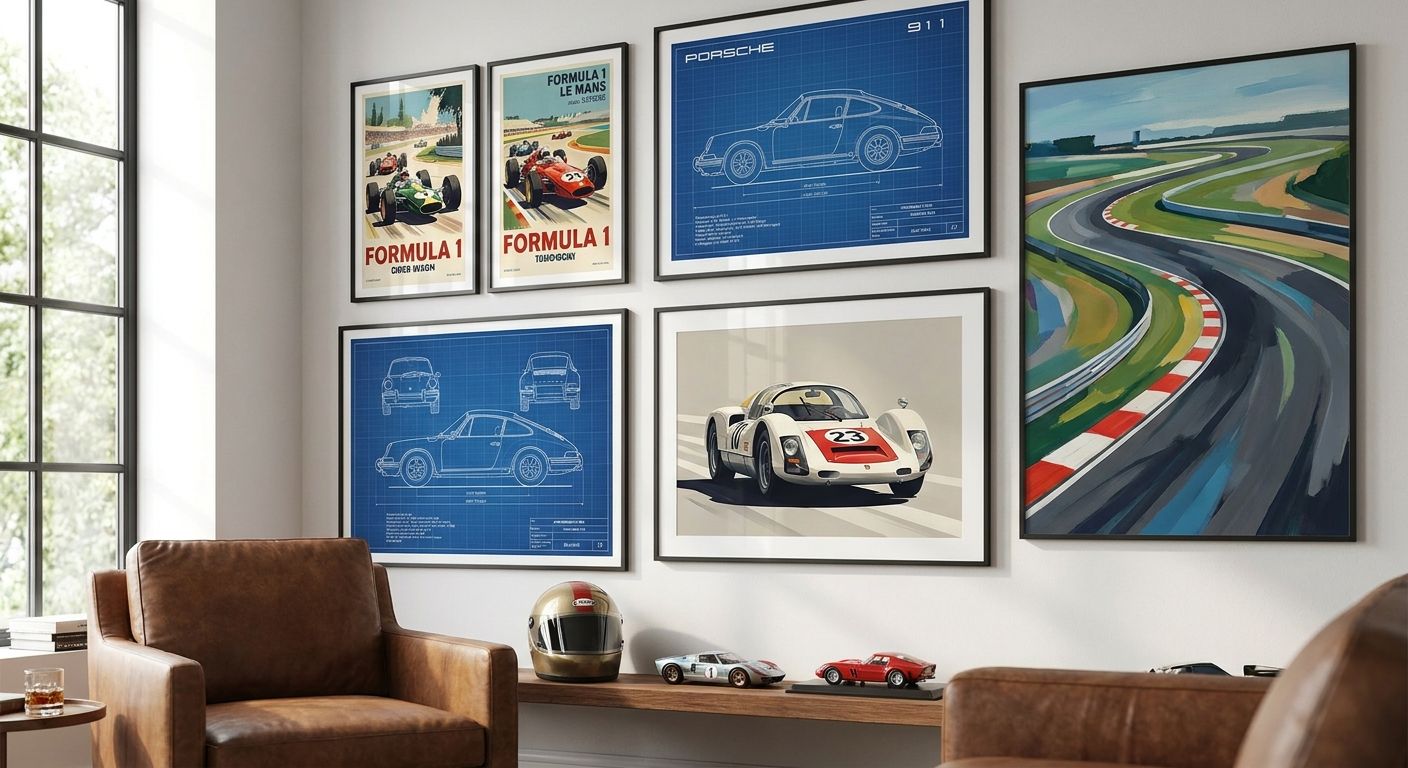
Vintage motorsport poster reproduction — the budget-friendly classic. Reproductions of period racing advertisements or event posters bring nostalgia into the room at a lower price point than photography canvas, and they layer well with other memorabilia like number plates or model cars. Consider this as a secondary piece rather than the room's main focal point.
Framed pit-lane or paddock print — the collector's choice. For anyone treating the space as a proper collection rather than casual decor, a framed print with glazing keeps the surface protected from workshop dust and adds a more finished, gallery feel than a bare canvas edge. Buy if the room doubles as a display space for models, trophies or memorabilia.
Oversized illustrated car graphic — the wildcard. Bold, flat-colour illustrated car graphics can work in a younger or more playful space, but they date faster than photography and can look juvenile in a room otherwise furnished with real tools and real memorabilia. Consider only if the rest of the room already leans playful; otherwise Skip.
What to avoid
- Glossy, unframed posters near a roller door. Direct light and moisture from an open garage will fade and warp cheap poster stock within a season.
- Generic "cool car" stock art with no real subject. If a genuine enthusiast can't identify the make, model or era, it reads as filler, not decor with intent.
- Undersized prints on long garage walls. A 40cm print on a 4-metre wall looks like it was forgotten there, not chosen.
One more practical point before you hang anything: garage and man cave walls are often solid brick, plasterboard over stud, or a mix of both, and a large canvas is heavier than it looks once it's off the truck. The guide to hanging heavy canvas prints safely is worth reading before you commit to a 120cm-plus piece, particularly if you're mounting into anything other than a stud.
Verdict comparison
| Pick | Best for | Format | Verdict |
|---|---|---|---|
| Black-and-white racing photography | Any garage or den | Canvas | Buy |
| Large-format marque hero shot | One dominant feature wall | Canvas, 120cm+ | Buy |
| Vintage motorsport poster reproduction | Budget or secondary wall | Framed print | Consider |
| Framed pit-lane print | Collector/memorabilia rooms | Framed print | Buy |
| Illustrated car graphic | Playful, younger spaces only | Canvas/poster | Consider/Skip |
FAQ
What's the best wall art for car enthusiasts in 2026?
Black-and-white motorsport photography canvas is the safest choice for most garages and dens in 2026 because it suits almost any existing decor and doesn't date the way illustrated graphics do. A large-format hero shot of a specific marque works well as a single statement piece on a dominant wall.
Is canvas or framed print better for a garage?
Framed prints with glazing protect the surface from workshop dust and moisture better than bare canvas, which matters more in a working garage than a living room. Canvas still works well in a finished den or man cave with controlled conditions.
How big should wall art be over a workbench?
A single print should be at least 90-100cm wide over a workbench to read as intentional rather than an afterthought. Smaller prints under 60cm work better grouped in a gallery layout than as a standalone piece.
Does vintage racing poster art still work in 2026?
Yes — vintage motorsport poster reproductions age well because their appeal is nostalgia rather than a design trend, unlike illustrated car graphics which can look dated within a couple of years. They work best as a secondary piece alongside a larger photography print.
Should classic car wall art match the car's paint colour?
No — match the print's palette to the room's existing tools, furniture and walls rather than the vehicle's paint. A print chosen purely to match a car's colour scheme often clashes with everything else in the space.
Can I hang a large canvas print in a garage with a roller door?
Yes, but position it away from direct sun exposure through the door opening, since UV and moisture will fade and warp cheaper prints over time. A framed, glazed print handles those conditions better than an unframed canvas.
What's the safest way to hang a heavy canvas print?
Locate a wall stud where possible and use hardware rated for the print's actual weight rather than a generic picture hook, especially for anything over 100cm wide. Following a proper hanging method matters more in garages, where walls are often solid brick or unfinished stud.
Is illustrated car art or photography better for resale value of the room's decor?
Photography-based prints tend to hold their visual appeal longer than illustrated graphics, which can look dated within a couple of years as styles shift. If you're decorating a space you plan to keep long-term, photography is the safer investment.
One last thing
The detail most people miss: the print that ages best in a car-themed room usually isn't the one with the most obvious car in it. A tight, cropped shot of a wheel arch, a gauge cluster, or a driver's gloved hands on a wheel often reads as more authentic than a full side-profile hero shot, because it assumes the viewer already knows the car well enough not to need the whole thing spelled out. That's the same instinct that separates a real enthusiast's garage from a showroom display.