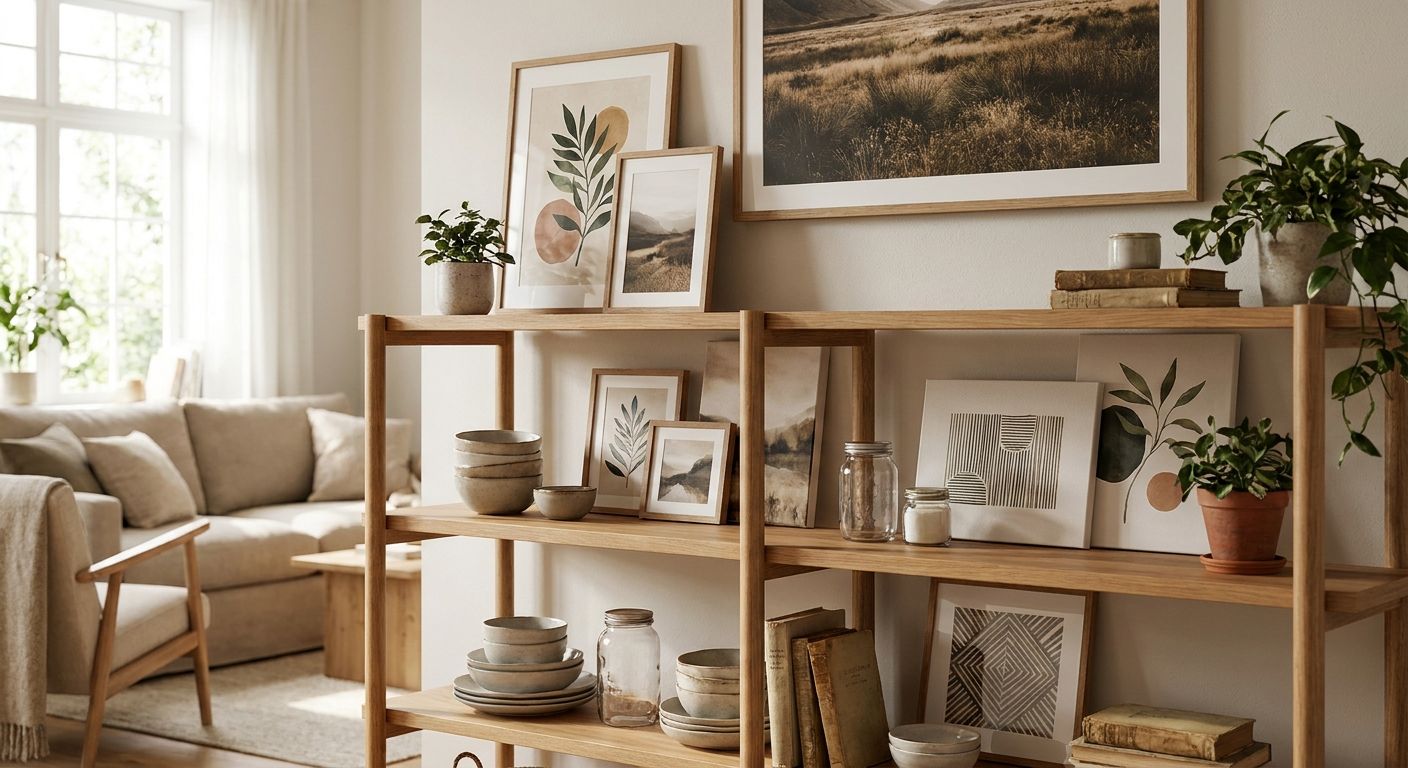
Open shelving strips a room back to its bones — no cabinet doors, no clutter to hide behind — which means every piece you lean against those boards carries more visual weight than it would on a full gallery wall. Get the scale, the lean angle and the palette wrong and the shelf reads as messy rather than styled.
- Wall art for open shelving works best at 20-40cm for leaning display, not full-wall scale — Buy small to medium framed or unframed prints.
- One original painting over 60cm anchors a shelf as a single statement — Buy one, skip a matching pair.
- Glossy glass-framed prints catch glare on shelves near windows in 2026 homes with big sightlines — Skip near natural light.
- Layer two to three prints of varied height per shelf run, never four-plus, to avoid a cluttered look.
Why this matters
Open shelving in 2026 living rooms and kitchens does double duty — storage and display in the same breath. A shelf loaded with books, ceramics and a plant needs art that fills gaps without fighting the objects around it, which is a different job than art hung alone on a blank wall.
Most buyers make the same mistake: they pick a print sized for a full wall, prop it on a 25cm-deep shelf, and it dwarfs everything else on the run. Canvas prints for open-plan living spaces sit at a different scale entirely to shelf-ready pieces, and mixing the two categories up is the fastest way to a lopsided shelf.
Who this is for
This guide is for anyone with open shelving — floating boards in a living room, a kitchen display run, a home office bookcase with open cubes — who wants the wall art on it to look intentional rather than like leftover frames from a house move. If you're furnishing a new build, styling a rental you can't drill into, or refreshing a shelf that's gone stale with the same three photo frames since 2022, the criteria below apply directly.
What to look for in wall art for open shelving
Scale relative to shelf depth
A standard floating shelf runs 20-30cm deep, and anything taller than the shelf is wide will topple forward the moment someone bumps it. Stick to prints between 20cm and 40cm on the long edge for leaning display — that range sits comfortably on most shelf depths without needing a wall anchor behind it.
Leaning angle and stability
Leaning art relies on gravity and a stable base, not picture hooks, so weight distribution matters more than it does on a hung wall. Framed prints with a slight lip on the frame edge grip the shelf better than flat unframed sheets, which tend to slide when the shelf gets bumped.
Palette against shelving contents
Open shelves already carry color from books, ceramics and plants, so the art needs to either match that palette or deliberately contrast it — there's no neutral middle ground on an open display. A muddy mid-tone print gets visually swallowed by a shelf full of terracotta pots and timber bowls.
Frame finish for layering
Mixing a framed piece with an unframed canvas on the same shelf run reads as curated; three identical frames in a row reads as a starter-home display. Vary the finish — one framed print, one unframed canvas, one small original — and the shelf gains depth without extra effort.
Object-to-art ratio
A shelf that's 100% wall art looks like storage that failed; a shelf that's 100% objects looks unfinished. The workable ratio is roughly one art piece for every two to three objects per shelf run, which keeps the eye moving without overcrowding any single board.
Weight and lean-back angle
Heavier original paintings need a firmer lean-back angle against the wall, usually 5-10 degrees, to stop the frame sliding forward over time. A 30cm x 30cm original like Apple & Snail sits securely at that angle; anything larger needs a wall stud behind it for backup support, not just a lean.
Top picks for open shelving styling
The safe pick — small framed prints. Prints around 179.99 in the 30-40cm range fit almost any shelf depth and don't dominate the objects around them. The spec that matters here is frame depth under 3cm, which keeps the piece flush enough not to tip forward. Buy for a first shelf styling pass.
The statement piece — a mid-size original. An original painting like Taking Time at 101cm x 101cm is too large to lean on most shelves but works propped on a lower, wider shelf as the single anchor of the whole run — no competing art needed elsewhere on that board. Buy if your shelf run has one dominant lower shelf; Skip if every shelf is under 90cm wide.
The wildcard — an unframed canvas leaned loose. Something like Messy Play at 31cm x 21cm, sold unframed, leans flat against the wall with a raw edge that reads more casual than a boxed frame. It works well tucked behind a plant or stack of books rather than standing alone. Consider for a looser, lived-in shelf; Skip if your styling is otherwise formal.
The texture layer — a small original in a floating frame. Opaline at 61cm x 51cm on stretched canvas adds mixed-media texture that photographs differently under shelf lighting than a flat print does. Buy for a mid-shelf position where side light hits the surface.
The high-shelf option — lightweight and print-based, not canvas. For shelves above eye level, weight matters more than finish — a flat unframed print under 200g is far safer than a heavy original that can shift with vibration from foot traffic below. Buy lightweight prints for top shelves; Skip heavy originals above 180cm height.
For step-by-step layout logic once you've picked pieces, how to create a picture ledge display walks through spacing and lean order shelf by shelf.
What to avoid
- Full-wall-scale canvases. A 100cm+ canvas built for a blank wall overwhelms a 25cm-deep shelf and usually can't lean without a stand behind it.
- Glossy glass frames near windows. Reflective glass throws glare across a shelf run that gets afternoon sun, hiding the art instead of showing it.
- Perfectly matched frame sets. Three identical frames in a row look like a display kit rather than a curated shelf — vary size and finish instead.
Verdict comparison table
| Pick | Best shelf position | Size | Frame finish | Verdict |
|---|---|---|---|---|
| Small framed print | Any depth 20-30cm | 30-40cm | Framed | Buy |
| Mid-size original | Lower, wider shelf | 90cm+ | Unframed canvas | Buy (single shelf only) |
| Unframed loose canvas | Mid-shelf, layered | 20-35cm | Unframed | Consider |
| Mixed-media original | Mid-shelf, side-lit | 50-65cm | Stretched canvas | Buy |
| Lightweight print | Above eye level | Under 35cm | Unframed/light frame | Buy |


Gioia stocks these at the same 179.99 price point across the print range, which keeps a multi-piece shelf styling job predictable on cost even when you're buying three or four prints for one run.
FAQ
What size wall art works best for open shelving?
Wall art for open shelving works best between 20cm and 40cm on the long edge for leaning display in 2026 homes. Anything larger than the shelf depth risks tipping forward when the shelf is bumped.
Should I frame or leave prints unframed for shelf styling?
Mix both — a framed print grips the shelf edge better and reads more finished, while an unframed canvas adds a looser, layered look. Using only one finish across a shelf run tends to look flat.
How many pieces of art should go on one open shelf?
One art piece for every two to three objects per shelf keeps the display balanced. More than that on a single run starts to look cluttered rather than curated.
Is an original painting too heavy for open shelving?
A small original under 65cm, like a piece on stretched canvas, leans safely at a 5-10 degree angle. Anything larger than 90cm needs a stud-backed wall behind the lean, not just gravity.
Can I put wall art on a high shelf above eye level?
Yes, but keep it lightweight — an unframed print under 200g is far safer on a top shelf than a heavy framed original that can shift with foot traffic vibration.
Does glossy framing cause glare on shelves near windows?
Yes, glossy glass reflects window light directly across a shelf run that gets afternoon sun. Matte glass or unframed canvas avoids that glare entirely.
What's the difference between shelf styling art and wall-hung art?
Shelf styling art is sized and weighted for leaning, usually 20-40cm, while wall-hung art is sized for the full wall and often exceeds 80cm. Buying wall-hung scale for a shelf run is the most common styling mistake.
How do I stop leaning art from sliding on a shelf?
Frames with a slight lip on the back edge grip the shelf better than flat unframed sheets. A 5-10 degree lean-back angle against the wall also reduces sliding over time.
One last thing
The detail most people skip: rotate the objects around the art every few months rather than the art itself. A 30cm print like Apple & Snail can sit on the same shelf for years and still look fresh if the books, ceramics and plant beside it change — the art anchors the shelf, the objects do the seasonal work.