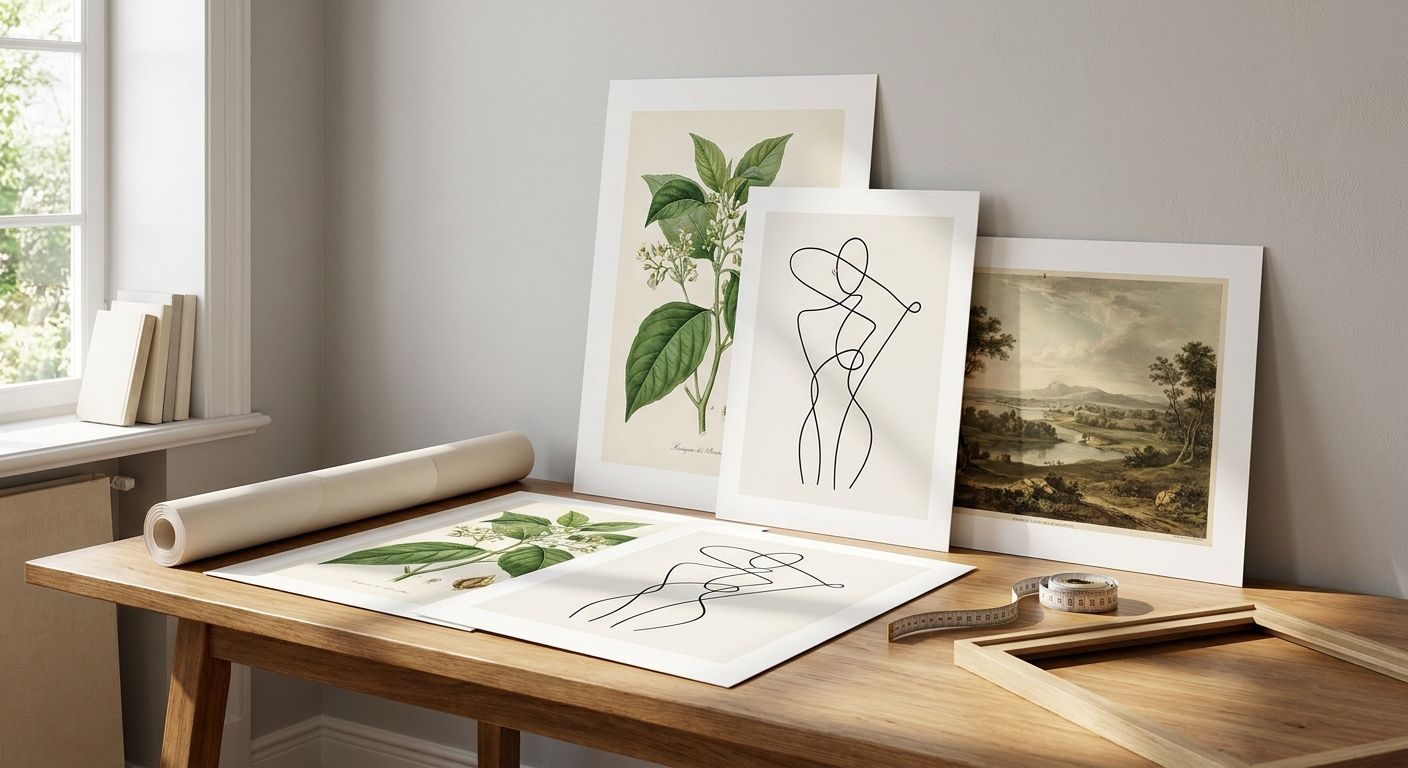
Ordering art prints unframed and pairing them with a custom frame gives you control over mat colour, glazing, and profile that a ready-framed print can't match, and it's the smarter buy whenever the artwork is a genuine feature piece rather than a filler print.
- Fine art paper at 300gsm or heavier is the safest stock for unframed art prints going into custom framing in 2026 — buy it over standard poster stock.
- Fashion illustration and botanical prints frame well in narrow 3cm profiles; large-format landscapes need a deeper rebate, at least 3.5cm.
- Pre-stretched canvas is not a custom-framing candidate — skip it if you're planning to frame the piece yourself.
- Standard poster-weight paper at 190gsm is the budget pick but tends to curl at the frame edges within a year or two.
- Gioia Wall Art's unframed prints ship on archival stock sized to fit standard Australian frame dimensions like A1, A2 and 50x70cm.
Why this matters
A framed print locks you into whatever mat and moulding the seller chose. An unframed print is a blank canvas for the actual framing decision — colour, width, glazing — which matters more in 2026 as more interior schemes mix timber, brass and matte black hardware in the same room.
Buying Gioia Wall Art's print catalogue unframed also means you're not paying for glass and moulding you might swap out within a year of a styling refresh. The saving isn't huge on a single print, but it adds up fast across a gallery wall of five or six pieces.
The catch: not every print stock behaves the same way once it's under glass. Paper weight, coating, and even the ink process change how the piece ages behind a frame.
How this list is ranked
Each entry below is scored on three things that actually affect a custom-framed result: paper or print stock quality, how forgiving the format is for a framer to work with, and value relative to a comparable framed-and-glazed alternative. Pricing reflects unframed print listings on the Australian market in 2026. Sizing notes assume standard Australian frame dimensions — A1, A2, A3 and 50x70cm — since matching a print to a stock frame size avoids a custom-cut surcharge.
The ranked list
1. Fine art paper prints (giclée) — the archivist's pick
Giclée prints on 300gsm-plus archival matte paper are the benchmark for anything you plan to keep for more than five years. The paper is acid-free, so it won't yellow at the edges the way cheaper stock does once it's sealed behind glass.
Most framers can mount these up to 100x150cm without the paper buckling, and the matte finish plays nicely with both UV-filtering glass and standard acrylic glazing. If a piece is going above a bed or on a feature wall you're not repainting soon, this is the stock to specify. Buy.
2. Standard poster-weight prints — the budget pick
At around 190gsm satin paper, poster-weight prints cost roughly half of what a fine art paper equivalent runs. They're a fair call for a rental, a kid's room, or anywhere the art is likely to be swapped out within two or three years.
The trade-off shows up over time: satin-coated stock tends to curl slightly at the corners once it's been behind glass for 12 to 18 months, especially in humid coastal homes. Fine for short-term styling, less ideal as a long-term framing investment. Consider.
3. Fashion and portrait illustration prints — the statement pick
High-contrast line-and-colour illustration work — think elegant portrait studies or fashion figures — frames well even in narrow 3cm profiles because the composition doesn't need a wide mat to breathe. It reads as a design object rather than "art you inherited."
These pieces are carrying real weight in 2026 interior trends that lean toward personality-led feature walls over neutral abstracts. A single well-framed portrait illustration can anchor an entryway or hallway on its own. Buy.
4. Botanical and still-life prints — the safe pick
Soft, muted botanical and still-life prints pair naturally with timber or brass frames and don't fight with existing furniture colours the way a bold abstract might. They're the easiest category to get "right" on a first custom-framing attempt.
They also work in multiples — three to five botanical prints in matching frames make a coherent gallery wall without needing to coordinate colour palettes across wildly different subjects. Check framed prints for gallery walls if you're building a set rather than a single hero piece. Buy.
5. Large-format landscape and abstract prints — the wildcard
Anything printed wider than 100cm needs a deeper rebate — the recessed channel that holds the glass, mat, and print together — usually at least 3.5cm, which most stock ready-made frames don't offer. This is where custom framing actually earns its cost over a big-box frame.
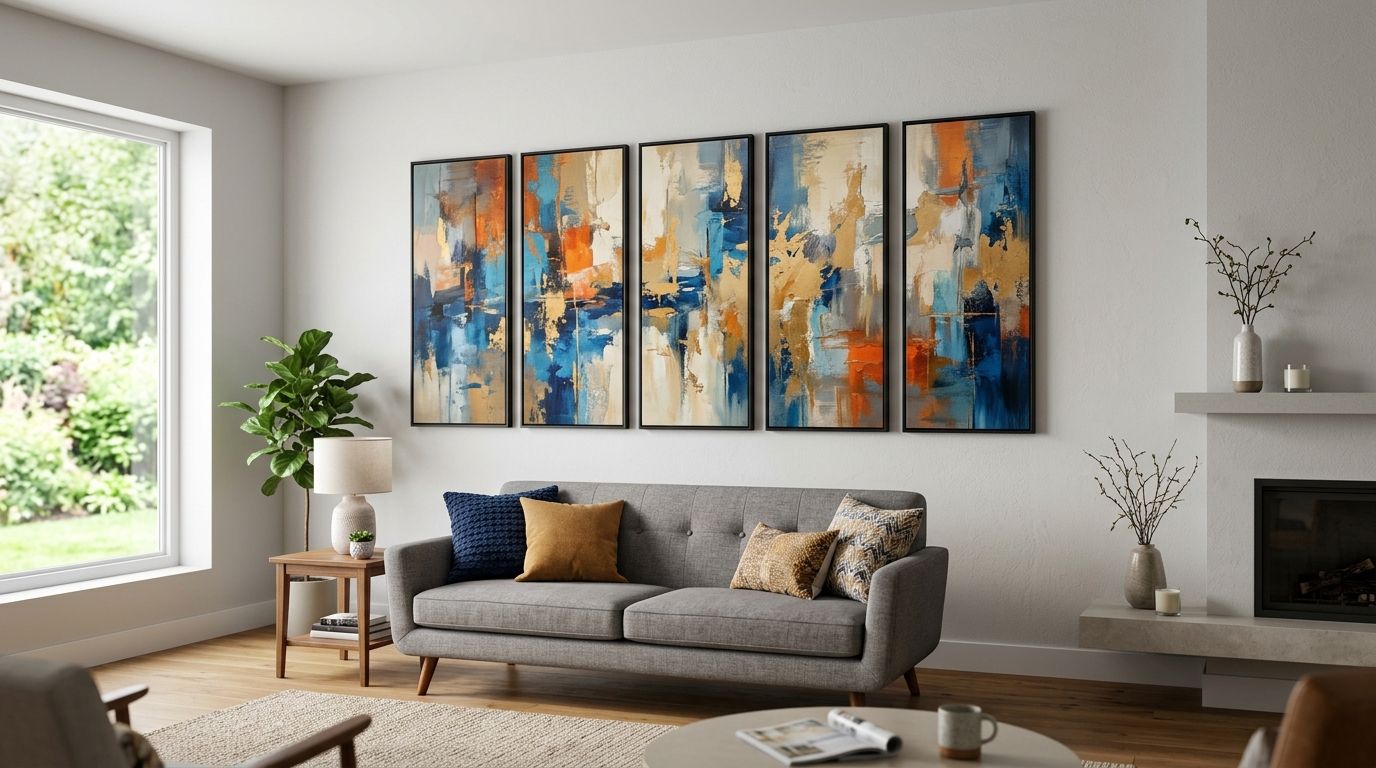
The upside is scale: a large landscape or abstract print fills a wall that three or four smaller pieces can't, without the visual clutter of a gallery arrangement. The downside is cost — custom-cut glazing at this size isn't cheap. Consider.
6. Generic stock-imagery prints — the one to skip
Low-resolution stock photography sold as "art prints" is the trap here. It looks fine as a thumbnail but pixelates or shows visible dot patterns once it's enlarged past A3 and placed under glare-reducing glass, which exaggerates the flaw rather than hiding it.
If a listing doesn't specify print resolution, paper weight, or print method, treat that as a red flag rather than an oversight. Skip.


Comparison table
| Print type | Stock/weight | Best frame profile | Approx. price (2026) | Verdict |
|---|---|---|---|---|
| Fine art paper (giclée) | 300gsm+ archival matte | 2-4cm, any material | ~$180 | Buy |
| Standard poster print | 190gsm satin | 2-3cm | ~$90-100 | Consider |
| Fashion/portrait illustration | 300gsm archival | 3cm minimum | ~$180 | Buy |
| Botanical/still life | 300gsm archival | 2-3cm timber/brass | ~$180 | Buy |
| Large-format landscape/abstract | 300gsm+ archival | 3.5cm+ deep rebate | ~$180-250 | Consider |
| Generic stock imagery | Unspecified | N/A | Varies | Skip |
Where to buy
- Confirm the paper spec before you order. A listing should state gsm weight and print method (giclée vs. standard digital print) — if it doesn't, ask before buying.
- Match the print size to a standard frame dimension. A1, A2, A3 and 50x70cm are the easiest and cheapest sizes to custom-frame in Australia; anything off those measurements adds a custom-cut fee.
- Check the return policy on colour accuracy. Screen colour and printed colour aren't identical — a seller that allows exchanges if the colour is noticeably off is worth prioritising over one that doesn't.
What to avoid
- Pre-stretched canvas sold as an "unframed" option. Canvas needs float-mount hardware, not a standard rebate frame — it's a different framing job entirely, and most custom framers will tell you this on the spot.
- Prints with no stated resolution. If a seller can't tell you the DPI or print method, assume it's not giclée and won't hold up enlarged past A3.
- Glossy finishes for rooms with strong natural light. Gloss paper throws glare under window light and under downlights, which defeats the purpose of framing a piece to be looked at.
FAQ
What is the best paper for unframed art prints in custom framing?
Archival matte paper at 300gsm or heavier is the best choice for unframed art prints in custom framing as of 2026. It resists yellowing under glass and holds detail at larger sizes better than standard 190gsm poster stock.
Is it cheaper to buy unframed art prints and frame them yourself?
Yes, buying unframed art prints and having them custom framed separately is usually cheaper than buying a pre-framed piece of the same size, especially for standard sizes like A2 or 50x70cm. The saving shrinks for oversized prints that need a custom-cut frame.
How do I know what size unframed print to order for a specific frame?
Order a print sized to a standard frame dimension — A1, A2, A3 or 50x70cm — to avoid a custom-cut surcharge. Measure the wall space first, then work backward to the closest standard size rather than choosing an arbitrary dimension.
Can canvas prints be custom framed?
Canvas prints are not typically suited to standard custom framing because they need float-mount hardware rather than a recessed rebate frame. If you want a framed look, choose a paper print instead of a stretched canvas.
What paper weight should I look for in an unframed print?
Look for 300gsm or heavier archival paper for anything you plan to keep long-term. Lighter 190gsm satin paper is acceptable for short-term or rental styling but tends to curl at the edges within 12 to 18 months behind glass.
Is giclée printing worth it for unframed art prints?
Giclée printing is worth the extra cost for feature pieces because the ink and paper combination resists fading and yellowing far better than standard digital prints. For a hallway print you'll swap out in a year, it's not necessary.
How much does custom framing cost in Australia in 2026?
Custom framing costs vary by size and moulding choice, but standard sizes like A2 or 50x70cm framed in a simple timber or metal profile are the most cost-effective in 2026. Oversized prints above 100cm wide cost more due to deeper rebate and glazing requirements.
Should I choose matte or gloss finish for a print going into a frame?
Matte finish is the better choice for framed prints in most rooms because it doesn't throw glare under window light or downlights. Gloss can look richer in low-light rooms but shows reflections in bright spaces.
One last thing
Framers charge less to mount a flat unframed print than a stretched canvas, because canvas needs float-mount spacers and extra depth that a standard rebate frame doesn't have — if budget is the deciding factor in 2026, order the paper print, not the canvas version of the same artwork.