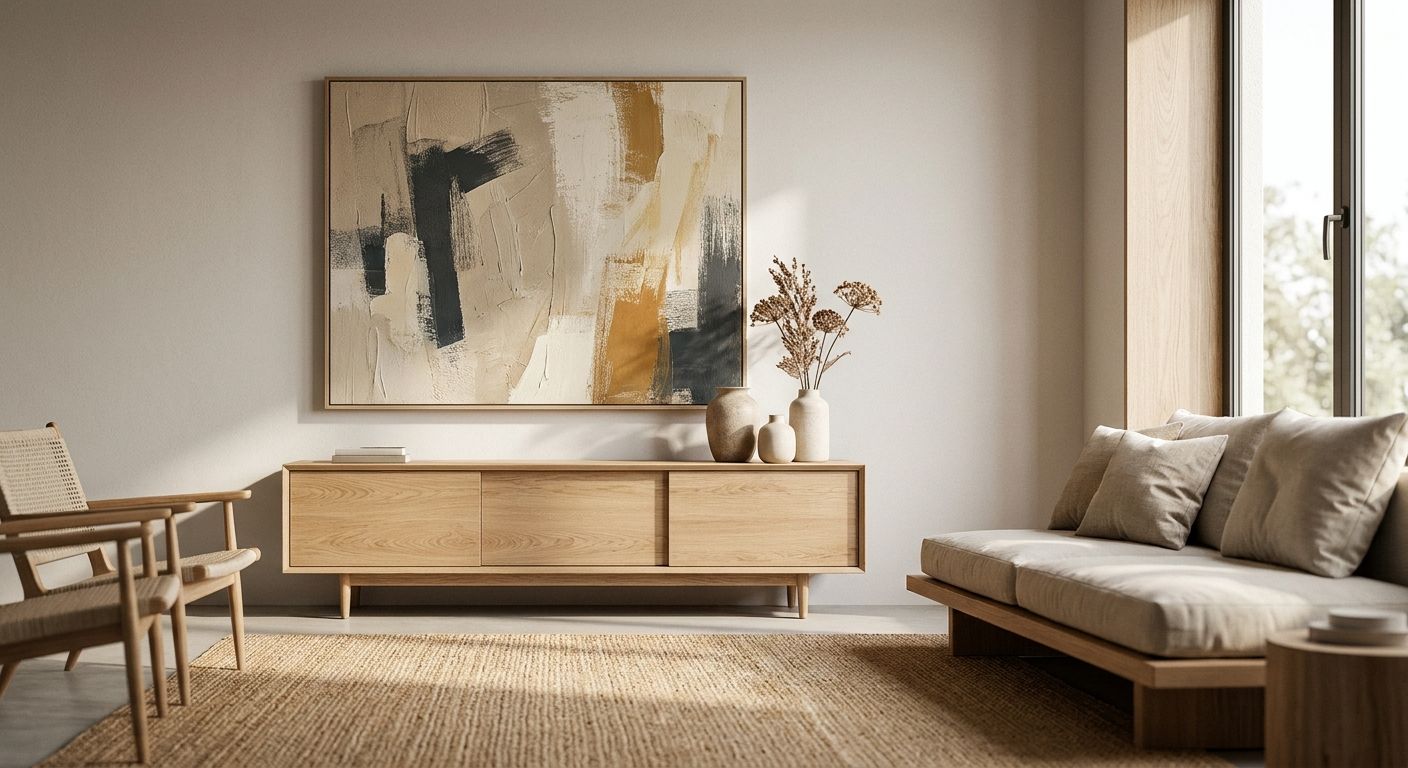
Japandi wall art blends Japanese restraint with Scandinavian warmth, and picking the right piece comes down to matching muted palettes and negative space to how the room actually gets used. This guide ranks five wall art categories for a Japandi-style home in 2026, plus exactly where each one earns its wall space.
- Minimalist abstract line art is the best overall japandi wall art for open-plan living rooms in 2026.
- Botanical prints add organic warmth without breaking Japandi's restraint rule, best for reading nooks and home offices.
- Terracotta and earthy abstracts carry the wabi-sabi half of japandi wall art, best for feature walls and dining rooms.
- Black and white ink-wash prints suit entryways and hallways but need a timber frame to avoid feeling cold.
- Scale matters more than subject: fewer, larger japandi wall art pieces read calmer than several small frames.
Why this matters
Japandi rooms fail one of two ways: too bare to feel intentional, or too busy to feel calm. Wall art carries more weight here than in a maximalist home, because Japandi furniture is deliberately quiet — oak, linen, low profiles — and leaves the walls to do the talking. Get the palette wrong and a Japandi living room reads like an empty rental; get it right and one piece anchors the whole room. Gioia Wall Art's guide to minimalist wall art covers the restraint side of that equation, but Japandi adds a second layer: warmth. That balance is what the rest of this guide ranks against.
What makes the best japandi wall art in 2026
- Muted, low-saturation palette — sand, clay, sage, charcoal, never neon or high-gloss primary colour
- Natural materials and finishes — raw timber frames, unframed canvas, matte paper over glossy poster stock
- Negative space and restraint — one or two larger pieces beat a wall crowded with small frames
- Organic or abstract subject matter — landscape, botanical or abstract form over literal, busy figuration
- Handmade-reading texture — linework, ceramic tones, plaster-like abstracts that avoid looking mass-produced
- Scale that respects the room — a piece sized for the wall, not squeezed in to fill a gap
A useful gut check: if a piece needs a caption to explain why it's on the wall, it doesn't belong in a Japandi room.
“If a piece needs a caption to explain why it's on the wall, it doesn't belong in a Japandi room.”
Japandi wall art at a glance
| Category | Best for | Standout feature | Key limitation |
|---|---|---|---|
| Minimalist abstract line art | Open-plan living rooms | Large negative space reads calm across long sightlines | Can feel flat in rooms that want more colour |
| Scandinavian-toned nature photography | Light-filled bedrooms | Soft grain and pale tones lean into the Nordic half of Japandi | Runs cool without a warm textile or timber nearby |
| Botanical and muted greenery prints | Reading nooks and home offices | Organic shapes soften the hard lines of Japandi furniture | Busy botanical patterns break the restraint rule fast |
| Terracotta and warm earthy abstracts | Dining rooms and feature walls | Clay and rust tones carry the wabi-sabi half of the look | Needs a neutral wall behind it or the room tips too warm |
| Black and white ink-wash prints | Entryways and hallways | Near-zero colour keeps narrow sightlines quiet | Reads cold without a timber or oak frame |
1. Minimalist abstract line art: best japandi wall art for open-plan living rooms
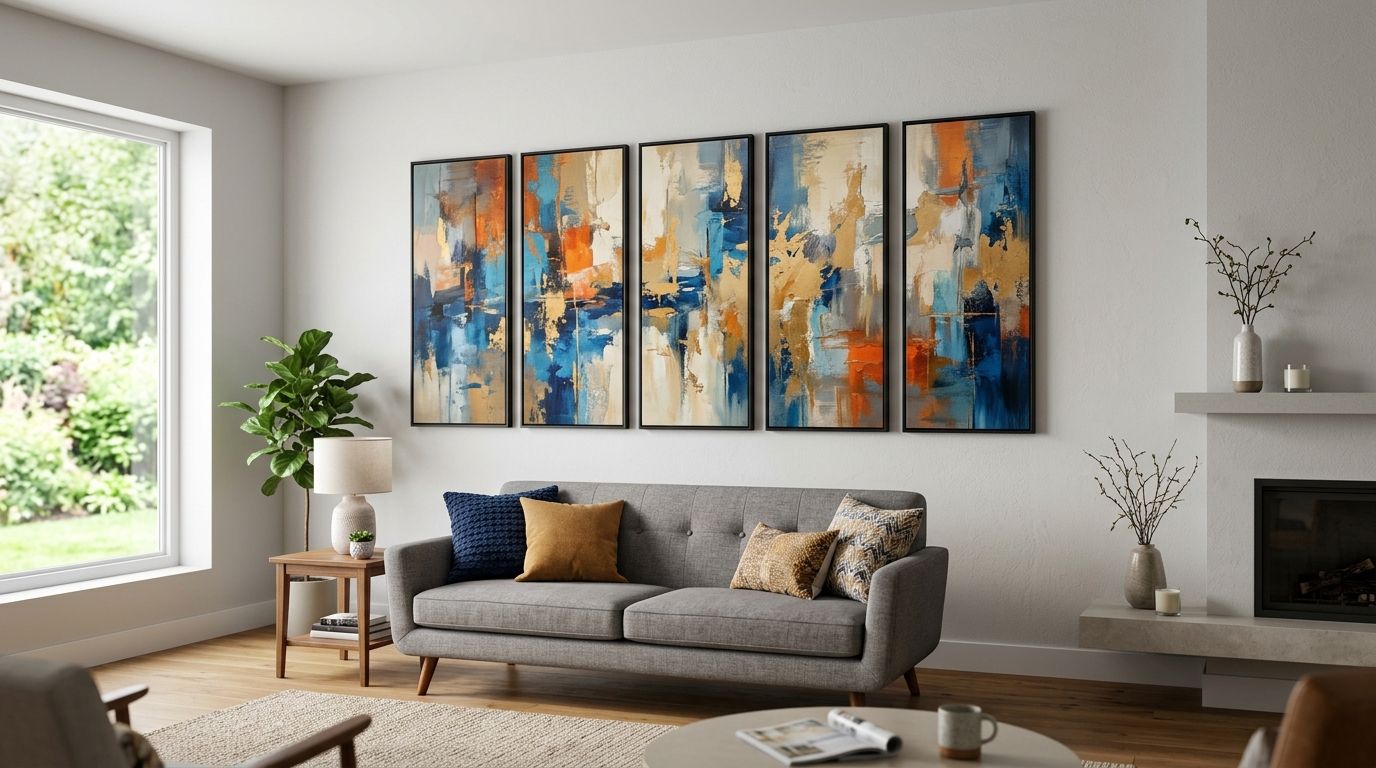
A single large abstract, painted in two or three muted tones with wide negative space, does the heaviest lifting in a Japandi living room. It gives the eye one thing to land on across an open-plan layout instead of competing with a kitchen island, a dining table and a sofa all in the same sightline. Gioia Wall Art's minimalist collection leans hard into this — fewer lines, more air.
Minimalist abstract line art pros:
- Reads calm from across an open-plan space, not just up close
- Works above a sofa, a console or a stairwell without resizing
- Pairs with almost any Japandi timber tone, from oak to walnut
Minimalist abstract line art cons:
- Can feel flat or cold in a room that already lacks colour
- Not a fit for anyone wanting a busier, gallery-wall look
Best for: open-plan living and dining zones. Verdict: Buy — this is the safest starting point for a first Japandi wall.
2. Scandinavian-toned nature photography: best japandi wall art for light-filled bedrooms
Pale, soft-grain landscape or forest photography brings the Scandinavian half of Japandi into a bedroom without adding visual noise. It works best in rooms that already get good natural light, since the pale tones need daylight to avoid looking washed out under lamp light alone. Gioia Wall Art's guide to Scandinavian-inspired wall art is built around this exact palette.
Scandinavian-toned nature photography pros:
- Soft, low-contrast tones suit a room meant for winding down
- Photography ages better than trend-driven graphic prints
- Frames well in raw oak, which most Japandi bedrooms already use
Scandinavian-toned nature photography cons:
- Loses impact in a north-facing room with limited daylight
- Can skew too cool without a warm rug or throw to balance it
Best for: bedrooms with good natural light. Verdict: Buy for bright rooms, Skip for dim ones.
3. Botanical and muted greenery prints: best japandi wall art for reading nooks and home offices
Botanical prints in muted sage, olive or dusty green add the organic texture Japandi rooms lean on, without the maximalist floral patterns that clash with the style's restraint. A single stem or leaf study, printed large, does more for a Japandi reading nook than a cluster of smaller botanical frames. Gioia Wall Art's botanical wall art collection is worth browsing for the muted end of that range specifically.
Botanical and muted greenery prints pros:
- Softens hard-edged Japandi furniture lines with organic shapes
- Works in small rooms since a single print carries the whole space
- Pairs naturally with real plants already common in Japandi styling
Botanical and muted greenery prints cons:
- Busy, multi-colour botanical patterns break the restraint rule fast
- Overly literal florals can tip a room toward cottage style instead
Best for: home offices and reading nooks. Verdict: Buy, but stick to one dominant tone per print.
4. Terracotta and warm earthy abstracts: best japandi wall art for dining rooms and feature walls
The wabi-sabi half of Japandi calls for warmth, and terracotta, clay and rust-toned abstracts deliver it without abandoning the muted palette rule. This category works hardest as a single feature-wall piece in a dining room, where the warmth reads as inviting rather than overwhelming. Gioia Wall Art carries a dedicated terracotta and warm earthy range for exactly this brief, worth checking directly on the site.
Terracotta and warm earthy abstracts pros:
- Adds warmth to a Japandi room without introducing pattern or clutter
- Reads well in both large canvas and framed print formats
- Complements linen, rattan and other Japandi-favoured textures
Terracotta and warm earthy abstracts cons:
- Needs a neutral wall colour behind it, or the room tips too warm
- Not the right fit for a Japandi space already heavy on timber tones
Best for: dining rooms and single feature walls. Verdict: Buy for warm-leaning rooms, Hold if the space already runs warm.
5. Black and white ink-wash prints: best japandi wall art for entryways and hallways
Near-monochrome ink-wash or line-based prints suit narrow sightlines like entryways and hallways, where a busy or colourful piece competes with everything passing through the space. This is the lowest-commitment pick on the list and the easiest to swap out later. Gioia Wall Art's monochrome range covers this end of the palette in more depth for anyone building a full hallway run.
Black and white ink-wash prints pros:
- Near-zero colour keeps a narrow hallway feeling quiet, not cluttered
- Easy to run as a matched series along a staircase or corridor
- Cheapest way to test the Japandi look before committing to a feature wall
Black and white ink-wash prints cons:
- Reads cold and clinical without a timber or oak frame around it
- Least memorable option if the room only has space for one piece
Best for: entryways, hallways and stairwells. Verdict: Buy as a supporting piece, Skip as the room's only artwork.
Consider peel-and-stick wallpaper for a Japandi accent wall
A muted, nature-led wallpaper pattern does the same job as botanical wall art but covers a whole wall instead of one frame — useful behind a bed or in a small powder room where a single print won't carry the space. Pattern choice matters more here than in framed art, since wallpaper repeats across the entire wall.


How Gioia Wall Art ranked these picks
Each category is scored against the same six criteria: muted palette, natural materials, negative space, organic or abstract subject matter, handmade-reading texture and room-appropriate scale. Minimalist abstract line art tops the list because it satisfies all six with the least risk of clashing with existing Japandi furniture. The lower-ranked picks — terracotta abstracts and black and white ink-wash — score just as well on the criteria but suit narrower use cases, which is why they sit further down rather than dropping off the list.
Which japandi wall art should you choose?
For most Japandi living rooms in 2026, start with one large minimalist abstract above the main sofa or console — it satisfies every criterion above and gives the room a single, calm focal point. Add botanical prints in a reading nook once the main space is settled, then layer in terracotta tones for a dining wall if the room still feels flat. Skip black and white ink-wash entirely unless there's a hallway or entryway to fill first.
FAQ
What is Japandi wall art?
Japandi wall art combines Japanese minimalism with Scandinavian warmth: muted, low-saturation colours, natural materials like raw timber frames or unframed canvas, and abstract or organic subject matter over busy patterns. It favours fewer, larger pieces over cluttered gallery walls.
What colours work best for Japandi wall art?
Sand, clay, sage, charcoal and soft off-white dominate Japandi wall art in 2026. Bright primaries, neon tones and high-gloss finishes work against the style's calm, restrained palette.
Should Japandi wall art be framed or unframed?
Both work, but raw timber or oak frames suit Japandi's natural-material rule better than glossy black or ornate frames. Unframed canvas is also common since it keeps the piece looking simple and unfussy.
How much wall art is too much in a Japandi room?
One or two larger pieces per wall is the Japandi standard, not a cluster of small frames. If a wall feels busy or crowded, it has moved away from the style's core restraint principle.
Is black and white art Japandi style?
Yes, near-monochrome ink-wash or line-based prints fit Japandi well, particularly in entryways and hallways. Pair them with a timber or oak frame so the look doesn't read too cold or clinical.
What size wall art suits a Japandi living room?
A single large piece, sized to fill roughly two-thirds the width of the furniture below it, suits a Japandi living room better than several small prints. Scale that respects the room is one of the style's core criteria.
Can botanical prints work in a Japandi home?
Muted, single-tone botanical prints work well in Japandi homes, especially in reading nooks and home offices. Busy, multi-colour floral patterns break the style's restraint and tip the room toward a different aesthetic.
Is Japandi wall art the same as Scandinavian wall art?
No, Scandinavian wall art covers only the pale, minimalist half of the equation. Japandi wall art adds warmth through earthy, wabi-sabi-influenced tones like terracotta and clay that pure Scandinavian styling tends to skip.
One last thing
Most Japandi guides skip hanging height entirely, but it changes how a piece reads. The standard gallery convention centres artwork around 145cm from the floor for a standing eye line; Japandi rooms often hang slightly lower than that, closer to seated eye level, because the style is built around low furniture and floor-level living. Before buying a second piece, measure against the sofa arm or bed frame already in the room — in a Japandi space, that furniture line matters more than the standard gallery rule.