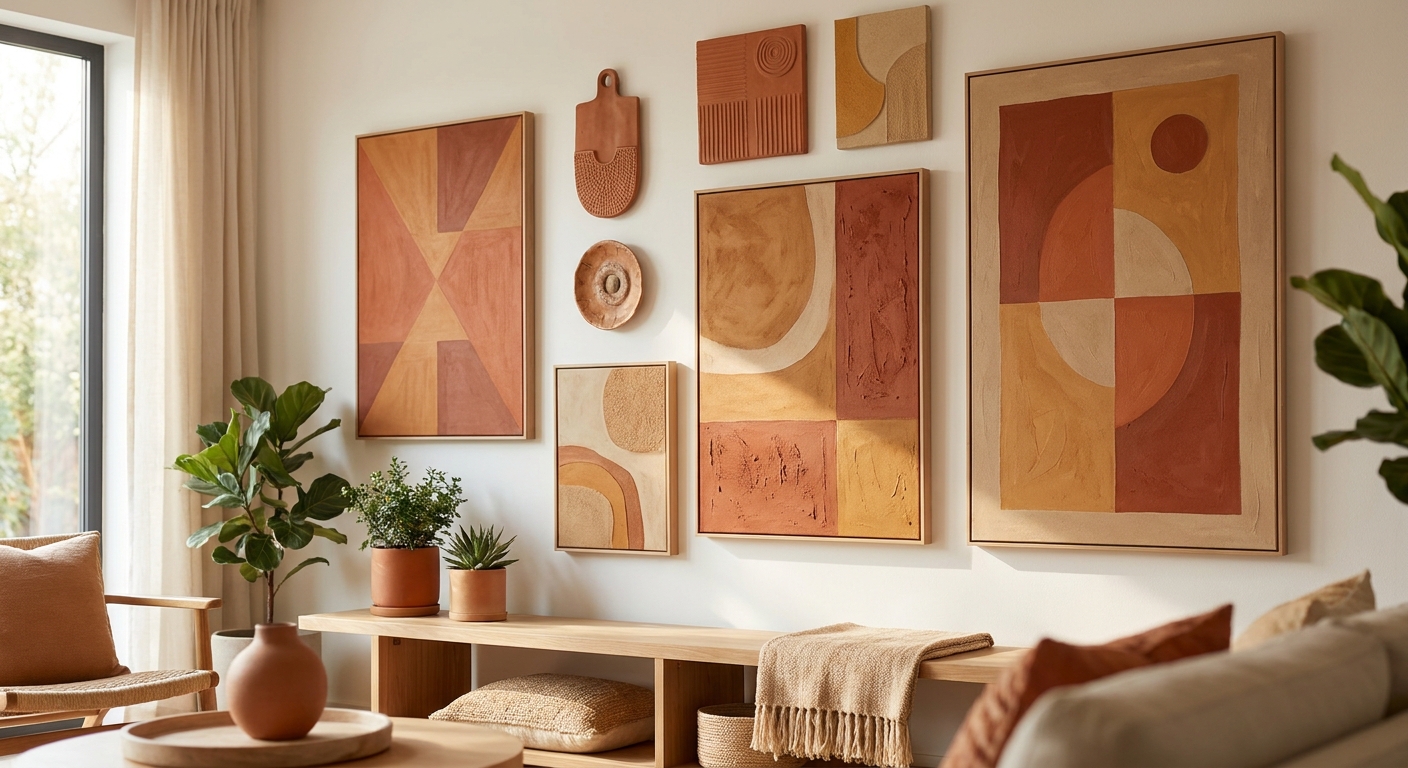
Terracotta wall art brings the warmth of ochre, rust and sun-baked clay into rooms that lean too cold or too matched. This guide breaks down what actually makes terracotta wall art work in a 2026 home, and which pieces are worth buying versus skipping.
- Terracotta wall art pairs best with warm timber, linen and brass — clash-free, not matchy. Buy.
- Arltunga by Pamela Gleeson captures Red Centre ochre tones at $545 — the safe terracotta pick.
- Skip stark white gallery walls with high-gloss frames; the contrast reads harsh, not curated.
- Growing Toward the Sun ($1,340) suits a single statement wall above a sofa or console.
Why this matters
Terracotta has moved past a trend footnote — 2026 interior moodboards keep pulling it in as the answer to all-white, all-grey rooms that feel flat under photography and flatter still in daylight. The colour reads as warm without being loud, which is why it shows up on feature walls, above sofas and in reading nooks that need one grounding note.
The risk is picking a print that looks terracotta on a screen and reads orange on a wall. Gioia Wall Art's curated collection leans on artists working directly with Australian landscape tones, which is a more reliable route than a generic stock print in a similar hex code.
Who this is for
This guide is built for homeowners and renters furnishing a living room, bedroom or hallway who want one warm anchor piece rather than a full colour overhaul. It suits Hamptons, Japandi and Coastal Luxe interiors where terracotta plays a supporting role, and bolder maximalist rooms where it's the headline. It is not for anyone chasing a strict monochrome palette — terracotta wall art needs at least one other warm surface in the room to land.
What to look for in terracotta wall art for modern homes
Undertone match
Terracotta swings from dusty pink-clay to deep burnt-orange, and the wrong undertone fights your existing palette instead of completing it. A cool-toned terracotta print next to warm oak flooring looks like a mismatch photographed at the wrong time of day. Check the undertone against your flooring and largest soft-furnishing colour before buying, not against the wall paint alone.
Texture and finish
Canvas absorbs light and softens a terracotta tone; a framed print under glass sharpens it and can throw glare in a north-facing room. Original paintings carry visible brushwork that reads as texture from across the room, which matters more in terracotta than in cooler palettes because texture is doing half the warmth work. For a room with big windows, canvas usually wins over glass-framed prints.
Scale for the wall
A 60x90cm terracotta piece on a 3-metre wall reads as decoration; the same tone at 100x150cm reads as a design decision. Terracotta specifically needs scale because a small warm patch on a large pale wall looks like an afterthought, not a feature. Measure the wall, not just the furniture below it, before committing to a size.
Companion palette
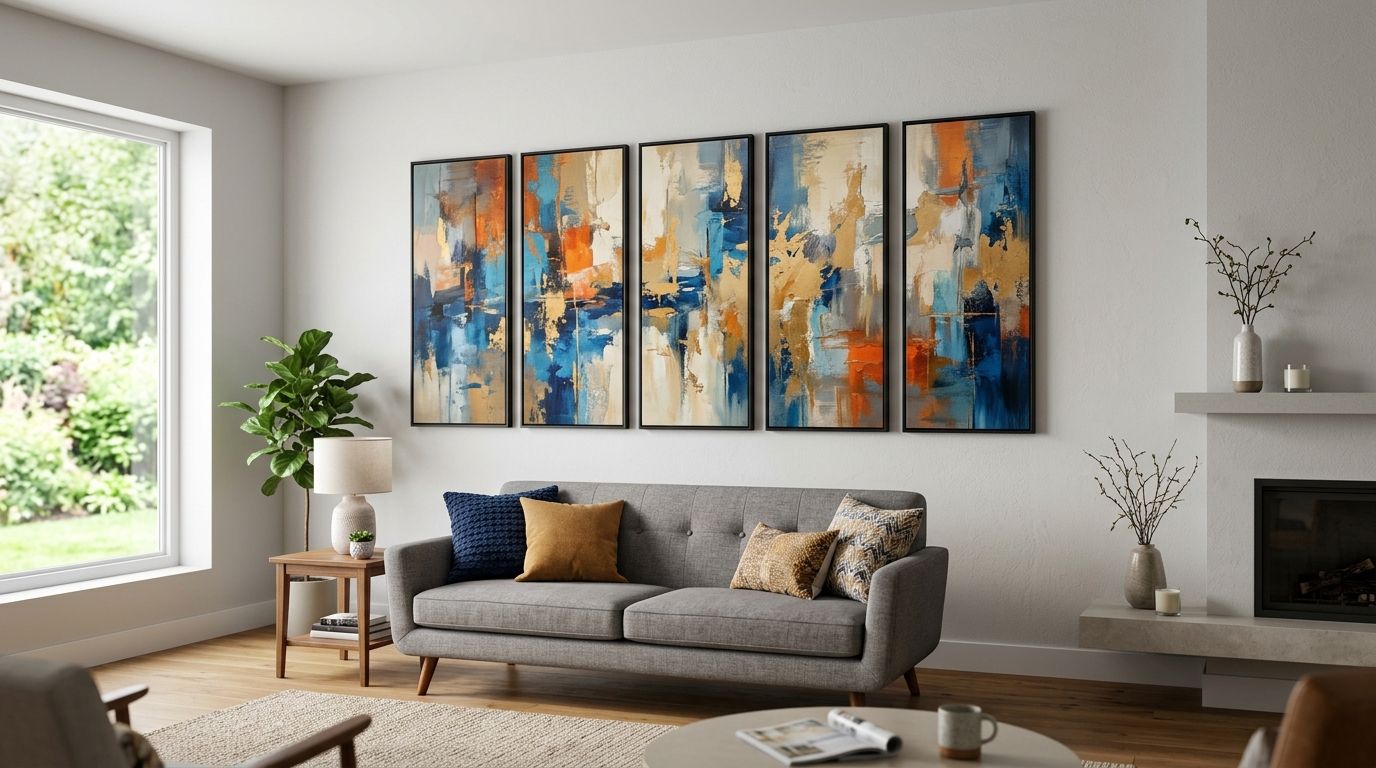
Terracotta wall art works hardest when it's echoed once elsewhere in the room — a linen cushion, a timber shelf, a brass tap. If you're unsure what to pair it with, matching wall art colours to your existing sofa is the fastest way to avoid a piece that fights the room instead of finishing it.
Original versus print budget tier
An original terracotta-toned painting runs from roughly $450 to $4,300 in the Gioia range reviewed for this guide, while framed prints of similar tones sit well below that. Originals carry brushwork and one-off status; prints are the practical choice for renters or anyone furnishing multiple rooms in 2026 on one budget.


Top picks
Arltunga by Pamela Gleeson — the safe pick. This original captures the remains of a historic gold mining town in the Eastern MacDonnell Ranges, and the ochre-and-rust palette is about as authentically terracotta as it gets without leaving Australia. At $545, it's priced like a print but delivers an original's texture. Buy for a hallway or reading nook that needs one warm anchor.
Growing Toward the Sun — the statement pick. Part of Alanah Jarvis's Weathered Nature Series, this piece leans into warm, sun-worn tones at $1,340, sized to hold its own on a wall wider than 2.5 metres. It's the pick for a living room feature wall where terracotta needs to do the heavy lifting alone. Buy if you're building the room around this one piece.
The Road Home — the wildcard. A country lane scene between Ballarat and Daylesford, priced at $545, with a lighter, more diffused warm tone than the other two. It suits a bedroom or reading corner better than a busy living space because the drama is quieter. Consider if your terracotta needs to whisper rather than announce itself.
What to avoid
- High-gloss glass frames in north-facing rooms — terracotta already runs warm, and glare from glass over a warm tone reads cheap in photos, even when it looks fine in person.
- Stark white minimalist walls with zero other warm surfaces — a single terracotta print on an otherwise all-white, all-cool room looks stranded rather than intentional.
- Undersized prints on oversized walls — a 40x50cm terracotta piece on a 3-metre wall reads as an afterthought no matter how good the tone is.
Verdict at a glance
| Pick | Tone | Size feel | Price | Verdict |
|---|---|---|---|---|
| Arltunga | Ochre/rust | Small-mid wall | $545 | Buy |
| Growing Toward the Sun | Warm sun-worn | Large feature wall | $1,340 | Buy |
| The Road Home | Soft diffused warm | Small-mid wall | $545 | Consider |
FAQ
What is terracotta wall art?
Terracotta wall art is any print, canvas or original painting dominated by warm clay, ochre or burnt-orange tones. It's used to add warmth to rooms styled in neutral, white or grey palettes.
Is terracotta wall art still trending in 2026?
Yes, terracotta remains a strong pick in 2026 interior styling because it warms up minimalist and Scandinavian rooms without introducing a full new colour scheme. It works as a single accent piece rather than a redesign.
What wall colour goes with terracotta wall art?
Warm white, sage green and deep navy all sit well against terracotta wall art. Cool grey walls can work too, provided the room has at least one other warm surface, like timber flooring or a linen throw.
Should terracotta wall art be framed or unframed?
Canvas or unframed prints suit terracotta best in bright, north-facing rooms because they avoid the glare that glass-framed prints throw. Framed prints work better in darker rooms where reflection isn't an issue.
How much does terracotta-toned original art cost in Australia?
Original terracotta-toned paintings reviewed for this guide range from $450 to $4,300 in 2026, depending on size and artist. Framed and canvas prints in similar tones cost considerably less.
Can terracotta wall art work in a small apartment?
Yes, a smaller terracotta piece around 60x90cm works well in an apartment as long as it's paired with one other warm surface nearby, like a timber shelf or rattan chair.
Does terracotta wall art suit a Scandinavian or Japandi interior?
Terracotta wall art suits Japandi interiors particularly well because the style already favours warm timber and clay ceramics. It softens the starker, cooler edges of pure Scandinavian styling.
Where should terracotta wall art be hung for the best effect?
Above a sofa, console table or bed head are the strongest spots because these are the walls a room is designed around. A hallway works too, but scale the piece to the wall width, not just the furniture below it.
One last thing
The piece most people skip over is The Road Home at $545 — it's priced the same as Arltunga but has a quieter, more diffused warmth that suits bedrooms better than any bolder terracotta pick on this list. If you're furnishing a room you actually sleep in rather than one you show guests, that's the one worth a second look.