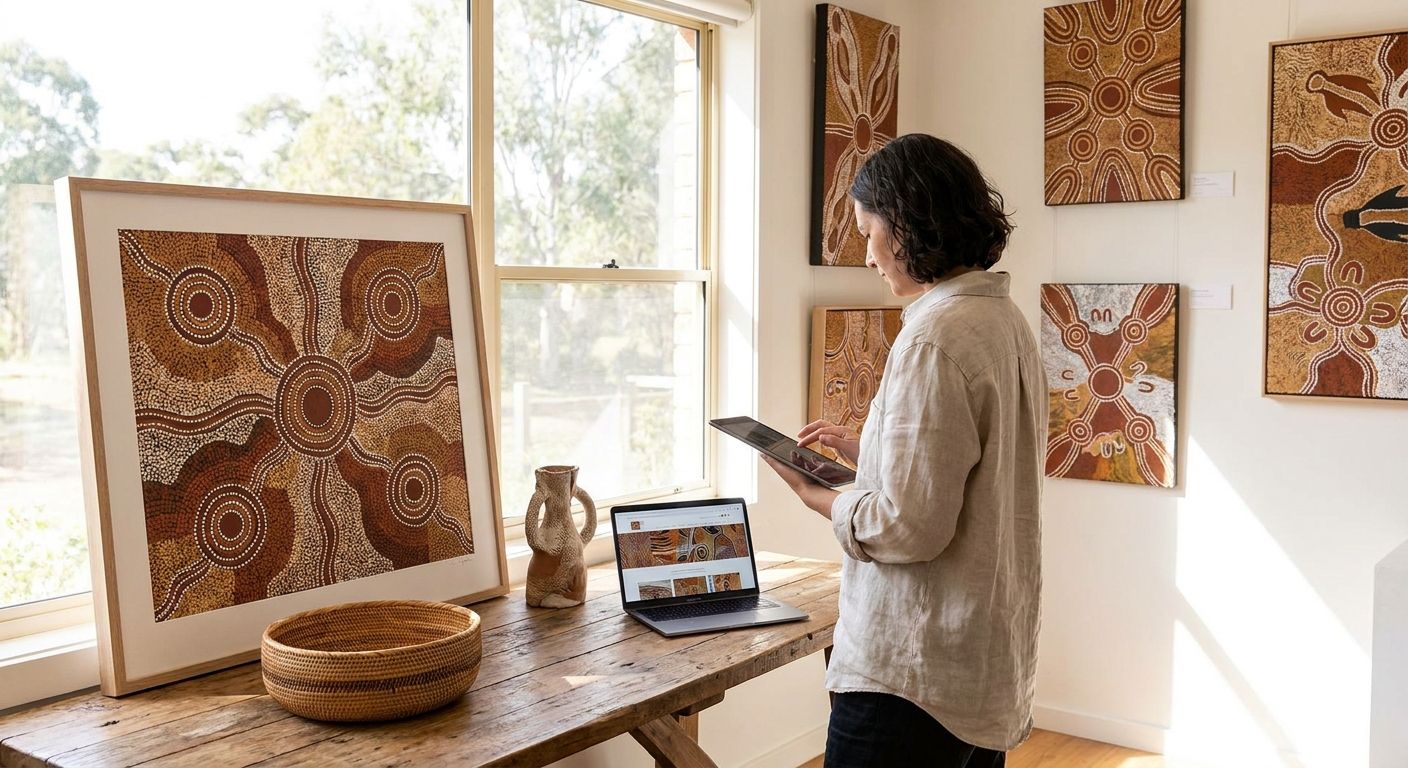
Buying authentic Aboriginal art online in 2026 means going through an Indigenous Art Code signatory, an Aboriginal-owned art centre, or a gallery that discloses full provenance — not a marketplace listing with no artist name attached. The catch most buyers miss: a licensed reproduction print carrying an artist's design is a legitimate purchase, but it is not the same thing as an original, hand-painted work, and plenty of sellers blur that line on purpose.
- Buy authentic Aboriginal art online through Indigenous Art Code signatories or Aboriginal-owned art centres for verified provenance in 2026.
- A certificate naming the artist, community and story is the minimum bar — vague 'Aboriginal-inspired' labels are a red flag.
- Licensed reproduction prints are legitimate but different from originals; know which one you're buying before checkout.
- An estimated 80% of Aboriginal-style souvenirs sold in Australia are not authentic, per the Fake Art Harms Culture campaign.
- The Indigenous Art Code, established in 2010, is the closest thing to an industry standard for ethical dealers.
Why this matters
The Aboriginal art market has a well-documented authenticity problem. Campaigns like Fake Art Harms Culture, run by peak bodies including ANKAAA and Arts Law Centre of Australia, have long flagged that an estimated 80% of Aboriginal-style art and craft sold in Australia carries no real connection to an Aboriginal artist or community.
Online stores that curate original paintings and prints, including Gioia Wall Art, operate under the same basic expectation buyers should hold Aboriginal art sellers to: know who made the work and where it came from. That standard gets harder to enforce online, where a product photo and a short description are often all you get before you pay in 2026.
How to buy authentic Aboriginal art online
Work through these checks before you add anything to cart:
- Confirm Indigenous Art Code status. Ask the seller directly, or check their site footer — signatories commit to a written code of ethical conduct with artists.
- Ask which art centre or community the artist works through. A real answer names a specific centre — Warlukurlangu, Papunya Tula, Buku-Larrnggay Mulka and similar community-owned centres are documented and searchable.
- Read the certificate of authenticity closely. It should name the artist, their language group, and the story behind the piece — not a generic paragraph reused across dozens of listings.
- Ask if it's an original, a licensed print, or an unlicensed reproduction. Get the answer in writing before you pay, not after.
- Search the artist's name independently. Established Aboriginal artists show up through their art centre's own records or past auction results.
- Walk away from listings that can't answer any of the above. No provenance, no purchase.
Buying from Aboriginal-owned art centres
Community-owned art centres represent artists directly and reinvest sale proceeds into the community. Best for: buyers who want the highest confidence in provenance.
Buying from Indigenous Art Code signatory galleries
These are independent dealers who've signed onto a formal code covering fair payment and accurate representation of artists. Best for: buyers who want gallery curation with accountability attached.
Buying licensed reproduction prints
A licensed print uses an artist's design with their consent and usually pays a royalty, but it's a reproduction, not a one-off original. Best for: buyers decorating on a budget who understand they're buying a licensed design, not an original painting.
Buying from unverified marketplace listings
Generic marketplaces and tourist-shop listings frequently can't name the artist, the community, or confirm any licensing. Best for: nobody — skip these entirely.
| Channel | Authenticity assurance | Typical documentation | Best for |
|---|---|---|---|
| Aboriginal-owned art centres | Highest — artist and community verified directly | Certificate with artist name, language group, story | Verified provenance |
| Indigenous Art Code galleries | High — dealer bound by a written code | Certificate plus dealer disclosure statement | Curated selection, accountability |
| Licensed reproduction sellers | Moderate — design licensed, not an original | Licensing statement, not a provenance certificate | Budget decor with a known design |
| Unverified marketplace listings | Low — no artist or community confirmation | Often none, or a vague label | Skip |
Why authenticity varies
- Whether the artist sold through a community-owned art centre or independently
- Whether the piece is an original painting or a licensed reproduction print
- Whether the seller discloses the artist's specific community and language group
- Whether the seller is a signatory to the Indigenous Art Code
- Whether a resold, secondary-market piece still has its original certificate attached
- Whether the design is used with the artist's documented consent under copyright law
Is Aboriginal art sold on Etsy or Amazon authentic?
Some listings are, most aren't verifiable — the platforms don't screen for Indigenous Art Code compliance or artist provenance the way a dedicated art centre does. Treat any Etsy or Amazon listing the same as an unverified marketplace listing: ask for the artist's name, community, and a real certificate before buying.
What's the difference between an original Aboriginal painting and a licensed print?
An original is a single, hand-painted work by a named artist with a certificate tying it to that artist and community. A licensed print reproduces that artist's design across multiple copies under a royalty agreement — legitimate, but a different category of purchase with a different resale and cultural value.
Does the Indigenous Art Code guarantee authenticity?
No — the Indigenous Art Code, established in 2010, sets ethical conduct standards for dealers but doesn't certify individual artworks itself. It tells you the seller has agreed to fair, transparent dealing; you still need the certificate and artist details for the specific piece.
If you're building a broader collection of original paintings alongside Aboriginal art pieces, the same due-diligence habits apply everywhere. Gioia Wall Art's guide on how to tell if an original painting is worth the price walks through checking provenance, signatures and condition before you buy — useful backup reading no matter whose work ends up on your wall.
FAQ
How do I buy authentic Aboriginal art online in 2026?
Buy through an Indigenous Art Code signatory, an Aboriginal-owned art centre, or a gallery that names the artist and community in writing. Avoid any listing that can't answer basic provenance questions.
What percentage of Aboriginal-style art sold in Australia is fake?
An estimated 80% of Aboriginal-style art and souvenirs sold in Australia are not authentic, according to the Fake Art Harms Culture campaign run by ANKAAA and Arts Law Centre of Australia. That figure covers tourist-market souvenirs specifically, not all Indigenous art sales.
Is a certificate of authenticity enough to prove a piece is real?
A certificate is only useful if it names the artist, their language group and the story behind the piece. A generic certificate with no specific details is not proof of anything.
What is the Indigenous Art Code?
The Indigenous Art Code is a voluntary code of conduct, established in 2010, that binds signatory dealers to fair and transparent dealing with Aboriginal and Torres Strait Islander artists. It doesn't certify individual artworks, but signatory status is a strong trust signal.
Can I trust Aboriginal art bought from an overseas seller?
Treat overseas sellers with extra caution — the Indigenous Art Code only binds Australian signatories, so an overseas listing has no equivalent accountability layer. Ask for the same artist and community details you'd demand from a local dealer.
Is a licensed Aboriginal art print a fake?
No — a licensed print is legitimate when the artist consented to the reproduction and receives a royalty, but it is not an original painting. Sellers should state clearly whether you're buying a licensed print or an original work.
How do I check if an Aboriginal artist is real?
Search the artist's name against their stated art centre's own records or past auction results. Established Aboriginal artists working through community art centres are documented independently of any single seller's listing.
One last thing
The detail most buyers skip: ask which language group the artist belongs to, not just their name. A real certificate names it specifically — a fake one almost never does, because the seller doesn't know it either.