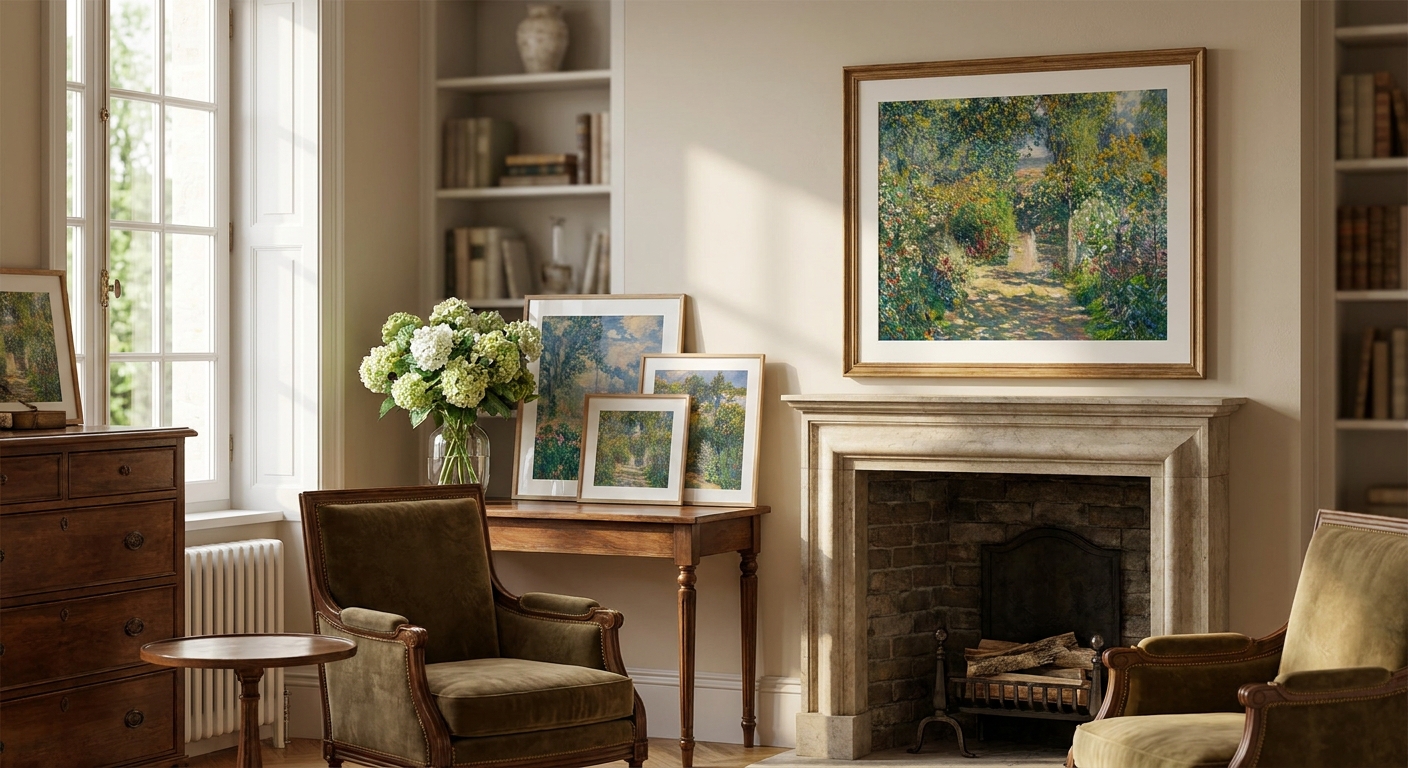
Impressionist art prints work in traditional interiors when the palette stays warm, the framing stays formal, and the subject matter leans toward gardens, water and pastoral scenes rather than abstract colour blocks.
- Claude Monet prints suit Hamptons-style and traditional lounge rooms best -- buy framed, warm-toned pieces.
- Impressionist art prints for traditional interiors need gilt or timber frames, not thin black metal.
- Skip high-contrast, cool-toned impressionist reproductions -- they read modern, not classic.
- Original impressionistic Australian landscapes work as a one-off statement over a mantel or hallway console.
- 2026 marks 100 years since Monet's death, which has pushed demand for water-lily and garden prints back up.
Why this matters
Traditional interiors run on symmetry, warm timber tones and a sense of history in the room -- which is exactly what pulls people toward Impressionism instead of anything more graphic or abstract. The movement was already a reaction against rigid academic painting back in 1874, and that same softness is why it still reads as "classic" in a panelled dining room or a Hamptons-style hallway in 2026.
The mistake most buyers make is treating any Monet or Renoir reproduction as automatically "traditional." A cool-toned, high-contrast impressionist print in a thin black frame looks contemporary, not classic, no matter whose name is on the canvas. Choosing well means matching the palette and the framed wall art prints presentation to the room, not just the artist.
Who this is for
This guide is for homeowners furnishing a traditional or transitional living space -- think Hamptons, classic Georgian-influenced homes, or a heritage renovation with cornicing and timber floors intact. It's also useful for anyone styling a formal dining room or entry hall who wants art that feels established rather than trendy, and for renovators who've already committed to a warm, layered colour scheme and need wall art that won't fight the sofa or the curtains.
What to look for in impressionist art prints for traditional interiors
Warm, layered colour over stark contrast
Traditional rooms rely on tonal warmth -- cream walls, timber tones, brass fittings -- so an impressionist print with warm ochres, dusty pinks or soft greens will sit far more naturally than one built on cool blues and hard shadow. Cross-check any print against your existing palette before buying; the wall art colours that match your sofa guide is the fastest way to do that without a swatch book.
Framed presentation, not a raw canvas edge
A raw-edge stretched canvas reads casual and modern. Traditional interiors want a print behind glass in a timber or gilt-effect frame, which instantly signals "considered" rather than "quick Kmart run." This one criterion does more to make a print feel traditional than the subject matter itself.
Classic subject matter: gardens, water, pastoral scenes
Water lilies, formal gardens, harbour scenes and countryside landscapes are the safest subject choices for a traditional room. Anything abstract-leaning or urban-industrial, even if painted in an impressionist brush style, will clash with wainscoting and antique-style furniture.
Scale that matches the room's proportions
Traditional rooms often carry higher ceilings and formal furniture groupings, which means undersized prints get swallowed. Measure the wall and the seating distance before choosing dimensions, and use the right size wall art for your wall guide if you're unsure between a single large statement piece and a grouped arrangement.
Brushwork that reads well under warm lighting
Impressionism relies on visible brushwork and texture, and that texture either glows or flattens depending on your lighting. Warm, low lamplight (common in traditional interiors) flatters textured impressionist prints far more than cool overhead downlights do -- check your fittings before committing to a heavily textured piece.
Top picks for 2026
The safe pick: Claude Monet prints for Hamptons-style homes. Monet's garden and water scenes are the single most reliable entry point into Impressionism for a traditional room, and 2026's centenary of his death has kept demand for his water-lily series steady all year. One specific number worth knowing: Monet painted over 250 canvases in his water-lily series alone, so there's genuine variety to choose from rather than the same three prints everywhere. Buy the Claude Monet prints for Hamptons-style homes collection if your room leans coastal-traditional.
The investment pick: an original impressionistic landscape. A one-off original painting carries more weight over a mantel than any reproduction, and it ages better in a formal room because no one else on the street has the same piece. Buy if you have a single feature wall that needs a conversation piece rather than a repeated motif.
The wildcard: watercolour florals with an impressionist hand. Watercolour naturally softens edges the way oil-based Impressionism does, which makes it an easy substitute when a full Monet-style piece feels too literal for the room. Consider this route for a hallway or reading nook rather than the main living space.


What to avoid
- High-gloss acrylic block mounts. They look premium in a showroom photo but read cold and modern the second they hang next to timber furniture -- wrong finish for a traditional room even with the right subject.
- Impressionist-inspired abstracts with no recognisable scene. These borrow the brushwork but drop the garden, water or pastoral subject that makes the style feel classic, and they end up reading as generic modern art instead.
- Undersized prints in oversized frames. A common styling mistake in period homes: the frame dominates and the artwork itself disappears, which defeats the point of choosing Impressionism for its detail.
Verdict comparison
| Pick | Best for | Frame style | Verdict |
|---|---|---|---|
| Claude Monet prints (Hamptons collection) | Coastal-traditional living rooms | Timber or white-washed frame | Buy |
| Original impressionistic landscape | Feature wall over a mantel | Gallery frame or unframed canvas | Buy |
| Watercolour florals | Hallways, reading nooks | Light timber frame | Consider |
| High-gloss abstract impressionist print | Modern or transitional spaces only | N/A for traditional rooms | Skip |
FAQ
What are the best impressionist art prints for traditional interiors?
Claude Monet's garden and water-lily prints are the safest choice for traditional interiors in 2026 because their warm palette and pastoral subject matter match panelled walls and timber furniture. Look for a timber or gilt-effect frame rather than a raw canvas edge.
Is Monet or Renoir better for a traditional living room?
Monet's landscapes and water scenes generally suit traditional rooms better than Renoir's figure-heavy portraits, which can feel busier on a formal wall. Renoir works well in a reading nook or smaller accent space instead.
Should impressionist prints be framed or unframed for a traditional home?
Framed is the safer choice for a traditional interior -- an unframed, raw-edge canvas reads casual and works better in a modern or industrial room. A timber or gilt frame instantly reads more classic.
How much does an original impressionistic painting cost in Australia?
Original impressionistic-style paintings from independent artists typically range from a few hundred dollars for smaller watercolours up to several thousand for larger statement canvases. Reproduction prints cost considerably less than an original.
What size impressionist print works over a traditional mantel?
A single large piece or a symmetrical pair usually works better over a mantel in a traditional room than a small gallery cluster. Measure the mantel width and leave roughly 10 to 15 cm of breathing room on either side.
Do impressionist prints work in a traditional dining room?
Yes -- garden, harbour and pastoral scenes are common choices for traditional dining rooms because they hold up well under warm pendant lighting. Avoid anything with cool, high-contrast tones in a room lit mostly by candlelight or warm bulbs.
What's the difference between Impressionism and Post-Impressionism for interior styling?
Impressionism (Monet, Renoir) favours soft light and blended colour, which suits traditional rooms, while Post-Impressionism (Van Gogh, Cezanne) uses bolder colour and shape that leans more toward Scandinavian or contemporary interiors. Choose based on the room's existing colour intensity, not just the era.
Can impressionist art prints work with antique furniture?
Impressionist prints pair well with antique and reproduction-antique furniture because both share a sense of established, unhurried style. Keep the frame finish consistent with the furniture's timber tone for the best match.
One last thing
Most people default to Monet's water lilies because they're the most recognisable Impressionist image, but a garden or harbour scene from the same period often blends into a traditional room more quietly and lasts longer without feeling like a cliché print everyone recognises from a coffee mug.