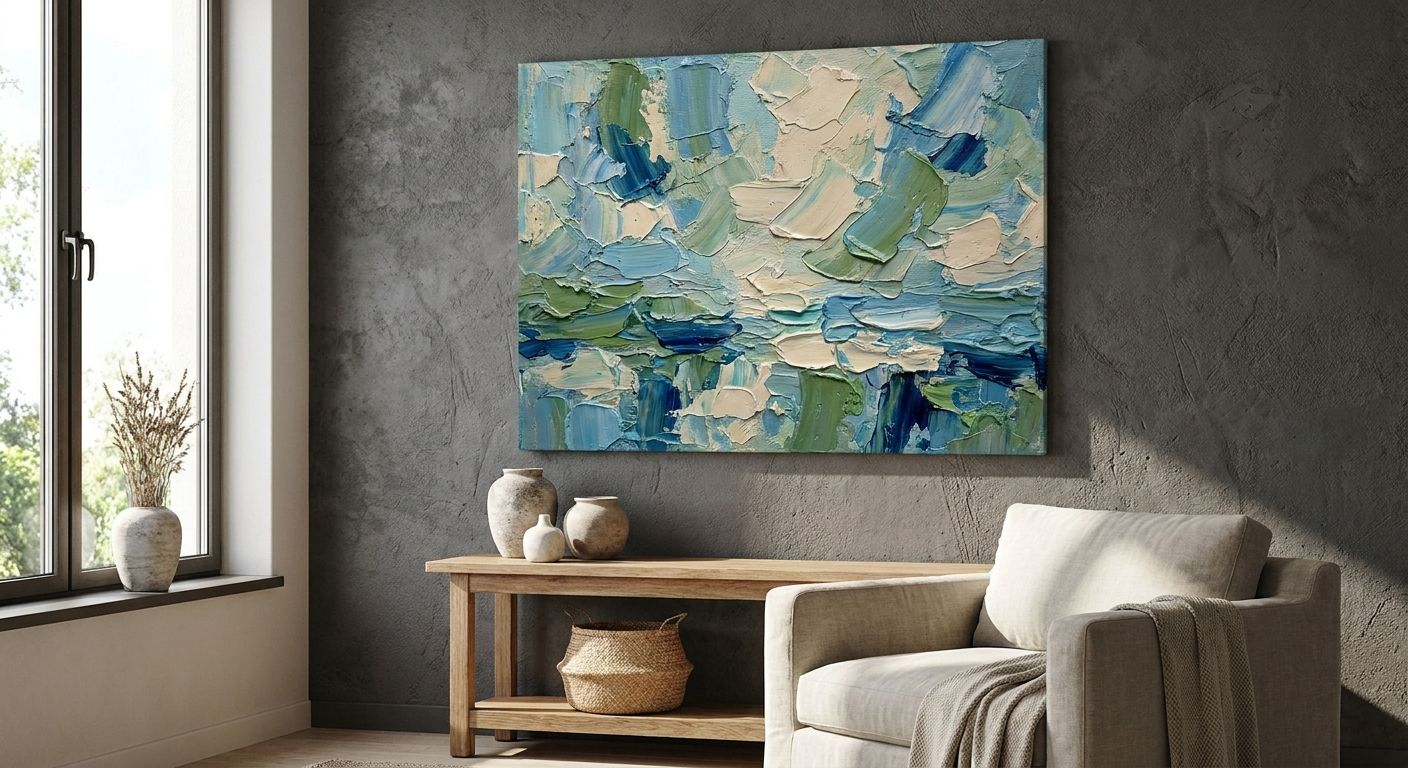
Hand painted canvas art for a textured feature wall is original, brush-worked artwork made directly on canvas, where the paint itself creates ridges, drips or knife strokes you can see and feel from across the room. For homeowners building a feature wall, that surface texture is the whole point: a flat print reads the same from every angle, while a hand-painted piece catches light differently as you walk past it, which is exactly what turns one wall into the focal point of a room.
This segment isn't shopping for decoration. They're shopping for a statement, usually in a living room, entryway or above a sofa, and they need guidance on scale, texture and placement that a generic wall art article skips over. Gioia's best statement wall art for a feature wall guide covers the wider category; this one is specific to hand-painted canvas and the texture question.
- Hand painted canvas art wins for feature walls because visible brushwork adds dimension a flat print cannot replicate.
- Measure the wall first: a single canvas should span 60-75% of the available wall width to read as a focal point.
- Original paintings from Gioia Wall Art suit buyers who want one textured statement piece; textured canvas prints suit buyers who need an exact size match.
- Direct sun fades pigment on hand-painted canvas faster than on sealed prints, so plan placement before you plan the piece.
Why hand painted canvas art matters for feature walls
A feature wall fails when the art is too flat, too small, or too matched to the room to actually stand out. Hand-painted canvas solves the first problem structurally. The paint has physical height, so it reads as three-dimensional even under flat overhead lighting.
It is also the piece people ask about when they walk into the room, which is the functional job of a feature wall in 2026: the backdrop for the photo, the thing a guest comments on, the reason the room doesn't look like a display home. That's a different brief than art chosen to blend in, and it changes every decision below.
Measure your feature wall before you choose a piece
The biggest mistake is picking the art first and the wall second. Work from the wall's dimensions, not the piece you liked on a screen.
- Measure the full width of the wall, not just the furniture beneath it
- Aim for the artwork or arrangement to span 60-75% of that width
- Leave at least 15-20cm of breathing room on either side
- Check ceiling height: a single tall canvas often reads better than a wide one under standard 2.4m ceilings
- Photograph the wall in daytime and evening light before ordering anything
Decide on one dominant piece vs a grouped arrangement
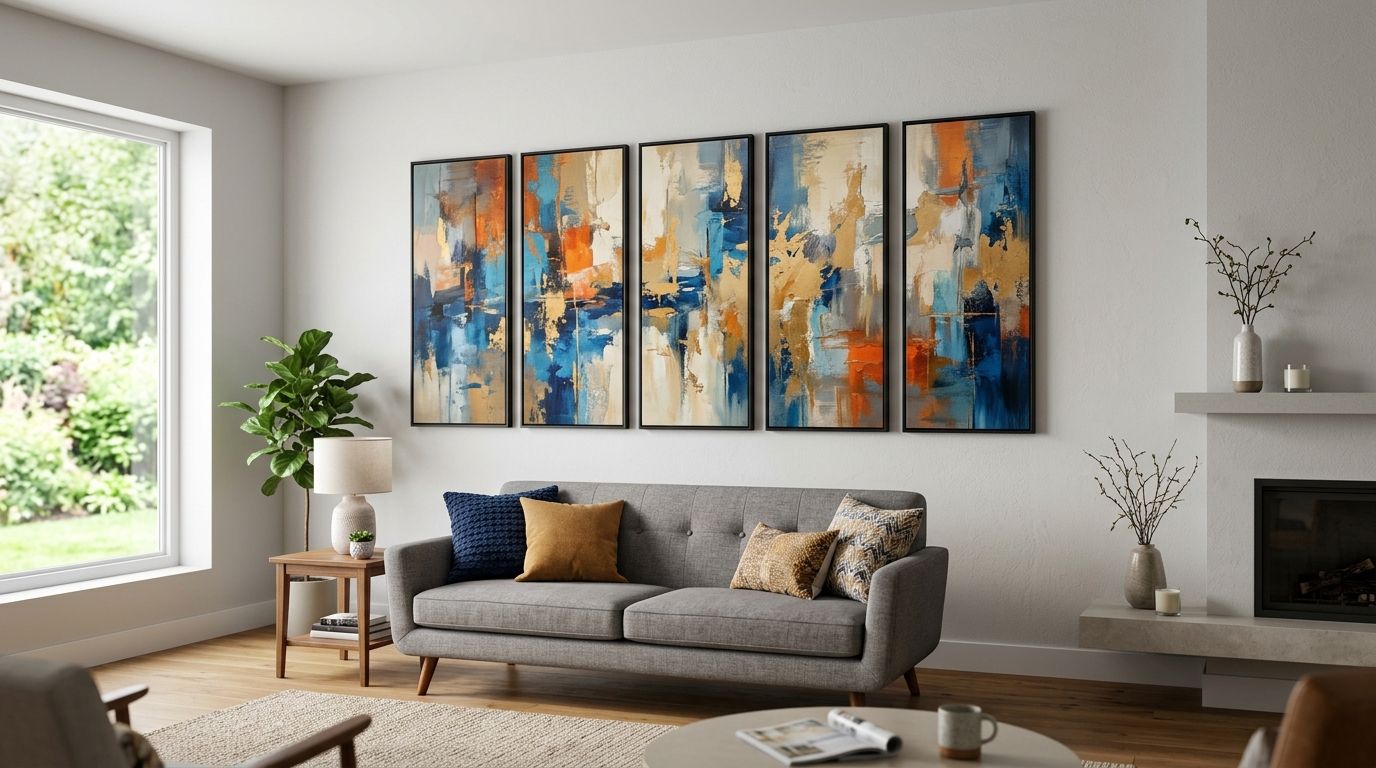
A feature wall works with either a single oversized canvas or a tight cluster of two to three smaller ones. Loose, scattered pieces rarely read as intentional.
- A single large canvas suits walls over 2.4m wide and rooms with minimal other decor
- A grouped arrangement of 2-3 pieces suits narrower walls or rooms with strong existing furniture lines
- Keep gaps between grouped canvases consistent; 5-8cm is standard
- Original paintings are usually one-off pieces, so grouping means buying from a cohesive series rather than matching after the fact
- If you're unsure how a cluster will sit, how to create a focal point wall in an open-plan home walks through the layout logic
Match the paint texture to your lighting
Texture only shows up when light hits it at an angle. Flat, direct downlights flatten even heavy impasto work.
- Side lighting from a floor lamp or wall sconce shows brushstrokes far better than a ceiling spotlight
- North-facing rooms in Australia get low-angle winter light that exaggerates texture naturally
- Glossy varnish reflects more light but shows glare from windows; matte varnish softens texture under bright light
- If your wall gets harsh afternoon sun, ask about UV-stable varnish before you commit
- This is where an original pulls ahead of a print: best original paintings to buy online in Australia shows work where finish and surface are visible in the photography, not just described
Choose a palette that anchors the room's existing colours
Hand-painted work carries more varied pigment than a printed canvas, so it needs a palette decision, not just a subject decision.
- Pull two or three colours already in the room (rug, cushions, timber tone) and match at least one
- Warm earthy palettes work against timber floors and neutral walls; cooler blues and greens suit rooms with heavy natural light
- Avoid matching too closely, or the art relates to nothing and simply vanishes into the room
- If your home leans warm and textured, terracotta and warm earthy wall art for modern homes is a useful palette reference before you commit
Verify authenticity and brushwork before buying
A hand-painted piece should show genuine texture in its photography: raking light across the surface, close-ups of the paint edge, not a flat evenly-lit shot that could pass for a print.
- Ask whether the piece is a one-off original or a hand-embellished reproduction; both exist, both are legitimate, and they're treated differently
- Check for a signature or certificate of authenticity on original work
- Read how the artist describes their process, since palette knife, heavy brush and layered glaze all behave differently under light
- How to tell if an original painting is worth the price breaks down what separates a considered original from an inflated one
Hang and light the piece to show off the texture
Installation is where visual impact gets lost. A textured canvas hung flush under flat light looks like any other print from across the room.
- Use a mount that holds the canvas slightly proud of the wall; a few millimetres of shadow line adds depth
- Position at eye-line height, roughly 145-155cm to the centre of the piece, then adjust for the furniture below
- Add one directional light source even if the room already has ambient lighting
- Recheck the hang in both daytime and evening light before finalising picture hooks
Protect the canvas from sun and moisture
Heavier paint layers hold more exposed surface area than a sealed print, so placement matters more here than for standard wall art.
- Avoid direct, unfiltered afternoon sun on the painted surface
- Keep original canvas out of bathrooms, kitchens near stovetops and high-humidity laundries
- Dust with a soft dry brush rather than a damp cloth
- Reposition if the piece sits in a sunbeam for several hours daily
Comparing your options for a textured feature wall
| Option | Best for | Key limitation |
|---|---|---|
| Hand-painted original canvas | One statement piece with genuine visible texture | One-off, so sizing and colour are limited to what's available |
| Textured canvas print with added medium | Buyers who need an exact size or colour match | Texture is applied, not painted, so less depth up close |
| Standard canvas print | Budget-conscious feature walls and precise reproduction | Completely flat surface, no light-catching texture |
| Framed art print | Renters and buyers who want to swap art later | Frame reads as decor, not statement, so the image has to work harder |
Verdict: if the brief is genuine texture and a one-of-a-kind feature wall, an original hand-painted canvas from Gioia Wall Art beats any printed alternative. A textured print is the right call only when exact sizing rules an original out.
Common mistakes this segment makes
- Buying the art before measuring the wall. A 90cm canvas looks lost on a 3m wall.
- Hanging it under flat overhead light only. Texture disappears without an angled light source.
- Matching the palette too exactly. The piece blends in instead of anchoring the room.
- Skipping the authenticity check. Not every hand-painted listing is a genuine original rather than a textured reproduction.
- Ignoring sun exposure at purchase time. Faded pigment on an original is far harder to remedy than on a print.
FAQ
What is hand painted canvas art?
Hand painted canvas art is original artwork created directly on canvas with visible brushwork, palette knife texture or layered paint, rather than a printed reproduction. Each piece is one-off, so surface depth varies from painting to painting.
Is hand painted canvas art better than a printed canvas for a feature wall?
For visible texture and one-of-a-kind impact, yes, because hand-painted canvas catches light and shadow in a way flat prints cannot. A textured canvas print is a reasonable middle ground when you need an exact size or colour match an original cannot guarantee.
How big should a feature wall painting be?
Aim for the artwork to span 60-75% of the wall's width, with 15-20cm of clear space on either side. A single oversized canvas usually reads better than several small ones on a wide wall.
Does hand painted canvas art fade in sunlight?
Yes. Heavier paint layers exposed to direct, unfiltered sun fade faster than a sealed print, so placement away from strong afternoon light matters more for originals than for standard canvas prints.
Can I hang a grouped arrangement of hand-painted canvases?
Yes, a cluster of two to three pieces from a cohesive series works on narrower walls or in rooms with strong furniture lines. Keep spacing consistent, typically 5-8cm between pieces.
How do I know if a painting is a genuine original?
Check for a signature or certificate of authenticity, and look for photography that shows raking light across the paint surface rather than a flat, evenly-lit shot. Sellers who describe technique such as palette knife or layered glaze are usually selling genuine originals.
What lighting shows off textured canvas best?
Side or angled lighting from a floor lamp or wall sconce reveals brushwork far better than a flat overhead downlight. North-facing rooms with low winter sun also exaggerate texture naturally.
One last thing
The detail most buyers miss in 2026: texture reads differently in a listing photo than on your wall, because product shots are almost always lit flat to show colour accurately. Before committing to a hand-painted canvas, check whether the listing includes a close-up or raking-light shot of the surface. If every photo is flat and evenly lit, ask for one that isn't before you buy.