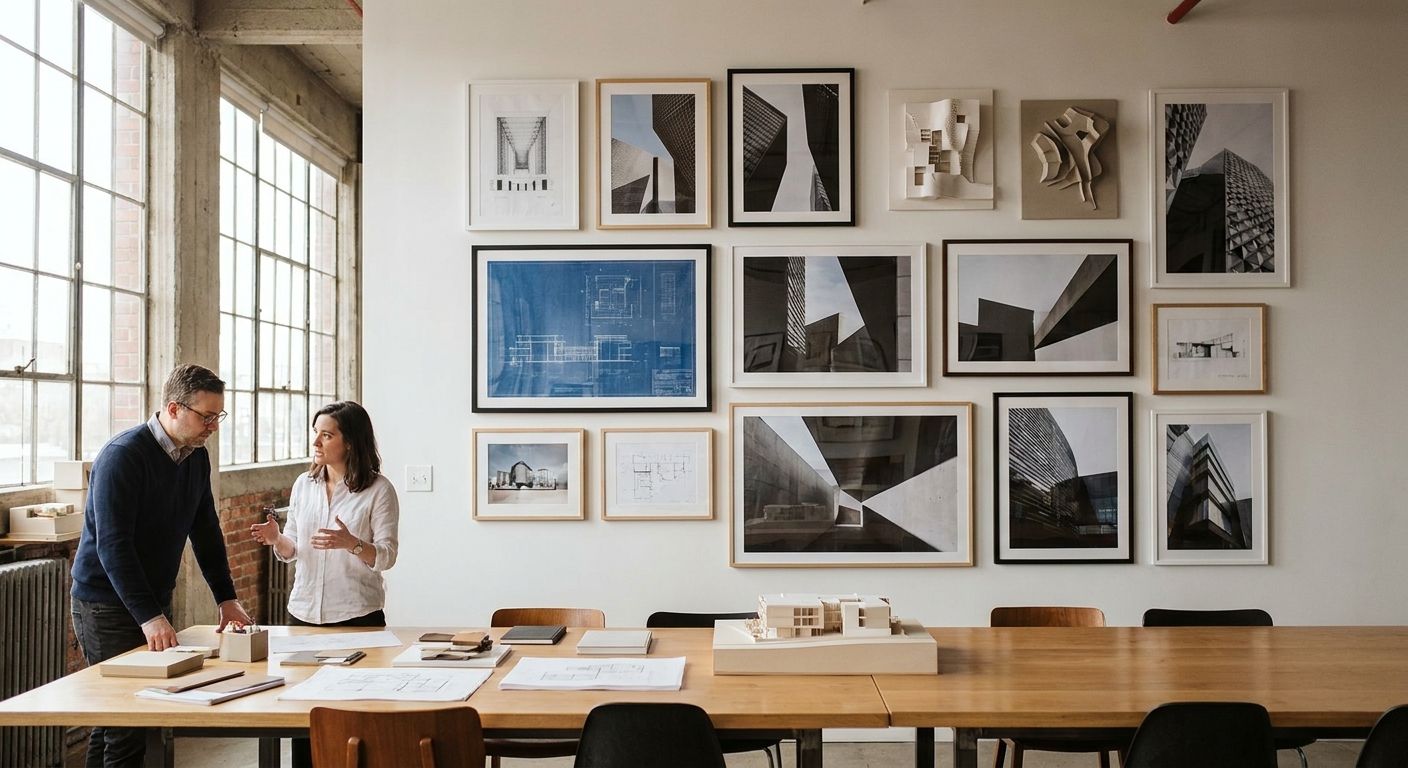
Architecture and design studios sell taste before they sell anything else, and the walls in reception, the boardroom and the open studio floor say more about that taste than any brochure ever will. This guide picks wall art for architecture studio walls that reads as considered rather than decorative, with actual sizes, prices and verdicts pulled from current stock.
- Taking Time by Bianca Slade (101 x 101cm, $1,400) is the scale anchor for double-height studio walls — Buy.
- Skip literal skyline or blueprint photography — it competes with the actual drawings pinned nearby.
- Unframed canvas reads better than gilt frames on concrete, steel or timber studio finishes.
- Through the Visible / Visible Through IV ($4,500) suits flagship reception walls only — Buy for statement studios, Skip on a co-working budget.
Why this matters
A design studio's walls are a working portfolio, whether the team plans it that way or not. Clients walk past them before a single render gets opened on screen, and the wrong art — a stock skyline photo, an undersized print lost on a 3.5-metre wall — undercuts the exact credibility the studio is trying to build in 2026. The right wall art for architecture studio spaces does the opposite: it signals restraint, scale literacy and an eye that's already been trained on proportion. That's the whole brief here, applied to real pieces rather than a mood board.
Who this is for
This guide is for principals and studio managers at architecture, interior design and industrial design practices — the people responsible for what a visitor sees in the first ten seconds of walking through the door. It applies just as well to studios sharing a floor with a co-working space as it does to a standalone practice with a dedicated reception. If you're also decorating adjoining meeting rooms that double as client presentation spaces, the logic below carries over directly from what studios have learned styling corporate office wall art more broadly.
What to look for in wall art for architecture studios
Scale matched to your ceiling height
Most studios convert warehouses, retail shopfronts or old commercial floors, which means ceiling heights well above the 2.4m of a standard house. A print sized for a lounge room disappears on a wall that tall — go for single panels at 90cm or larger, or commit to a proper gallery arrangement instead of one small frame floating in empty space.
Palette that doesn't fight your finishes
Exposed concrete, blackened steel and raw timber are the default studio palette in 2026, and loud, saturated color competes with all of it. Earth tones, muted abstracts and monochrome work sit with those finishes instead of against them.
Abstract composition over literal subject matter
Skyline shots and blueprint prints look like they belong in a studio, which is exactly the problem — they read as filler that's trying too hard, and they compete visually with the actual project renders and site photography already on the walls. Abstract work does the decorating job without duplicating the studio's own output.
Unframed or float-framed for portfolio walls
Heavy ornate frames clash with an industrial fit-out, and they make it harder to swap pieces when the portfolio wall gets refreshed for a new pitch. Unstretched or floating-frame canvas is easier to rehang and reads cleaner against raw materials.
A story you can repeat to clients
Original, signed work gives a studio something to say when a client asks about the reception wall — provenance, medium, the artist's name. A generic print doesn't give you that line, and in a room full of design-literate visitors, that line matters more than it should.
Top picks for architecture and design studios
Taking Time by Bianca Slade — the scale anchor. Acrylic on canvas at 101 x 101cm, sold unframed, priced at $1,400. Large enough to hold its own on a double-height reception wall without a supporting cast of smaller frames. Verdict: Buy for any studio with a genuine floor-to-ceiling wall behind the front desk.
Opaline by Patricia Walsh — the meeting room pick. Mixed media on stretched canvas at 61 x 51cm, priced at $1,500, with the frame shown for display only. Sized to add presence in a boardroom without dominating the table or the projector screen. Verdict: Consider for smaller conference rooms where the art needs to support conversation, not steal it.
Through the Visible / Visible Through IV by Ekaterina Prisich — the flagship wildcard. A single panel priced at $4,500, built around a series exploring overlapping, translucent fragments. This is the piece that tells a client the studio invests in original work, not stock decor. Verdict: Buy for studios with a real reception wall to justify it; Skip if the studio is still on a shared desk.
Where The Wild Things Grow by Tara Lewis — the earth-tone safe pick. Abstract acrylic priced at $3,280, built on warm natural tones that sit easily against timber and concrete. Low risk for studios that want color without clashing with the fit-out. Verdict: Consider for practices leaning into a warmer, less clinical studio look.
Studios weighing geometric, hard-edged compositions over painterly abstracts should also look at Piet Mondrian prints for geometric interiors — the grid-based structure echoes the discipline of a plan drawing without repeating it literally. And for practices with a genuine flagship reception space and the budget to match, premium statement wall art is worth a look before committing to any single piece above the $3,000 mark.


What to avoid
- Literal skyline or blueprint photography. It looks on-brand at first glance but competes directly with the studio's own renders and drawings — it reads as filler, not curation.
- Heavy gilt or ornate frames. They clash with exposed concrete, steel and raw timber, and they're harder to rehang when the wall gets refreshed for a new pitch.
- Undersized prints on tall walls. A 40cm frame on a 3.5-metre wall disappears. Go bigger, or commit to a proper multi-piece arrangement instead.
Verdict comparison
| Pick | Size | Price | Best for | Verdict |
|---|---|---|---|---|
| Taking Time | 101 x 101cm | $1,400 | Double-height reception wall | Buy |
| Opaline | 61 x 51cm | $1,500 | Boardroom / meeting room | Consider |
| Through the Visible IV | Single panel | $4,500 | Flagship reception, statement budget | Buy |
| Where The Wild Things Grow | Large abstract | $3,280 | Timber and concrete palettes | Consider |
FAQ
What's the best wall art for an architecture studio reception?
A single large-scale abstract piece, sized at 90cm or larger, works best for architecture studio reception walls in 2026. Taking Time by Bianca Slade at 101 x 101cm is built for exactly this kind of double-height wall.
Should design studios use framed or unframed prints?
Unframed or float-framed canvas suits most studios better than ornate frames. It sits cleaner against concrete, steel and timber fit-outs and is easier to rehang when a portfolio wall gets refreshed.
Is abstract art better than architectural photography for a studio?
Yes, for studio walls specifically. Skyline and blueprint photography competes with the studio's own renders and site photos, while abstract work adds color and texture without duplicating the practice's output.
How big should wall art be for a double-height studio ceiling?
Aim for a single panel of at least 90cm to 100cm, or a coordinated multi-piece arrangement. A print sized for a standard 2.4m ceiling gets lost on anything taller.
Does original art cost more than prints for a studio wall?
Original signed works typically cost more than reproduction prints — pieces in this guide range from $380 to $4,500 depending on scale and medium. The premium buys provenance and a story to tell clients, not just square footage.
Can wall art in a design studio double as a portfolio backdrop?
Yes. A restrained abstract piece behind a reception desk or presentation wall photographs well in client meetings and site visits, which is why scale and palette matter more here than in a typical home.
What colours work best in a concrete or timber-finish studio?
Earth tones, muted neutrals and monochrome abstracts sit best against raw concrete and timber. Saturated, busy color tends to compete with those finishes rather than complement them.
One last thing
The priciest pick in this guide isn't the biggest one. Through the Visible / Visible Through IV runs $4,500 as a single panel, while Taking Time is physically larger at 101 x 101cm and costs $1,400 — original work prices on scarcity and story, not surface area, and that's the line worth remembering before signing off on a studio's reception wall budget in 2026.